Aa
  • Read, Watch, Listen
  • TJI Series
  • Community Action
  • Events
  • Zedi
Follow us and continue the conversation
  • LinkedIn
  • Instagram
  • FaceBook
  • X
  • YouTube
Test yourself with the TJI Quiz!

Adjust size of text

Aa

Follow us and continue the conversation

  • LinkedIn
  • Instagram
  • FaceBook
  • X
  • YouTube

Your saved articles

You haven't saved any articles

What are you looking for?

Original reporting, insightful analysis and diverse views, delivered straight to your inbox

  • LinkedIn
  • Instagram
  • FaceBook
  • X
  • YouTube
Your support fuels our mission to inform, entertain and inspire.

The Jewish Independent is bound by the Standards of Practice of the Australian Press Council. If you believe the Standards may have been breached, you may approach The Jewish Independent or make a complaint to the Australian Press Council in writing at www.presscouncil.org.au. The Council may also be contacted on 1800 025 712.

  • Our Story
  • Contact us
  • Our Team
  • Support us
  • Guidelines
  • Pitch your idea
  • Republishing us
  • Community Action
  • Our Awards
  • LinkedIn
  • Instagram
  • FaceBook
  • X
  • YouTube
Aboriginal FlagTorres Strait Islanders Flag

The Jewish Independent acknowledges Aboriginal and Torres Strait Islander peoples as the Traditional Owners and Custodians of Country throughout Australia. We pay our respects to Elders past and present, and strive to honour their rich history of storytelling in our work and mission.

© The Jewish Independent 2026All Rights Reserved
Website design and development by Your Creative, MelbourneTerms & ConditionsPrivacy Policy
HomeRead, Watch, ListenAustralia
NewsAustralia

Uni racism report shows widespread impact for Jews

Half of Jewish students and a third of staff say racism affects their study or work but academics say a new report fails to address Jewish concerns.
Deborah Stone
Print this
removing kippah antisemitism

Many Jews now feel uncomfortable identifying as Jewish on campus (Image: AI)

Published: 19 February 2026

Last updated: 19 February 2026

Jews are the religious group most likely to experience racism at university, according to a new report from the Australian Human Rights Commission (AHRC).

A survey conducted by the AHRC last year found 94% of religiously Jewish respondents had experienced some form of either direct or indirect racism, compared with 76% of Muslims and 71% of Christians.

Among secular Jews, 81% of respondents reported experience of racism. This is a comparable level with other minority groups including Middle Eastern, Chinese, and First Nations people. Palestinians reported the highest level of racism among ethnic groups, with 90% saying they have experienced racism.

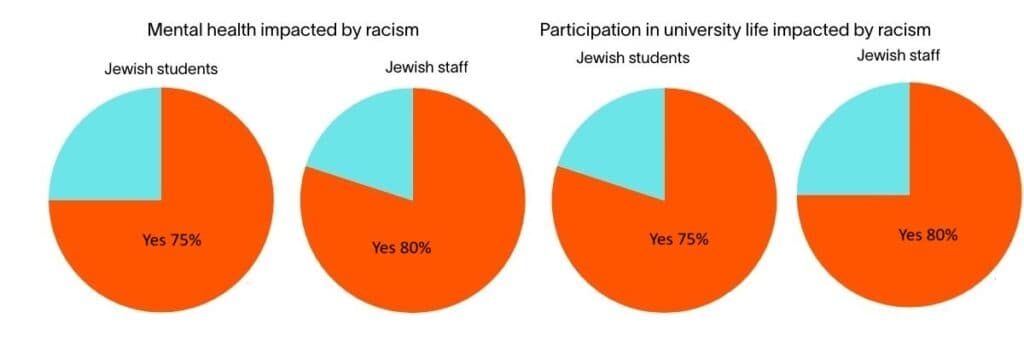
The impact of racism for Jewish students and staff is widespread. Half of students say racism towards Jews has impacted their academic work and a third of university staff say it has impacted their careers.

Respect at Uni: Study into antisemitism, Islamophobia, racism and the experience of First Nations is based on a survey of 76,131 students at 42 Australian universities and 310 focus group participants. There were 1,324 Jewish respondents.

Visibility makes Jews more vulnerable to racism. Among Jewish respondents who identified as religiously Jewish, 56% had experienced direct personal racism, while among those who identified as secular, 25% had. Similarly, 41% of religious respondents reported feeling unsafe at university, compared with 17% of secular respondents.

Data & graphic: AHRC

As a result, a significant number of Jews avoid disclosing their identity at university.

Data: AHRC, Graphic: TJI

Impacts were widespread across both secular and religious Jews and across staff and students.

Data: AHRC, Graphic: TJI

The report included 47 recommendations for changes, based on four outcomes: creating a sector anti-racism framework for universities; creating safe environments; establishing accountability; creating inclusive teaching systems and curriculum; and workforce diversity.

The Gaza context

The experience of Jewish, Palestinian and Middle Eastern students during the Israel-Hamas war in Gaza was discussed in the report, with an emphasis on the analogous impacts for the three cohorts.

“Jewish, Israeli, Palestinian, Muslim and Middle Eastern staff and students have experienced unprecedented levels of racism since the start of the Israel-Hamas war. Middle Eastern and Palestinian participants shared their view that the current climate has intensified a long history of anti-Arab racism.

“As a Middle Eastern staff participant shared: ‘I have to say, after you know, having been at universities working at universities for over 15 years, I've never seen it worse than this. In terms of suppressing or the fear around expressing views in university if you’re from the Middle East.’

“A Jewish student similarly shared how things were worse than ever: ‘I’d encountered antisemitism before, but I had never been scared to be Jewish. In uni, I frequently feel the need to hide my religion.’”

The report quoted several Jewish respondents on feeling unsafe or unable to express themselves at university. One Jewish staff member said, “As an Israeli and Jew, since the war in Gaza, I have not felt safe on campus. The protests against Israel are legitimate, but there have been too many incidences that crossed the line to antisemitism. The worse incident involves students targeting an individual Jewish staff member… This has made me fear my safety. Support from the University was minimal.”

It also quoted Jewish respondents who implied concern about antisemitism was exaggerated. “Threats to Jewish safety are being defined extremely widely to include Palestinian flags, misinterpretations of the phrase 'From the River to the Sea', keffiyehs being worn at graduations - and it's up to the university to take a strong stance on this and repeatedly reiterate that these are not threats or acts of violence. They are forms of political expression and solidarity that have long histories for Palestinian and other Arab people, as well as allies - and as a Jewish staff member, I do not require that these be stifled in order to make me feel safe.”

The report begins with a short note acknowledging the murder of 15 Jews in Bondi on December 14 but data was collected in September 2025 and the report was written before the attack.

Jewish academics disappointed

Jewish academic advocacy group Australian Academic Alliance Against Antisemitism (5A) criticised the approach and limitations of the report.

Director Professor Greg Rose said the report ignored the context of the recent dramatic escalation of antisemitic violence in Australia and failed to address Jewish experiences which are different from those of other minorities.

"The AHRC report is grounded in critical race theory, into which the Jewish people do not easily fit. It fails to acknowledge the historic and contemporary casting of Jews as uniquely powerful and demonic that is distinct in antisemitism.

“The AHRC report tends to equilibrate all racisms as the same and merely to identify where they intersect, a simplistic, abstract cookie-cutter approach.

“This is not a neutral methodological choice. It echoes a long-standing dynamic in which Jews are required to justify, explain, or defend claims of antisemitism in ways not demanded of other groups.”

He also criticised the AHRC’s failure to take on the recommendations of the Special Envoy to Combat Antisemitism.

You might also like
  • How not to apologise
    Zac Klugman
  • Proposed digital care law to offer protection against online antisemitism
    Deborah Stone
  • Mind the mentality: not every rejection is antisemitism
    Nomi Kaltmann
logomark.67a07ee3
We believe in the free flow of information

Republish our articles for free, online or in print, by using our Creative Commons licence

You might also like

    Penny Wong
    DebateAustralia

    Sanctions must influence, not just perform disapproval

    Adam Slonim
    Protest against settler violence in Jerusalem
    DebateAustralia

    Sanctioning settlements is a defence of Israel, not an attack

    Elisheva Madar 2
    chai necklace copy
    ReflectionAustralia

    Facing my mortality, the Book of Life is no metaphor

    Talia Slonim 4

About the author

Deborah Stone

Deborah Stone

Deborah Stone is Editor-in-Chief of TJI. She has more than 30 years experience as a journalist and editor, including as a reporter and feature writer on The Age and The Sunday Age, as Editor of the Australian Jewish News and as Editor of ArtsHub.

More from the author

ReflectionArts & Culture

On despair: A reflection after watching ‘Cancelled’

NewsAustralia

Proposed digital care law to offer protection against online antisemitism

NewsIsrael

‘Israel is systemically eliminating Palestinian collective life’:  Israeli human rights report

Australia

Tame apologises – but with little grace

Comments2

  • Avatar of Larrry Stillman

    Larrry Stillman20 February at 06:20 am

    People may like to see my own remarks on the report. It’s very useful, but there are some key methodological issues which affect the accuracy of data about the experience of Jewish students/staff. Despite these limitations, the results are disturbing, as they are for other groups. https://www.webstylus.net/p/the-australian-human-rights-commission?r=2jgheu

  • Avatar of David Knoll AM

    David Knoll AM19 February at 06:24 am

    No other community was divided into religious and secular. The AHRC set out to divide and dilute our pain so that it appeared no different to any racial minority group. Sad that it never waivered from that misdiagnosis.