Aa
  • Read, Watch, Listen
  • TJI Series
  • Community Action
  • Events
  • Zedi
Follow us and continue the conversation
  • LinkedIn
  • Instagram
  • FaceBook
  • X
  • YouTube
Test yourself with the TJI Quiz!

Adjust size of text

Aa

Follow us and continue the conversation

  • LinkedIn
  • Instagram
  • FaceBook
  • X
  • YouTube

Your saved articles

You haven't saved any articles

What are you looking for?

Original reporting, insightful analysis and diverse views, delivered straight to your inbox

  • LinkedIn
  • Instagram
  • FaceBook
  • X
  • YouTube
Your support fuels our mission to inform, entertain and inspire.

The Jewish Independent is bound by the Standards of Practice of the Australian Press Council. If you believe the Standards may have been breached, you may approach The Jewish Independent or make a complaint to the Australian Press Council in writing at www.presscouncil.org.au. The Council may also be contacted on 1800 025 712.

  • Our Story
  • Contact us
  • Our Team
  • Support us
  • Guidelines
  • Pitch your idea
  • Republishing us
  • Community Action
  • Our Awards
  • LinkedIn
  • Instagram
  • FaceBook
  • X
  • YouTube
Aboriginal FlagTorres Strait Islanders Flag

The Jewish Independent acknowledges Aboriginal and Torres Strait Islander peoples as the Traditional Owners and Custodians of Country throughout Australia. We pay our respects to Elders past and present, and strive to honour their rich history of storytelling in our work and mission.

© The Jewish Independent 2026All Rights Reserved
Website design and development by Your Creative, MelbourneTerms & ConditionsPrivacy Policy
HomeRead, Watch, ListenArts & Culture
Arts & Culture

‘Violins of Hope’ tell poignant stories from Nazi camps

Steve Meacham
Print this

Published: 16 May 2023

Last updated: 5 March 2024

STEVE MEACHAM reports on an upcoming theatrical production in Sydney that combines stories of violins rescued from the camps with Jewish melodies played on a very special violin.

They are known as “the Violins of Hope” - precious instruments which are part of Holocaust history. 

Most were rescued from the Nazi concentration camps, having been played to give spiritual succour to the poor souls disembarking from the railway cattle trucks or marching to the extermination shower blocks.

And they are the focal point of Lisa Rosenbaum and Rhonda Spinak’s play, Stories from the Violins of Hope, that will be staged by Moira Blumenthal Productions at Sydney’s Bondi Pavilion from May 31 to June 18. 

The production will tell the stories of the violins and include performances by a violin-piano duo, who will play snippets of songs to highlight the text, and excerpts from Jewish prayers and niggunim (wordless melodies).

The violins are usually introduced by speakers and in program notes as instruments that have survived the Holocaust. No one had dramatised the story of the Violins of Hope themselves.

Lisa Rosenbaum, co-writer of the play

The music ranges from Jewish folk songs to classical music by Mendelssohn and Mozart that was played in the camps.

One of the stories describes Mozart being played by prisoner musicians at the gates of Auschwitz as the refugees were getting off the trains or walking to the gas chambers.

The play, which was originally commissioned to be premiered at the HK Baird Theatre in Los Angeles in 2020, had to be postponed because of Covid. A later, filmed version has been shown worldwide and at the United Nations in 2021 to commemorate Kristallnacht.

Co-writer of the play, Lisa Rosenbaum

“I was commissioned to write a play about the renowned Violins of Hope in 2019, prior to their arrival for a concert tour of southern California,” Rosenbaum explains from her home in Los Angeles. 

“The violins are usually introduced by speakers and in program notes as instruments that have survived the Holocaust. There are documentary videos and a book about them, but no one had dramatised the story of the Violins of Hope themselves.”

Rosenbaum began by reading the written descriptions of the violins. Her research came to life when she interviewed world renowned, Tel Aviv-based, master luthier (maker of string instruments) Amnon Weinstein by phone and Facetime.

“Amnon is a warm and generous man in his eighties with a big moustache. For him, restoring violins that survived the Holocaust is a sacred mission. His workshop is a timeless place filled with violins, violin parts, tools, shavings and the smell of varnish. He says when he works on these violins he can feel, and hear, that they have suffered.”

One of the violins Weinstein restored was rescued near Lyon by a railway worker when its owner threw it from a cattle car near the city, while bound for a concentration camp.

Another was called “Friend” by a Romanian Jew who had been transported with wife, children and elderly parents to the Ukrainian ghetto of Shargorod.

By playing his violin - which was made in Schönbach in Austria around 1880 - he was able to make a little money and keep his family from starvation.

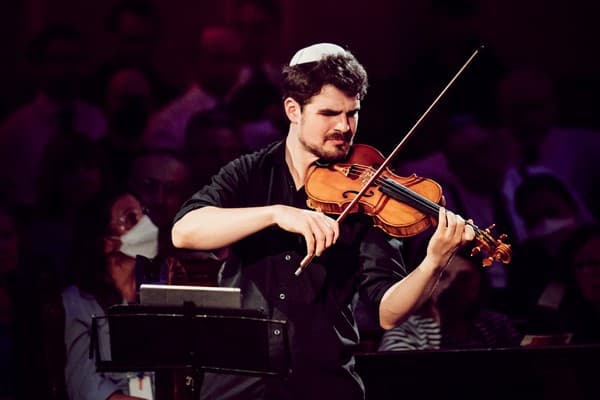
ACO violinist Ben Adler will play a much-travelled violin in the production

However, the most fascinating of the violins is the one that will be played by Ben Adler, of the Australian Chamber Orchestra and founder of klezmer-fusion band Chutney. (It has been given clearance to travel to Australia, pending quadruple insurance premiums.)

The story behind this “Violin of Hope” was unearthed by Adler’s accompanist on stage, pianist Noreen Green, founder and conductor of the Los Angeles Jewish Symphony Orchestra and musical director for this production.

It was Green who arranged for the much-travelled instrument to be travel with her to be played in Sydney. She had met one of Amnon Weinstein’s relatives at a concert and was instrumental in setting up the Violins of Hope project in 2017. Initially the violins were just coming over from Israel for a lecture tour of southern California in 2020.

One of the violins was rescued near Lyon by a railway worker when its owner threw it from a cattle car near the city, while bound for a concentration camp.

A few months before the violins arrived, Green mentioned the play to a former high school friend, Rachelle Blaine, daughter of Louis Blaine and Joyce Vanderveen. 

“Rachelle said, ‘My mother’s violin should be in that.’ And for the next 45 minutes she told me about her mother’s violin,” Green explains.

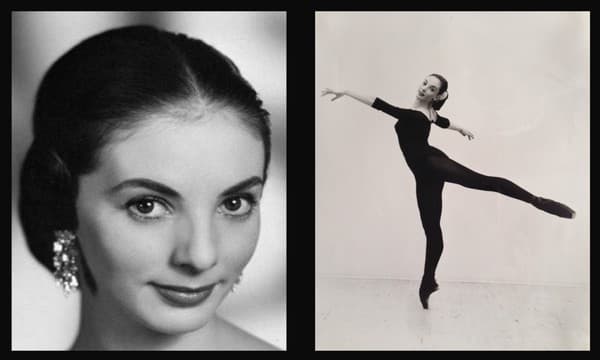
“Her mother was a musician, actress, author and prima ballerina who, after the war, danced for some of the royal houses of Europe. 

“She was born in Amsterdam to a Jewish seamstress who’d been banished from her family for marrying a non-Jewish sculptor and master craftsman.”

Because the story of Joyce’s violin comes from Green and not the playwrights, it doesn’t feature in the play. But it is almost worth a play in itself.

 Joyce Vanderveen in her younger days as a ballerina. Her childhood violin is being brought out specially for the production.
Joyce Vanderveen in her younger days as a ballerina. Her childhood violin is being brought out specially for the production.

The violin was a childhood gift from Joyce’s father, who chose it because it was small, elegant and “suited her redhead complexion”.

The Nazis invaded Holland when Joyce was 13. One day, after a violin lesson, Joyce was warned the Nazis were rounding up Jews. The family escaped to northern Holland on two bicycles with no tyres and found refuge with three impoverished farm families.

The rest of her family were murdered by the Nazis but a bone-thin Joyce, covered in boils and suffering from scarlet fever, managed to escape - taking only her prized violin with her.

After the war, Joyce became a star of the Royal Netherlands Ballet, later joining the Monte Carlo Ballet.

When she retired from dancing and moved to Los Angeles to work at Universal Pictures, she met Louis Blaine, who was the studio’s director of international press and publicity. They married in 1957, and she spent the next 25 years training professional young dancers. 

One became her protégé, a 12-year-old boy from Russia named Ilya Burkov. Joyce lent Ilya the violin, but when he returned to Russia, it remained under Joyce’s bed for 25 years.

Now a doctor in the UK, Ilya told Rachelle over the phone the full story of her mother’s violin when she finally tracked him down.

“I have wonderful memories of my mother playing classical music on the piano,” Rachelle said. “I never heard her play the violin. I think it reminded her of the awful war years.”

When Green learned about the violin, she persuaded her friend to have it evaluated at a prominent LA violin shop. The owner, Robert Cauer, “immediately made us take the violin out of its mite-invested case,” Green recalls. “The violin was alright, but the bow’s horsehair had been eaten up by the critters.

A portrait of Joyce Vanderveen is on the wall of the Anne Frank House in Amsterdam, underlying her fame before the war.

“Robert, who was from Germany, handled the violin with such care and love. He told us it was French, made by Mirecourt in the 1920s and in excellent condition. He cleaned it up and gave Rachelle a new case to keep it safe.”

The Violins of Hope were stored at LA’s Soyara Theatre for safe keeping but were taken to Washington DC in May 2020 for an Anne Frank Special Recognition Award from the Netherlands ambassador to the US.

A portrait of Joyce Vanderveen is on the wall of the Anne Frank House in Amsterdam, underlying her fame before the war.

But Joyce never visited the famous Holocaust museum. “I don’t need to,” she told her daughter. “I lived that life.”

“Joyce’s violin reminds us of the horror human beings are capable of," Rosenbaum says. “And the beauty we are capable of creating through music.”

Photo: Actor Barry French, who plays Amnon Weinstein

Stories from the Violins of Hope, Bondi Pavilion, May 31- June 18. CLICK HERE FOR DETAILS

You might also like
  • When the state faltered, civil society and Diaspora Jewry stepped up
    Shahar Burla
  • The case for leaving graffiti up for a while
    Adam Slonim
  • New ‘spoken word’ festival in Sydney offers stories directly from creators
    Miriam Hechtman
logomark.67a07ee3
We believe in the free flow of information

Republish our articles for free, online or in print, by using our Creative Commons licence

You might also like

    Fauda
    Israel Hamas WarAnalysisArts & Culture

    Fauda and the illusion of vengeance

    Ittay Flescher 1
    Bashevis Singers
    FeatureArts & Culture

    Yiddish poetry finds new audience through Bashevis Singers

    Miriam Hechtman
    Jerusalemites_Muslim_Quarter_email (1)
    NewsArts & Culture

    Jerusalemites photos cancelled by Indian Festival

    Deborah Stone

About the author

Steve Meacham

Steve Meacham

Steve Meacham is a senior features writer whose work has appeared in many Australian and British publications. He has also written several authorised biographies.

More from the author

Australia

‘Never seen anything like this’: Aussies watched war from their balcony

Arts & Culture

Is this show still funny after so many years? Well, it helps if you’re Jewish

FeatureAustralia

Living – and dying – with motor neurone disease: one family’s story

FeatureArts & Culture

A musical about lynching a Jew is striking a new chord