Aa
  • Read, Watch, Listen
  • TJI Series
  • Community Action
  • Events
  • Zedi
Follow us and continue the conversation
  • LinkedIn
  • Instagram
  • FaceBook
  • X
  • YouTube
Test yourself with the TJI Quiz!

Adjust size of text

Aa

Follow us and continue the conversation

  • LinkedIn
  • Instagram
  • FaceBook
  • X
  • YouTube

Your saved articles

You haven't saved any articles

What are you looking for?

Original reporting, insightful analysis and diverse views, delivered straight to your inbox

  • LinkedIn
  • Instagram
  • FaceBook
  • X
  • YouTube
Your support fuels our mission to inform, entertain and inspire.

The Jewish Independent is bound by the Standards of Practice of the Australian Press Council. If you believe the Standards may have been breached, you may approach The Jewish Independent or make a complaint to the Australian Press Council in writing at www.presscouncil.org.au. The Council may also be contacted on 1800 025 712.

  • Our Story
  • Contact us
  • Our Team
  • Support us
  • Guidelines
  • Pitch your idea
  • Republishing us
  • Community Action
  • Our Awards
  • LinkedIn
  • Instagram
  • FaceBook
  • X
  • YouTube
Aboriginal FlagTorres Strait Islanders Flag

The Jewish Independent acknowledges Aboriginal and Torres Strait Islander peoples as the Traditional Owners and Custodians of Country throughout Australia. We pay our respects to Elders past and present, and strive to honour their rich history of storytelling in our work and mission.

© The Jewish Independent 2026All Rights Reserved
Website design and development by Your Creative, MelbourneTerms & ConditionsPrivacy Policy
HomeRead, Watch, ListenIsrael
FeatureIsraelWorld

Virtual reality headsets transport user to Ground Zero of October 7

The new VR technology is designed to remind non-Jewish audiences of the scale and depravity of what happened.
Michael Visontay
Print this
Filming for the VR experience

Filming for the VR experience (Israel-Is)

Published: 27 June 2024

Last updated: 27 June 2024

The events of October 7 are seared permanently into the mind of every Israeli and Jew. But the scale and brutality of the Hamas attacks have not had the same impact on many others around the world. Whether because of the piecemeal evidence of the carnage, the focus on the hostages, or the ongoing coverage of Israel’s military offensive in Gaza, memories of that day have faded for much of the global audience.

In the war for hearts and mind being waged in parallel with the war in Gaza, some of those who are hostile to Israel have even tried to deny that the attacks took place, or tried to minimise their barbarity.

Nimrod Palmach was one of the Israeli responders on October 7, and as he absorbed the depravity of what Hamas had wreaked – to children, young people, women, families, whole communities – he knew that the story of that day had to be told but struggled to think of how the impact of those unimaginable attacks could be conveyed.

Palmach is CEO of a non-political organisation called Israel-Is, which was established in 2017 after its founders saw how negative Israel’s international image was, and set about “improving [its] global image through the Israeli people themselves”.

The survivors’ testimony immerses the user in the split-second decisions they had to make amid the chaos, as they lurched from one moment of terror to another.

Combining his sense of personal mission and professional advocacy, he decided that the most effective way to make people understand was to have survivors tell their stories through Virtual Reality (VR) technology, which puts the user right into the landscape of where the attacks occurred.

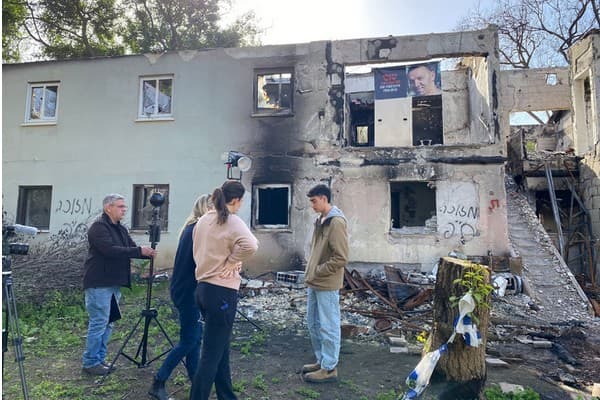
Last week a demonstration of this VR experience was offered to a range of Jewish advocates and media in Sydney and Melbourne. Those of us who put on the VR headsets found ourselves transported to the Ground Zero of the attacks, where five survivors told their stories in 3D while the user surveyed the destruction and aftermath in 360-degree reality.
The survivors’ testimony immerses the user in the split-second decisions they had to make amid the chaos, as they lurched from one moment of terror to another. The user hears from survivors from the Nova music festival and the kibbutzim, and from police responders, and at the same sees live footage from smart phones, the wall of cars after the Nova massacre, a sea of memorial posts across the festival ground, the children’s rooms in the kibbutzim, the scenes of devastation.

It is profoundly moving. When we put on the VR headsets, we feel we are there, among the chaos and terror. Our hearts were touched.

But whose hearts is it meant to persuade? Who is this experience designed for?

“The audience is the silent majority,” says Stephen Smith, a genocide scholar who worked with Spielberg on his Shoah archive and who created the VR experience for Palmach. “It’s very difficult to change the minds of those with fixed views. But I think most people just don't know. They haven't had the opportunity to think or immerse themselves.

“I think the audience is one outside of the Jewish community specifically, and particularly a younger audience,” he adds.

The experience may jolt users but their views may have already been shaped, if not fixed.

Smith is in Australia to talk with Jewish museums about the project – whether they will see it as a valuable tool for the thousands of non-Jewish students who visit every year, and what to include in the final version. We experienced a preliminary version but Smith and his colleagues are still trying to fine-tune what to include and exclude for Year 10 students.

The VR has been well-received by a volunteer audience of MBA university students in trials in London, says Smith. But there is quite some way to go before it is rolled out to museums and other educational institutions.

The aim is important and the technology is persuasive. But it is a lot of work for a niche audience and it raises two major questions. Firstly, by the time school students get to put those VR headsets on, it may be a too long after the event to make much difference. The experience may jolt users but their views may have already been shaped, if not fixed.

Secondly, it might imply a changed role for Jewish museums. Traditionally, many Jewish museums have avoided exhibits about Israel to quarantine Jewish history from the more politically volatile subject of Israel and to avoid becoming caught up in how to address the conflict and what language to use.

If museums include these VRs, thus introducing contemporary Israel content in response to anti-Zionism and antisemitism, they could be changing their character and mission. Is that a problem?

Stephen Smith, who has spent his life immersed in the Holocaust and Jewish history, was one step ahead of me when I put this question to him.

There’s been an “unintended outcome” to the fallout from October 7, he says. “The distinction between Israel and the diaspora has somewhat started to dissolve, partly to the anti-Jewish hatred that we've been seeing. So in a way the antisemites have created a condition in which maybe Jews don't see that same distinction that they used to.”

If he’s right, this technology may herald a new way of framing Jewish history.

You might also like
  • When the state faltered, civil society and Diaspora Jewry stepped up
    Shahar Burla
  • How Netanyahu can stay in power without winning
    Shahar Burla
  • I have lost faith in our multicultural institutions 
    Nomi Kaltmann
logomark.67a07ee3
We believe in the free flow of information

Republish our articles for free, online or in print, by using our Creative Commons licence

You might also like

    bialik Jewish schools shabbat
    OpinionAustralia

    Jewish schools are the marinade that infuses continuity

    Jeremy Stowe-Lindner
    Shocked New Yorker Watches the World Trade Center on September 11, 2001
    ReflectionWorld

    A new generation reckons with 9/11

    Gideon Cohen
    Btselem
    NewsIsrael

    ‘Israel is systemically eliminating Palestinian collective life’:  Israeli human rights report

    Deborah Stone 1

About the author

Michael Visontay

More from the author

NewsAustralia

Matt Chun’s hate speech prompts change in arts funding policy

AnalysisAustralia

Mishandled antisemitism education is not just ineffective, it’s dangerous

FeatureLifestyle

Where Shtisel meets The Jetsons

ReviewIsrael

Beinart’s utopian vision ignores awkward truths

Comments

No comments on this article yet. Be the first to add your thoughts.