Aa
  • Read, Watch, Listen
  • TJI Series
  • Community Action
  • Events
  • Zedi
Follow us and continue the conversation
  • LinkedIn
  • Instagram
  • FaceBook
  • X
  • YouTube
Test yourself with the TJI Quiz!

Adjust size of text

Aa

Follow us and continue the conversation

  • LinkedIn
  • Instagram
  • FaceBook
  • X
  • YouTube

Your saved articles

You haven't saved any articles

What are you looking for?

Original reporting, insightful analysis and diverse views, delivered straight to your inbox

  • LinkedIn
  • Instagram
  • FaceBook
  • X
  • YouTube
Your support fuels our mission to inform, entertain and inspire.

The Jewish Independent is bound by the Standards of Practice of the Australian Press Council. If you believe the Standards may have been breached, you may approach The Jewish Independent or make a complaint to the Australian Press Council in writing at www.presscouncil.org.au. The Council may also be contacted on 1800 025 712.

  • Our Story
  • Contact us
  • Our Team
  • Support us
  • Guidelines
  • Pitch your idea
  • Republishing us
  • Community Action
  • Our Awards
  • LinkedIn
  • Instagram
  • FaceBook
  • X
  • YouTube
Aboriginal FlagTorres Strait Islanders Flag

The Jewish Independent acknowledges Aboriginal and Torres Strait Islander peoples as the Traditional Owners and Custodians of Country throughout Australia. We pay our respects to Elders past and present, and strive to honour their rich history of storytelling in our work and mission.

© The Jewish Independent 2026All Rights Reserved
Website design and development by Your Creative, MelbourneTerms & ConditionsPrivacy Policy
HomeRead, Watch, ListenWorld
FeatureWorld

When Rabbis Abuse: patterns of sexual abuse by Jewish leaders revealed in new book

Elana Sztokman
Print this

Published: 7 June 2022

Last updated: 4 March 2024

ELANA SZTOKMAN conducted 84 interviews with survivors of sexual abuse by rabbis and other Jewish leaders. She uncovered disturbing patterns that cross national and denominational lines

For the most part, strategies of abuse are similar if not identical across faith cultures. The predator seeks out their victim’s vulnerabilities then works hard to gain trust, break down boundaries, weaken their prey, and control both the victim and the outside narratives through a host of serious mind games.

This is certainly the pattern across communities, cultures, and countries.

However, predators use the tools at their disposal, and in that sense, there are some distinctly Jewish language and cultural patterns, as well as societal expectations that Jewish abusers use.

For example, while grooming generally relies on victim vulnerabilities, rabbis often have privileged access to those—such as officiating during moments of loss, illness, or personal spiritual crisis.

Similarly, Jewish culture is often built around codes that identify “insiders,” whether that is Hebrew language, references to Bible or Jewish prayer, or even Jewish ideas such as “teshuva” (penance) or holiness.

"Many victims were drawn to their predator’s use of Jewish ideas ...holiness, divine purpose, fighting antisemitism, supporting Israel, or even sketchy kabbalistic ideas about unity and women’s bodies."

One abuser used references to Buber’s I and Thou, another used Kabbalah, and another used the fight against antisemitism.

These are examples of cultural codes that create a sense of insider-intimacy in a uniquely Jewish way.

Prowling religious and communal events and virtual spaces such as social media
In many stories, victims were being watched at Jewish events, from camp oneg (Shabbat celebration) to synagogue kiddush to Jewish fundraisers to Jewish dating apps. It may be worthwhile to consider what counts as acceptable touching or boundary breaking at places like this, where people are so focused on socializing that predatory behaviours go unchecked.
Use of Jewish ideas and spiritual concepts to lure and trap victims
Many victims were drawn to their predator’s use of Jewish ideas that they considered valuable or even sacred—such as chavruta (study partner), holiness, divine purpose, fighting antisemitism, supporting Israel, or even sketchy kabbalistic ideas about unity and women’s bodies. Jews in powerful positions are able to tap into deep desires among their victims for Jewish meaning, and that can be dangerous.

The Jewish Independent

Exploiting the desire for communal connectivity
Similarly, one of the points of vulnerability for many victims is the desire for belonging and connection. This desire may be particularly strong among people who are isolated in some way — who have a non-Jewish parent or partner, who are physically or emotionally challenged or “different”, who are lonely, or who are new to the community. Predators can both exploit and exacerbate that vulnerability, especially when the abuse happens in the context or a location of that cherished Jewish connectedness.

The “poor lonely rabbi” defence
Interestingly, while many predators use the tactic of victimizing themselves to gain sympathy, many interviewees reported a more specific tactic of the rabbi describing himself as a poor, lonely soul. That should be a red flag.

Relying on a rabbinic “aura”
The way people are socialised into giving absolute respect to the rabbi, no matter what, interfered with their ability to see what was really going on. Perhaps it is worth reconsidering how the community bestows that kind of infallibility on some of its leaders.

Using pastoral care as a lure
Across all faith communities, predators can use their position of being a pastoral carer to detect vulnerability and zoom in for the attack. In the Jewish community, it is not only rabbis who have that role; camp directors, professors, and teachers can have that power as well. Where people in certain positions are allowed to sit privately with those less powerful than themselves, and where one person has the cultural authority to give “counsel,” these are points of danger. The overreliance on rabbis in all spheres of Jewish life also gives potential predators disproportionate power over their victims.

Exploiting communal power structures
Communal institutions with all their hierarchies can embolden abusers. Victims shared stories about the synagogue board that supported the abusive rabbi, the rabbinical school that kept the predator on for decades, the organisational director head who was an abuser but also considered a skilful fundraiser, the rapist who was beloved in the synagogue and in camp because he played the guitar, the serial harasser who nobody said a word about because he donated millions dollars a year to Jewish causes—these structures can be used to support abusers and keep them preying on victims.

Exposing grassroots social hierarchies
Similarly, it is not just the formal hierarchies that support abuse but also informal cultural-social hierarchies. People who are treated as “less than” in the community—converts, newly religious, newly Jewish, non-Caucasian, disabled, single women, divorcees, or those who belong to a whole host of groups that are often discriminated against and made to feel inferior due to their gender, physical appearance, skin colour, ethnicity, sexuality, or life choices —often become easy prey. And overall men are generally higher up the social hierarchy due to Jewish history, traditions, custom or law, and for male predators, that patriarchy offers tools for enabling abuse. The community should seriously consider the impact of these implied hierarchies on the prevalence of sexual abuse.

Cultural criteria for Jewish power
Abusers in Jewish life receive power through their status, whether that’s based on being a rabbi, having advanced degrees, writing books, having access, or holding money. While deference to those with money is arguably common in many cultures, it is worth pointing out how dominant it seems to be in Jewish communal settings.

Moreover, people with the title “rabbi” are assumed to be more knowledgeable, holier, or more pious — and thus more trustworthy and even untouchable. The criteria that the community uses for determining a person’s worth demands re-examination in how status works to enable and hide abuse.

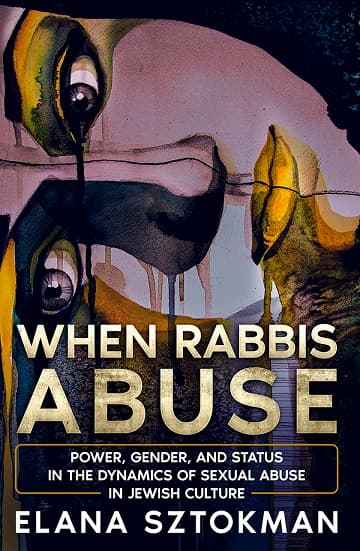
This article is an extract from When Rabbis Abuse: Power, Gender, and Status in the Dynamics of Sexual Abuse in Jewish Culture by Elana Sztokman, which is published on 14 June. 

IMAGE: Cover Design from When Rabbis Abuse (Rebeca @Rebecacovers/supplied)

You might also like
  • Abuse by IDF soldiers humiliates Muslim Palestinians
    Ben Lynfield
  • Who will get the money from the Cranbourne windfall?
    Gideon Cohen
  • Strategies for cohesion final focus of Royal Commission hearings
    Peter Kohn
logomark.67a07ee3
We believe in the free flow of information

Republish our articles for free, online or in print, by using our Creative Commons licence

You might also like

    man in blue suit is clapped by man in white robe and red checked keffiyah as audience watches
    AnalysisWorld

    Saudi nuclear deal fiasco: what was Trump thinking?

    Michal Yaari
    Finding ouor why
    PodcastLifestyle

    Finding Our Why

    The Jewish Independent
    Keshet
    FeatureLifestyle

    ‘We won’t ever leave’: Keshet Europe’s fight for Jewish LGBT+ inclusion

    Gideon Cohen

About the author

Elana Sztokman

Elana Sztokman

Dr Elana Sztokman is an award-winning Jewish feminist author, anthropologist, and activist. Her latest book is 'When Rabbis Abuse: Power, Gender, and Status in the Dynamics of Sexual Abuse in Jewish Culture'.

More from the author

ReflectionIsrael

How I changed my mind about the Zionist narrative

ReflectionIsrael

The painful process of truly listening to Palestinian pain

Arts & Culture

Hear us sing: Women musicians raise their voices against discrimination

Israel

Signs of change on the streets of Jaffa