Aa
  • Read, Watch, Listen
  • TJI Series
  • Community Action
  • Events
  • Zedi
Follow us and continue the conversation
  • LinkedIn
  • Instagram
  • FaceBook
  • X
  • YouTube
Test yourself with the TJI Quiz!

Adjust size of text

Aa

Follow us and continue the conversation

  • LinkedIn
  • Instagram
  • FaceBook
  • X
  • YouTube

Your saved articles

You haven't saved any articles

What are you looking for?

Original reporting, insightful analysis and diverse views, delivered straight to your inbox

  • LinkedIn
  • Instagram
  • FaceBook
  • X
  • YouTube
Your support fuels our mission to inform, entertain and inspire.

The Jewish Independent is bound by the Standards of Practice of the Australian Press Council. If you believe the Standards may have been breached, you may approach The Jewish Independent or make a complaint to the Australian Press Council in writing at www.presscouncil.org.au. The Council may also be contacted on 1800 025 712.

  • Our Story
  • Contact us
  • Our Team
  • Support us
  • Guidelines
  • Pitch your idea
  • Republishing us
  • Community Action
  • Our Awards
  • LinkedIn
  • Instagram
  • FaceBook
  • X
  • YouTube
Aboriginal FlagTorres Strait Islanders Flag

The Jewish Independent acknowledges Aboriginal and Torres Strait Islander peoples as the Traditional Owners and Custodians of Country throughout Australia. We pay our respects to Elders past and present, and strive to honour their rich history of storytelling in our work and mission.

© The Jewish Independent 2026All Rights Reserved
Website design and development by Your Creative, MelbourneTerms & ConditionsPrivacy Policy
HomeRead, Watch, ListenWorld
OpinionWorld

Reform Judaism and Zionism: Lowering the threshold without destroying the house

Reform Judaism has veered towards universalism, but last week it reconfirmed its commitment to Zionism
Gersh Lazarow
Print this
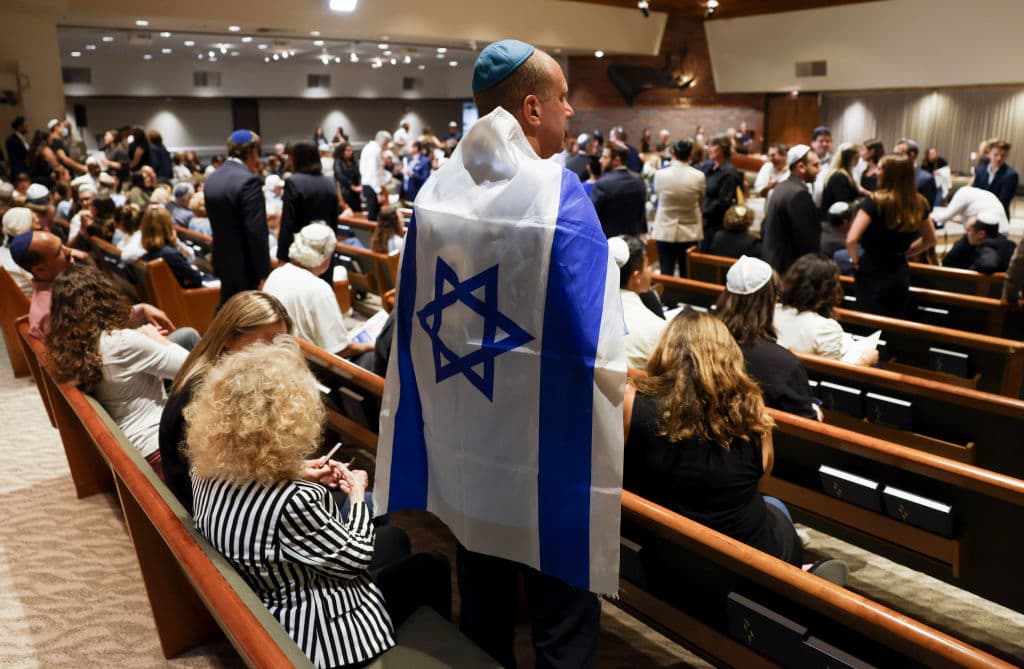
Israel flag synagogue vigil

A man wearing an Israeli flag at a vigil for Israel at the Stephen Wise Temple, a Reform synagogue in Los Angeles (Robert Gauthier/Los Angeles Times via Getty Images)

Published: 2 June 2026

Last updated: 2 June 2026

Over the past few years, Reform Judaism has faced a growing chorus of critics arguing that it has lost its way.

They have suggested that, in its embrace of universal values, it has become hesitant to speak about Jewish particularity; that, in its determination to be open, it has become reluctant to draw boundaries – and that, in some corners, Zionism has shifted from being understood as a central expression of modern Jewish identity to something that must be apologised for, qualified, or explained away.

For a long time, I rejected those criticisms outright. I did not become a Reform Jew because I wanted less Judaism. I became a Reform Jew because I wanted a Judaism that could engage honestly with the modern world, while remaining deeply rooted in Jewish tradition. I was drawn to its intellectual honesty, its willingness to engage scholarship seriously, and its conviction that revelation did not end at Sinai but continues to unfold through the lived experience of the Jewish people.

But the events of recent years, and especially the period following October 7, 2023, have made it increasingly difficult simply to dismiss every criticism of liberal Judaism as the complaint of those who never understood it.

Somewhere along the way, parts of liberal Judaism began confusing accessibility with the absence of expectations

Last week Rabbi Ammiel Hirsch gave a keynote address to the Re-CHARGING Reform Judaism Conference in the US that grappled with this failure. He argued that Reform Judaism must reinvigorate its commitment to Zionism, refuse to ordain anti-Zionist rabbis, and stop shying away from specific Jewish interests.

“We cannot succumb to those who preach a false philosophy of Jewish universalism that camouflages disdain for Jewish particularism under the guise of a sometimes sweeping, self-righteous, sanctimonious and suffocating misunderstanding of tikkun olam (world repair),” said Hirsch. 

The Judaism that first drew me into the Reform rabbinate was not a Judaism of lowered expectations, but a Judaism of intellectual courage. Not a Judaism that diluted Jewish identity in order to remain relevant, but one that understood that its relevance flowed from the depth of its Jewish commitments.

As I listened to Hirsch, I found myself thinking of Rabbi Jakob Petuchowski, one of the great Reform theologians of the twentieth century. Writing in the 1950s and later collected in Heirs of the Pharisees, Petuchowski reflected on the Pharisaic tradition from which all modern Judaism descends and argued that its success lay in its refusal "to accept the lowest common denominator as the norm and the ideal."

For Petuchowski, Reform Judaism was never intended to be Judaism stripped of expectations, obligations, or learning. It was an attempt to create knowledgeable, engaged, thinking Jews capable of carrying Jewish tradition forward into a changing world.

Reading Hirsch today, I hear an echo of that same concern.

Somewhere along the way, parts of liberal Judaism began confusing accessibility with the absence of expectations. We became so focused on opening the doors that we sometimes forgot to speak about what people would find once they walked through them.

At my community, Shtiebel, we often speak about lowering the threshold. We want our doors open as widely as possible because we believe Judaism is, at its core, audaciously hospitable. We want people to encounter Jewish life without fear, shame, or unnecessary barriers.

However, lowering the threshold is not the same thing as removing the house. Hospitality only matters if there is actually a home into which people are being welcomed.

The reason we make Judaism accessible is not because we believe Judaism should demand less of people. It is because we believe Judaism has something extraordinary to offer. We lower barriers because we want more people to encounter Jewish learning, Jewish practice, Jewish community, Jewish peoplehood, and Jewish meaning.

The same tension has played itself out around Zionism.

One of the most troubling developments in parts of the liberal Jewish world has been the increasing tendency to treat Zionism as an embarrassment to be managed rather than as one of the defining expressions of modern Jewish peoplehood. The aftermath of October 7 exposed just how fragile some of those foundations had become. In some circles, universalism had become so expansive that it struggled to make room for the particular concerns, fears, and aspirations of Jews themselves.

The resolutions adopted at the Re-CHARGING Reform Judaism Conference affirm that Jewish peoplehood matters, that Zionism matters, that Jewish literacy matters, and that continuity matters. They reject the false choice between universal values and particular commitments and remind us that the former emerge from the latter.

That is the Judaism that inspires me.

You might also like
  • What ‘Zionism’ means in Israel:  it’s not what you think
    Ittay Flescher
  • The hidden sting in the tail of Peter Beinart’s ‘dangerous’ idea
    Michael Visontay
  • When belonging becomes conditional
    Allen Zeesman
logomark.67a07ee3
We believe in the free flow of information

Republish our articles for free, online or in print, by using our Creative Commons licence

You might also like

    Rozana Beit Oula
    PeacebuildingOpinionIsrael

    Peacebuilding through the eyes of a sceptic

    Ron Finkel
    interfaith war
    FeatureWorld

    The illusion of Just War: Conflict ethics in Judaism, Christianity and Islam

    Dave Moskovitz
    Erdogan Turkey
    AnalysisIsrael

    Turkey emerges as military threat to Israel

    Dror Doron

About the author

Gersh Lazarow

Gersh Lazarow

Rabbi Gersh Lazarow is the founding rabbi of the Shtiebel, an independent Jewish community in Melbourne dedicated to openness, belonging, and the belief that every person should be empowered to “do Jewish their way.”

More from the author

ReflectionWorld

Three ways to make your Seder a living conversation in 2026

ReflectionIsrael

Chanukah, Israel, and the light we need

Comments

No comments on this article yet. Be the first to add your thoughts.