Aa
  • Read, Watch, Listen
  • TJI Series
  • Community Action
  • Events
  • Zedi
Follow us and continue the conversation
  • LinkedIn
  • Instagram
  • FaceBook
  • X
  • YouTube
Test yourself with the TJI Quiz!

Adjust size of text

Aa

Follow us and continue the conversation

  • LinkedIn
  • Instagram
  • FaceBook
  • X
  • YouTube

Your saved articles

You haven't saved any articles

What are you looking for?

Original reporting, insightful analysis and diverse views, delivered straight to your inbox

  • LinkedIn
  • Instagram
  • FaceBook
  • X
  • YouTube
Your support fuels our mission to inform, entertain and inspire.

The Jewish Independent is bound by the Standards of Practice of the Australian Press Council. If you believe the Standards may have been breached, you may approach The Jewish Independent or make a complaint to the Australian Press Council in writing at www.presscouncil.org.au. The Council may also be contacted on 1800 025 712.

  • Our Story
  • Contact us
  • Our Team
  • Support us
  • Guidelines
  • Pitch your idea
  • Republishing us
  • Community Action
  • Our Awards
  • LinkedIn
  • Instagram
  • FaceBook
  • X
  • YouTube
Aboriginal FlagTorres Strait Islanders Flag

The Jewish Independent acknowledges Aboriginal and Torres Strait Islander peoples as the Traditional Owners and Custodians of Country throughout Australia. We pay our respects to Elders past and present, and strive to honour their rich history of storytelling in our work and mission.

© The Jewish Independent 2026All Rights Reserved
Website design and development by Your Creative, MelbourneTerms & ConditionsPrivacy Policy
HomeRead, Watch, ListenArts & Culture
FeatureArts & Culture

The chilling reason why this Auschwitz book is like no other

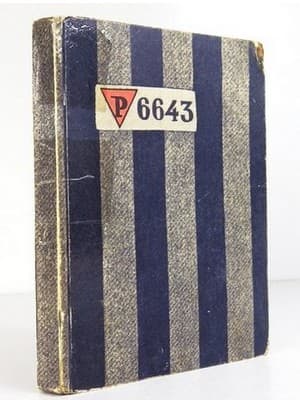
The first book published about Auschwitz has been rereleased with a cover that literally comes from the camps.
Michael Visontay
Print this
Auschwitz main final

Published: 22 April 2025

Last updated: 24 April 2025

The New York Antiquarian Book Fair is the rock star of rare book fairs. At this year’s event, dealers came from Europe and Asia to showcase ancient manuscripts, first edition James Bond books, the first scribbled notes of famous Beatles songs, 1970s protest literature, and much more.

There was even a dealer from Hungary, which specialised in socialism, Hebraica and Judaica. My family is Hungarian, so it was a natural port of call. As I inspected their offerings, my eye caught sight of something over in the corner of the stall. At first, I thought it must have been a prop, a gimmick.

I turned to the dealer: “Is this what I think it is?”

“Yes, it’s real, it’s authentic,” he replied. “You can pick it up.”

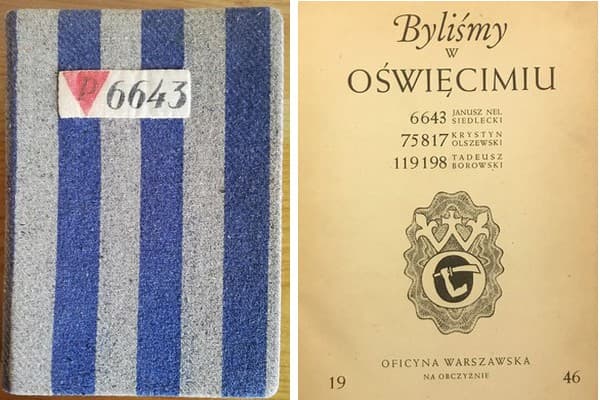
Lying in front of me was a book bound with a piece of the blue and white uniform that inmates of Auschwitz were forced to wear. There was no title, no writing on the cover, only a badge owned by one of the authors, sewn onto the material.

I could not believe my eyes. Forget Beatles lyrics, this blew everything else in the fair out of the water.

On the page inside was a title whose brevity was overpowering: We Were In Auschwitz (Byliśmy w Oświęcimiu) followed by the three authors and the numbers whey were given in the camp- 6643 Janusz Nel Siedlecki, 75817 Krysytn Olszewski, 119198 Tadeusz Borowski. The three men were Polish political prisoners. The Polish-language book was published in 1946.

According to the dealer, Földvari, the book is “believed to be the first-ever published about the horrors of the Nazi concentration camps”.
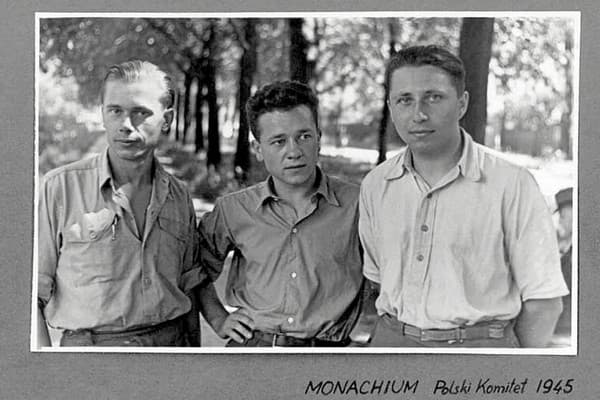
From left, Janusz Nel Siedlecki, Tadeusz Borowski and Krystyn Olszewski

The dealer’s notes describe it as an “extremely scarce inscribed copy of the book… one of the few examples bound into cloth, cut from the actual material of concentration camp striped uniforms. Brown stains on the badge. Pages yellowed due to acidic paper. Otherwise in fine condition.”

While the book “is generally considered as a book of memoirs of the three prisoners’,” Borowski’s biographer claimed that it is mainly written by Borowski, who co-authored and significantly edited the narratives of his two fellow-prisoners, according to Földvari.

Tadeusz Borowski was a Polish writer and journalist, who was involved in the underground in occupied Poland until 1943, when he was arrested and deported to Auschwitz. After liberation, he stayed in Germany for some months then returned to Poland where he joined the Communist Party and started writing books about his experiences in the camps. In 1951, aged just 28, he committed suicide.

The driving force behind this book, and its chilling design, was the Polish graphic artist Anatol Girs, himself a survivor of Auschwitz and Dachau concentration camps. After liberation, Girs founded a publishing house in Munich, and the first book he published was Borowski’s first book.

The Jewish Independent

We Were in Auschwitz was the third book Girs published. It is dedicated to the American Seventh Army and the copy at the book fair is inscribed by one of the other authors, Krystyn Olszewski, to a certain Alexander “after the first attempt of friendship”. There is no other information to shed light on the context for the inscription.

Olszewski was a political prisoner in Auschwitz, Pawiak, Gross Rosen, Buchenwald, and Dachau. Unlike Borowski, he lived a long and fruitful life. After liberation, he returned to Poland, studied architecture at the Warsaw University of Technology, and worked as a general designer of urban planning in Warsaw, Baghdad, and Singapore.

The third prisoner, Janusz Nel Siedlecki, was sent to Auschwitz by the Gestapo in November 1940, after being caught working as a liaison between the Polish Emigration Government in France and the underground in Poland. Of the three co-authors, he stayed the longest in concentration camps.

The length of Nel Siedlecki’s imprisonment “was important for the overall shape of the book,” according to Polish historians. “It was his knowledge of survival strategies that helped Borowski create his narrator, Tadek, who was such a shock for the literary audience.”

Földvari was offering the book for €25,000 ($A45,000). Any potential buyers should keep in mind that it is in Polish. When I inquired after the fair had closed, it had not been sold.

You might also like
  • Rediscovered in Melbourne: the 75-year odyssey of Nazi-looted Jewish books
    Jason Schulman
  • From NY to Melbourne, local politicians are whipping up hate 
    Nomi Kaltmann
  • Publisher cancels book over illustrator’s antisemitic comments about Bondi
    Michael Visontay
logomark.67a07ee3
We believe in the free flow of information

Republish our articles for free, online or in print, by using our Creative Commons licence

You might also like

    why main 4th
    PodcastArts & Culture

    Why we need to find our why now: new TJI podcast

    Ittay Flescher and Courtney Winter-Peters 1
    Copy of Website books template (2)
    FeatureArts & Culture

    The winning Jewish books by Australians in the past year

    Gideon Cohen
    Amidah main
    FeatureArts & Culture

    A circle of communal healing on stage, with a dash of humour

    Miriam Hechtman

About the author

Michael Visontay

More from the author

NewsAustralia

Matt Chun’s hate speech prompts change in arts funding policy

AnalysisAustralia

Mishandled antisemitism education is not just ineffective, it’s dangerous

FeatureLifestyle

Where Shtisel meets The Jetsons

ReviewIsrael

Beinart’s utopian vision ignores awkward truths

Comments

No comments on this article yet. Be the first to add your thoughts.