Aa
  • Read, Watch, Listen
  • TJI Series
  • Community Action
  • Events
  • Zedi
Follow us and continue the conversation
  • LinkedIn
  • Instagram
  • FaceBook
  • X
  • YouTube
Test yourself with the TJI Quiz!

Adjust size of text

Aa

Follow us and continue the conversation

  • LinkedIn
  • Instagram
  • FaceBook
  • X
  • YouTube

Your saved articles

You haven't saved any articles

What are you looking for?

Original reporting, insightful analysis and diverse views, delivered straight to your inbox

  • LinkedIn
  • Instagram
  • FaceBook
  • X
  • YouTube
Your support fuels our mission to inform, entertain and inspire.

The Jewish Independent is bound by the Standards of Practice of the Australian Press Council. If you believe the Standards may have been breached, you may approach The Jewish Independent or make a complaint to the Australian Press Council in writing at www.presscouncil.org.au. The Council may also be contacted on 1800 025 712.

  • Our Story
  • Contact us
  • Our Team
  • Support us
  • Guidelines
  • Pitch your idea
  • Republishing us
  • Community Action
  • Our Awards
  • LinkedIn
  • Instagram
  • FaceBook
  • X
  • YouTube
Aboriginal FlagTorres Strait Islanders Flag

The Jewish Independent acknowledges Aboriginal and Torres Strait Islander peoples as the Traditional Owners and Custodians of Country throughout Australia. We pay our respects to Elders past and present, and strive to honour their rich history of storytelling in our work and mission.

© The Jewish Independent 2026All Rights Reserved
Website design and development by Your Creative, MelbourneTerms & ConditionsPrivacy Policy
HomeRead, Watch, ListenWorld
AnalysisWorld

Challenging the myths about anti-Zionist Jews

Research into young American anti-Zionist Jews shows they are often driven by strong Jewish attachment and deep moral conviction.
Ittay Flescher
Print this
anti-zionist Jews US

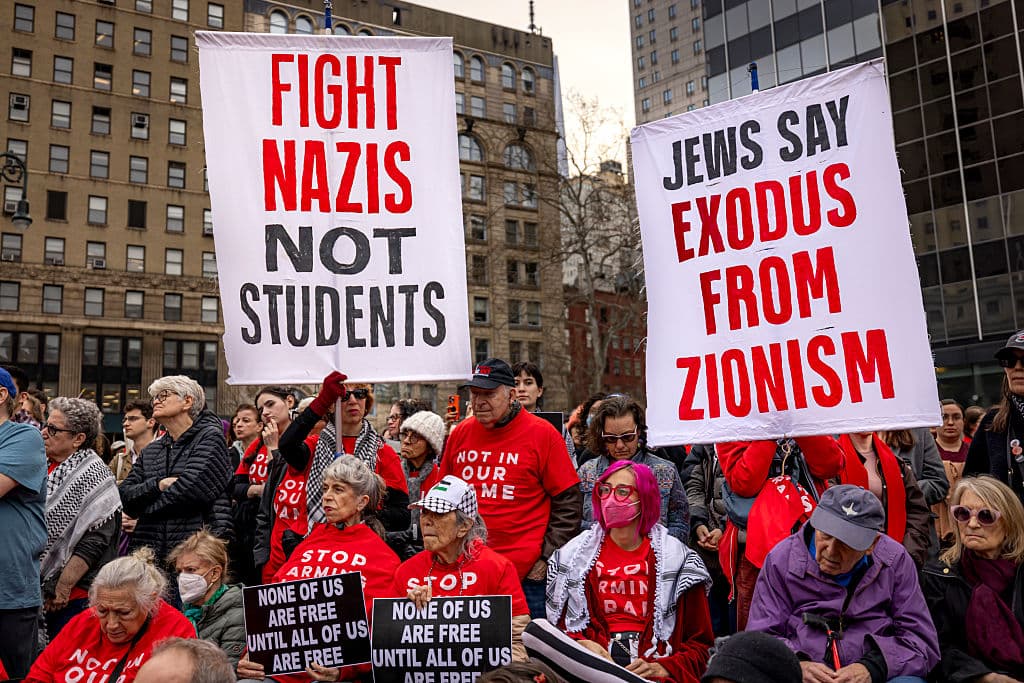
Jewish activists take part in a protest Seder in New York City, demanding the release of Palestinian activist Mahmoud Khalil and an end to the war on Gaza. (Michael Nigro/Pacific Press/LightRocket via Getty Images)

Published: 19 February 2026

Last updated: 20 February 2026

Imagine a Shabbat dinners in Caulfield or Dover Heights. The parent, in their 50s, is an ardent Zionist who donates regularly to the JNF, attends Zionist Federation events, and was deeply moved by the recent visit of Israeli President Isaac Herzog. The child, in their 20s, a graduate of a Jewish day school, has been protesting that same visit, arguing that Israel’s president should be arrested for inciting a genocide in Gaza.

The shadow of these differences hangs over many Jewish families, across the Diaspora.

In the increasingly fractured landscape of contemporary Jewish life, few subjects trigger as visceral a reaction as the rising tide of anti-Zionism among young Jews. For many in the mainstream community, this shift is viewed with a mixture of bewilderment, betrayal, and deep-seated alarm.

Seeking to move beyond the high-decibel rhetoric of social media and op-ed pages, Robbie Gringras and Abi Dauber Sterne of the organization For the Sake of Argument embarked on an ambitious qualitative research project. Their report, The Journeys and Destinations of Young Jewish Anti-Zionists, offers a sobering yet necessary look at the internal schisms threatening communal coherence.

While specifically focused on the schism happening in the US, based on interviews with 30 self-described anti-Zionist Jews, the report contains many insights that may be relevant for Australian Jewish families struggling with this question.


"I know my parents are terribly sad I'm no longer a Zionist but they don't realize how sad I am that I'm no longer a Zionist"

In an interview discussing the findings with TJI, Robbie Gringras, an Israel educator with over two decades of experience in the field, unpacked the complexities of the report and addressed the sharp criticisms directed at any attempt to engage with those who reject the Jewish state. His insights suggest that the current crisis is not merely a political disagreement, but a profound challenge to the very definition of Jewish belonging.

False assumptions about anti-Zionist Jews

One of the most provocative aspects of the report is its systematic dismantling of common assumptions held by the pro-Israel mainstream about anti-Zionist Jews. Gringras emphasized that these were not assumptions the researchers set out to prove, but rather findings that emerged from the lived experiences of the participants.

Assumption 1: Ignorance of Jewish Identity. A frequent critique is that anti-Zionists simply "don't know anything about being Jewish". The research found the opposite: many participants were deeply knowledgeable about Jewish practice and history, with some even having attended Jewish day schools or serving as rabbis. Their rejection of Zionism was often a result of deep engagement, not a lack of it.

Assumption 2: Brainwashing by "Woke" Ideology. Perhaps the most pervasive criticism of groups such as the JVP or If Not Now is that their members are young Jews who have been "brainwashed" by post-colonial or "woke" academic frameworks. Gringras argued that while participants were fluent in this language, their shift was driven by personal experience rather than abstract theory. He cited examples of "moral injury," such as witnessing settler violence in the West Bank or feeling rejected by their own communal leaders when they tried to discuss their misgivings. For many, the "woke" ideology provided a language to describe what they had already seen with their own eyes.

Assumption 3: "Making Nice with the Goyim." The report also challenged the idea that anti-Zionism is a social convenience used to gain acceptance in progressive non-Jewish circles. On the contrary, many interviewees reported experiencing significant antisemitism within those very progressive circles, leading them to form specifically Jewish anti-Zionist groups to find a sense of home.

Assumption 4: Indifference to the Jewish People. Finally, the report addressed the belief that these individuals simply don't care about their community. Gringras described focus groups where tears were common, as participants shared the "heartbreaking" pain of being alienated from families and communities they still deeply valued. "I know my parents are terribly sad I'm no longer a Zionist," one participant remarked, "but they don't realize how sad I am that I'm no longer a Zionist".

The argument over legitimisation

A key issue for the mainstream community is the  ethics of engagement. Does giving a platform to anti-Zionists provide them with a "hechsher" (kosher stamp), legitimising language that some say fuels antisemitism and endangers Jewish lives?

This argument is made by Canadian anthropologist Adam Louis-Klein, a fierce critic of anti-Zionism (which he pointedly spells as antizionism), who wrote that, “Antizionist Jews don’t merely hold an “uncomfortable opinion on Israel” against the pro-Israel Jewish community.” He added that Jewish groups who protest in solidarity with Palestinians, “insert themselves into scenes of antizionist abuse, harassment, and shaming, and shut down Jews who try to defend themselves. They systematically tell the public that Jews are faking their oppression, that Jews are liars and untrustworthy. Antizionist Jews are deeply immoral. There is nothing to legitimize, nothing to sympathize with. Antizionist Jews are agents of injustice.”

Gringras says the report doesn't seek to legitimise or delegitimise anti-Zionists, but rather to document a reality that already exists.

Not all anti-Zionists

Gringras also pushed back against "straw-manning" participants, the tendency to assume every anti-Zionist shares the most extreme views of the movement.

Instead, he proposed the image of a "glass wall". While the ideological divide remains a firm barrier, a glass wall allows both sides to at least see one another as human beings rather than monsters.

The report concludes by presenting three distinct paths for the American Jewish community:

  • Community-Strengthening: Prioritising coherence and loyalty by drawing sharp "red lines," a view articulated by American historian and Zionist activist Gil Troy.
  • Community-Educating: Focusing on the "journey" and asking what institutions did to alienate these young people so they can be brought back into the “big tent,” a view articulated by President of the Shalom Hartman Institute Yehuda Kurtzer.
  • Community-Healing: Prioritising the relationship over ideological alignment.

Asked which path he prefers, Gringras suggested that the immediate task might not be "healing," which implies a resolution, but rather, "community-holding" - the difficult, uncomfortable work of staying in the same room even when agreement seems impossible.

"Dialogue is not about convincing or negotiating a consensus," notes Gringlass. Rather, it is about maintaining a "healthy argument" that preserves connection in the face of searing difference.

Back at our Shabbat dinner example, many families who have intense disagreement about Zionism implement a hard and fast rule to keep the peace by avoiding the topic. While this works for some families, For the Sake of Argument suggests that ignoring the elephant in the room only makes its weight bear heavier on us all.

FULL REPORT

The Journeys and Destinations of Young Jewish Anti-Zionists (For the Sake of Arguement)

RELATED STORY

Most American Jews believe in Israel but won’t call themselves ‘Zionists’ (TJI)

You might also like
  • Abuse by IDF soldiers humiliates Muslim Palestinians
    Ben Lynfield
  • Beinart takes a wrecking ball to Israel
    Michael Visontay
  • Why you should take part in the Gen26 community survey 
    Adina Bankier Karp & David Graham
logomark.67a07ee3
We believe in the free flow of information

Republish our articles for free, online or in print, by using our Creative Commons licence

You might also like

    interfaith war
    FeatureWorld

    The illusion of Just War: Conflict ethics in Judaism, Christianity and Islam

    Dave Moskovitz
    Finding ouor why
    PodcastLifestyle

    Finding Our Why

    The Jewish Independent
    Keshet
    FeatureLifestyle

    ‘We won’t ever leave’: Keshet Europe’s fight for Jewish LGBT+ inclusion

    Gideon Cohen

About the author

Ittay Flescher

Ittay Flescher

Ittay Flescher is the Jerusalem Correspondent for The Jewish Independent. For over twenty years, he has worked as an educator, journalist, and peacebuilder in Melbourne and Jerusalem. His book, The Holy and the Broken: A Cry for Israeli-Palestinian Peace from a Land that Must Be Shared, was longlisted for the 2025 Walkley Book Awards.

More from the author

AnalysisIsrael

What ‘Zionism’ means in Israel:  it’s not what you think

AnalysisIsrael

From haven to hotbed: how Israel’s perception of Australia has changed

FeatureIsrael

New wave of Russian-speaking migrants may be key to Israel’s future

AnalysisIsrael

How a new International Peace Fund could make a tangible difference

Comments7

  • Avatar of Steve Holstein

    Steve Holstein26 February at 07:53 am

    To renounce Zionism is, to my mind, a retreat into defeatism that ignores the unmovable reality of sixteen million souls upon the soil: 10 million Israelis, the vast majority of whom (despite minority extremist rhetoric) remain committed to a democratic Jewish state, and 6 million Palestinians, whose future—and whose official guiding policy—must be built on the establishment of a democratic Palestinian state, alongside Israel. Despite the failures of Oslo, if the only vision is to renounce the rights of either people, what future is being authored?
    However, this article is about the rights of anti-Zionists (non-Zionists) to be accepted in their views, a right that should be whole heartedly respected; just as anti-Zionists should respect the vast majority of us who are Zionists.

  • Avatar of Stevyboy

    Stevyboy23 February at 01:42 pm

    We need to acknowledge that among the Jewish people there have always been traitors and fools. There is a vast difference between being a Jewish Zionist who doesn’t like one or other side of politics in Israel and being a Jewish anti-Zionist who mouths the outrageous lies and slogans of our mortal enemies. If “understanding” the warped minds of anti-Zionists could lead to some effective ways of changing their misguided, delusional and Jewish people harming ideas I’d be all for it but alas, I think they are mostly too far gone. Stockholm syndrome reigns supreme.

  • Avatar of Ric Solidad

    Ric Solidad21 February at 12:51 pm

    This article is a good explanation of researchers mistakes https://fornormalpeople.substack.com/p/report-on-young-jewish-antizionists

  • Avatar of Sean

Sean19 February at 10:48 pm

One of my biggest problems with anti-Zionist Jews is they apply universalist principles selectively. You care for egalitarianism and dislike Israel because it is an “exclusionary” state? How does that not equally apply to Palestine whose own Basic Laws say that Islam is the national religion and laws will be based on Sharia?

If that is unacceptable then where are the anti/non-Zionist Jews deploring Palestinian Islamism? They are nowhere. Their assumption is that Israel is the causal factor of antisemitism, whereas antisemitism is the causal factor that created Israel.

  • Avatar of Yehuda

    Yehuda19 February at 10:33 am

    I don’t think we (anti-zionist Jews) are needing to patch up our disagreements and work out our alienation with mainstream Jewish organisations to re-enter the “big tent”.

    Ultimately this dismisses the primary reason that we are not zionist or anti-zionist, which is a criticism of the Israeli state as being hostile to egalitarianism, founded on settler colonialism and perpetrating crimes against humanity.

    If the “big tent” can acknowledge that, I believe that we will be far less isolated.

    Until then, most of us will remain committed to our ideals of a free and fair society committed to the equal rights of all between the river and the sea – even if we are isolated for our views.

  • Avatar of Cora

    Cora19 February at 10:08 am

    deciding a state should be eliminated is peculiar and racist. not sure why they deserve to feel comfortable? i hope these racists feel uncomfortable! criticism of all states is paramount. there’s none of that going on here

  • Avatar of Farah-Lee

    Farah-Lee19 February at 09:23 am

    This is a REALLY important article and conversation, and I really appreciate that Ittay has started this. I do feel very disappointed that it wasn’t the main feature article in this edition, & also that I haven’t seen a proper apology to Sarah Schwartz. As a NON-Zionist (although not ‘antizionist’ nor ‘Pro Palestinian’), I have watched with horror at the way some within the Jewish community have vilified and ostracised those who don’t tow their party lines. Even Nomi Kaltmann was attacked terribly for her op-ed on why she didn’t think Herzog’s visit was a good idea. There is also lynch mob type behaviour, and tolerance of extreme right (and what can be described as kahanist style groups), who are given free reign in the community, and support from some communal figures, including Rabbi’s. This article is very forward thinking. I hope it will open conversations and help repair damage – and put an end to the terrible bullying behaviour I’ve witnessed in segments of the Jewish community against those who are not Zionist, and even against Zionists who ask certain questions or mention Palestinians, but just in the wrong way (i.e. they don’t blame everything on Hamas).