Aa
  • Read, Watch, Listen
  • TJI Series
  • Community Action
  • Events
  • Zedi
Follow us and continue the conversation
  • LinkedIn
  • Instagram
  • FaceBook
  • X
  • YouTube
Test yourself with the TJI Quiz!

Adjust size of text

Aa

Follow us and continue the conversation

  • LinkedIn
  • Instagram
  • FaceBook
  • X
  • YouTube

Your saved articles

You haven't saved any articles

What are you looking for?

Original reporting, insightful analysis and diverse views, delivered straight to your inbox

  • LinkedIn
  • Instagram
  • FaceBook
  • X
  • YouTube
Your support fuels our mission to inform, entertain and inspire.

The Jewish Independent is bound by the Standards of Practice of the Australian Press Council. If you believe the Standards may have been breached, you may approach The Jewish Independent or make a complaint to the Australian Press Council in writing at www.presscouncil.org.au. The Council may also be contacted on 1800 025 712.

  • Our Story
  • Contact us
  • Our Team
  • Support us
  • Guidelines
  • Pitch your idea
  • Republishing us
  • Community Action
  • Our Awards
  • LinkedIn
  • Instagram
  • FaceBook
  • X
  • YouTube
Aboriginal FlagTorres Strait Islanders Flag

The Jewish Independent acknowledges Aboriginal and Torres Strait Islander peoples as the Traditional Owners and Custodians of Country throughout Australia. We pay our respects to Elders past and present, and strive to honour their rich history of storytelling in our work and mission.

© The Jewish Independent 2026All Rights Reserved
Website design and development by Your Creative, MelbourneTerms & ConditionsPrivacy Policy
HomeRead, Watch, ListenAustralia
Royal CommissionAnalysisAustralia

A moment of national reckoning for all Australians

Royal Commission hearings this week laid bare the sheer scale of the antisemitism crisis, giving Jews belated acknowledgement of their experiences since October 7.
Michael Visontay
Print this
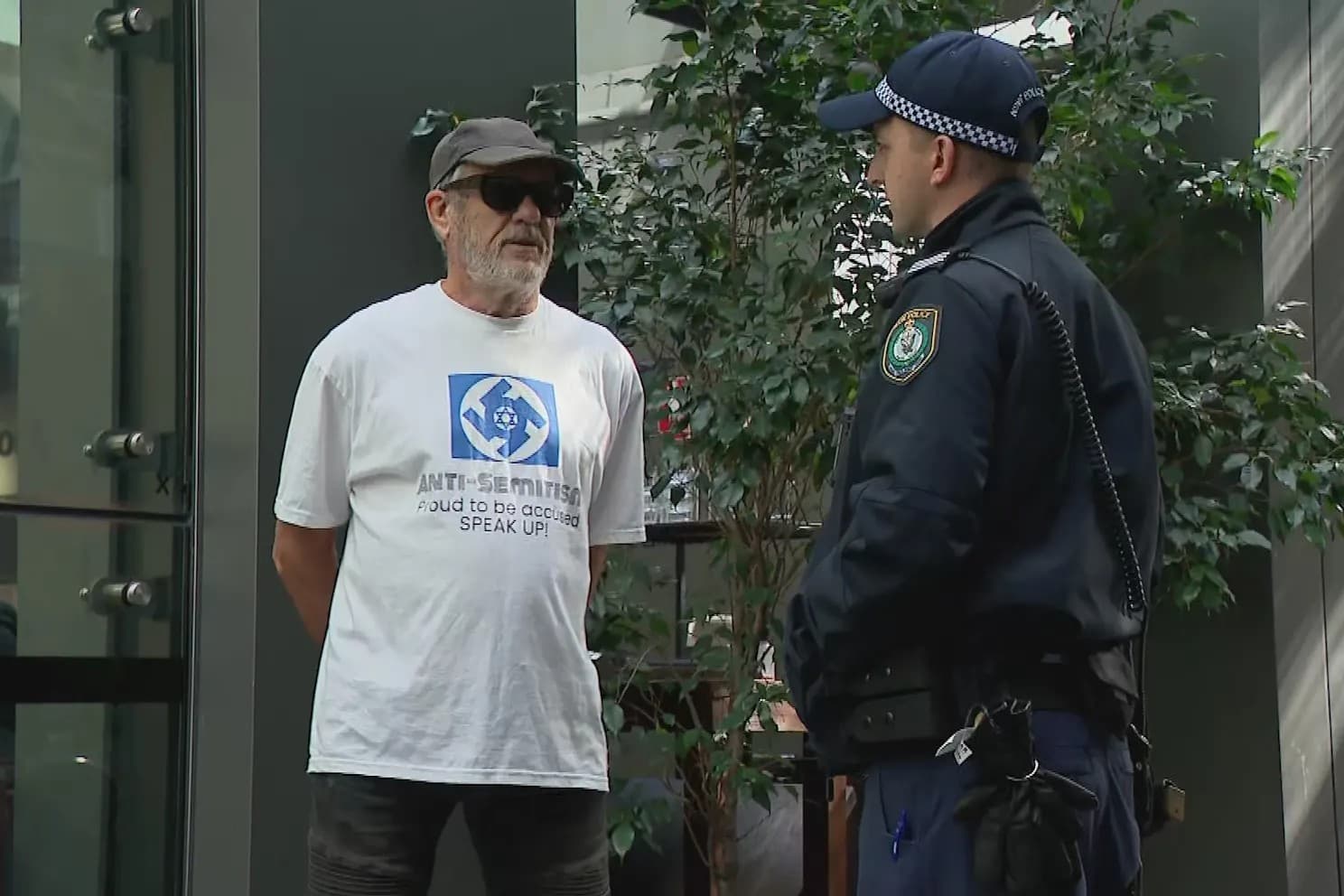
Nine photo of T shirt

Man wearing a T-shirt with swastika outside Commission hearings, May 6 (courtesy Nine Media)

Published: 7 May 2026

Last updated: 7 May 2026

There are times when a nation is forced to look into the mirror and acknowledge the flaws it sees. Up till now, non-Jewish Australians have been able to turn away from that mirror. But after this week’s opening hearings at the Royal Commission, not anymore.

The viciousness of words and deeds that witnesses recounted was chilling, yet the power of their testimony lies in the sheer number of experiences brought into the sunlight. These stories of hatred and sometimes violence are all the more shocking because of where they occurred – in the street, on the bus, at sporting events and other public places.

Much of this week’s testimony was a litany of these events, but the hearings also provided Australians with the opportunity to understand the lines in the sand that are instinctive to many Jews – which have been repeatedly crossed as criticism of Israel’s conduct of war in Gaza flowed through to attacks on Jewish Australians.

Key to this distinction was an exchange on Wednesday afternoon between Commissioner Virginia Bell and Zionist Federation of Australia (ZFA) president Jeremy Leibler.

Bell: “Mr Leibler, you talk about the delegitimisation of Israel, and as I understand it for you, that connotes the denial of the right of Israel to exist as a homeland for the Jewish people, and you talk about the excessive criticism of Israel…

“I appreciate that there are views on both sides about the pursuit of the war in Gaza by the current administration. But can you appreciate there is a difficult line between what you describe as delegitimising Israel and the views that may be conscientiously held by non-Jewish Australians of goodwill, who are trenchantly critical of actions of Israel, even against the Hamas attack?”

Leibler (extract): “There are many Jewish Australians that are also highly critical of the current Israeli government. I have been publicly [critical], as president of the Zionist Federation… of certain actions of the Israeli government. I don’t believe that it is difficult to draw the line. I believe that there are many that have an agenda that make it very difficult to blur the lines…

“It is perfectly acceptable to criticise Israel’s conduct of the war. It is not legitimate, it is not acceptable, and it does cross the line, to describe the Jewish right to self-determination as something that is inherently evil or immoral, that our identity, the core of who we are, is evil, because the logical extension of that is that we are evil… and that Zionism, the state of Israel, it’s an evil and racist endeavour.”

An epidemic of hostility

The Hamas attacks of October 7 unleashed an epidemic of hostility towards Jews in Australia, transmitted through the spoken word, television and social media air, in incidents that spread like a virus from committed antisemites to the casual.

While high-profile attacks on Jewish institutions and property have attracted prominent coverage, the majority of complaints from the Jewish community have been largely reported as garden variety offences that in themselves did not constitute a major threat.

It has been a drip-feed that media and political leaders often overlooked or minimised, and which pro-Palestinian advocates could easily dismiss as distorting legitimate criticism of Israel’s prosecution of the war.

The Royal Commission, by providing a public forum which can encompass accumulated experiences, has laid bare the sheer scale of the problem. As each person’s testimony is added, Australians can stand back and take in the size and ugliness of the big picture.

Even so, the scene outside the Commission building yesterday left many people lost for words. A man was seen wearing a T-shirt with a Star of David inside a swastika. Underneath were the words: Antisemitism – proud to be accused: SPEAK UP! The Commission said it was “appalled”. The man was later arrested. It was a shocking moment that underscored the role of the hearings in giving Australian Jews belated acknowledgement of a crisis that cannot be waved away.

So far there have been 12 witnesses a day, 48 in total, with similar numbers to be called next week. These testimonies are the tip of the iceberg. As of April 30, the Commission had received more than 5,700 submissions, the majority from NSW (more than 2,700), followed by Victoria (1,700).  More than 4,000 of these identified as Jewish.

Intimidation in everyday settings

Here are just a few of the experiences from normal life:

Israeli-born Sydneysider Nir Golan told the Commission he has been living in Australia since 2020.  He said he was called a “dirty Jew” in a Bondi Junction street by a man “in broad daylight”, after October 7, 2023, when there were “many people around us”. The man made a Nazi salute and pointed his fingers shaped like a gun in his direction. “No one intervened unfortunately except for one tourist, an American tourist,” Golan said. The tourist was bashed by the man, he said.

A Melbourne mother, giving evidence anonymously under the pseudonym AAM,  told of an incident experienced by her children on a suburban Melbourne bus. A young man was with a group of friends, laughing as he said with a raised voice: “Are there any f..king Jews on this bus? I can smell Jews. If there are any Jews, we’re going to burn this bus.”

Sitting together were a young Jewish sister and brother, along with the brother’s friend. The shouting men were looking directly at them, and the boys shifted to put their bodies in front of the girl.

Another Melbourne mother, identified as AAO, said she was at the Australian Open in Melbourne in January sitting next to a woman who started “ranting about Jewish people and how terrible they are.”

The woman was saying, “the job that they did in Bondi wasn’t good enough, and they should have killed more, and the Jews are the worst.”

“I just feel it was deep-seated; the hatred. I don’t know where that would have come from and why it was present on that day.”

She reported the incident to police, and the woman was removed from the tennis.

Political threats, union gaslighting, student hostility

Some of the other experiences that have been shared:

Joshua Kirsh (Saeed Khan/AFP via Getty Images)

Joshua Kirsh launched a campaign as an independent candidate for the New South Wales upper house in late 2025, but found his advertisements online were bombarded by antisemitic tropes, abuse and threats. “The ads … were deluged with antisemitic comments of a nature that was particularly vitriolic, in the sense of … ‘Fuck off you Zionist cunt’.

“And there were a range of conspiracy theories about Israel paying people to firebomb places in Australia, that the October 7 massacre was a false flag, that we’ve got enough Jewish politicians already.”

Kirsh, who is now chief operating officer of the Australian Union of Jewish Students (AUJS), catalogued the abuse and reported it to the Executive Council of Australian Jewry (ECAJ). He remains a candidate for NSW parliament, but says Jewish friends have been intimidated from participating in public life.

“I’ve had a lot of conversations with people in the Jewish community who are incredibly bright and talented and would be perfect fits to be more involved in politics in this country. But their view is that they can’t bear the risk of receiving the kind of backlash I have received.”

A Tasmanian teacher said she noticed a significant change in the attitude of students towards a Jewish member of the community after October 7.

An elderly Dutch man had gone to the school each year to talk to Year 10 students about the Holocaust, and was well received. But after the Hamas attacks, students became “boorish” and “very rude” to him.

“They were asking him questions about the conflict between Israel and Hamas and making comments to the effect where they were essentially blaming him for what was happening over there.”

“It was essentially a whole room of grade 10 students against one person who was just trying his best to educate students.”

Gayle King, from Jewish Care Australia, spoke of a community organisation that specialised in multicultural youth services, which told the charity it would not partner with them because they were a Jewish organisation.

“I asked them, ‘Was that a directive from their funders?’ They said, ‘No, it was the other youth they were working with that would not approve of them or like them working with a Jewish organisation’. They also added that Jewish youth didn’t need their services because they weren’t poor.”

Trade union worker Stephanie Cunio (AAP/Bianca De Marchi)

Trade union worker Stephanie Cunio, who grew up in Bondi as a Sephardi Jew, said she felt gaslit by those around her who denied the events of the attack. “They kept saying to me, ‘oh, but we work with Jews all the time and we’ve got great Jews’, and the Jews they were working with were Jews that said they held hardcore anti-Zionist beliefs that said Israel should not exist,” she said.

“If I wasn’t taking that position, I was cancelled and gaslit.”

Cunio said she has no problem with messaging that calls for a “free Palestine” but has struggled with the language used about Israel in left-wing groups.

“I completely understand that a Palestinian Australian will think about Israel in that way, I don’t have a problem with that. I have a problem with people that are not from a directly affected community… to recognise that when I see the word ‘Israel’ I see much more than the regime,” she said.

Toby Raphael, vice-president of Newtown Synagogue, said he encountered a protest at the University of Sydney in April 2024 after he went to synagogue for Passover. He stopped to find out “what it’s all about” and was wearing his yarmulka.

He said someone yelled at him, “You dirty f---ing pig Jew”, and “spat in my face”. Nobody helped him.

Asked how he felt after the attack, Raphael said: “Shell-shocked. I was in trauma. I couldn’t believe it. I was probably quite livid, to be honest.”

Alex Ryvchin, co-CEO of the Executive Council of Australian Jewry, said Australia now resembled the antisemitic Soviet Union his family had fled when he was a child. “The things we’ve seen in this country replicate what happened there: the rampant abuse, the violence, the denigration, and the sheer relish with which it is inflicted on the Jewish people.”

Ryvchin said he faced consistent death threats, threats against his children and family, and “fixated individuals” who posted personal pictures online. He said being called a “Jewish dog” in the street in Sydney “stopped me in my tracks”.

A Geelong mother of two, identified as AAP, said her high school-age children attend single-sex Catholic schools and are “probably the only Jewish children there”. AAP said some of her son’s friends joked about dressing up for Year 12 muck-up day “as Adolf Hitler or the Bondi shooters”.

“They also joked to him that we think you should dress up as an SS [Nazi regime] guard,” she said. She did not believe they were aware he was Jewish.

A climate of fear

Stefanie Schwartz, Mount Sinai College (AAP/Dean Lewins)

Jewish advocacy and community leaders have spoken about the climate of fear that has taken hold after October 7 as anger over Gaza was taken out on Jews.

STEFANIE SCHWARTZ, president of the board of Mount Sinai College in Sydney, said the school was the subject of an antisemitic graffiti attack on January 30, 2025, the day before school started for the year. The wall of the main school building was sprayed with phrases including, “Jews are real terrorists”, “Jew dogs”, “F---k Jews”, “Your killers”, “merderer” (sic) and “dog”.

Schwartz said the school has had to put into place many psychological supports. It has to conduct risk assessments for activities, including walks across the road to the park, excursions and sport. Extra guards have been employed, and capital works are required to make the school feel more secure for the students.

RABBI BENJAMIN ELTON, chief minister of the Great Synagogue in Sydney, said antisemitism has “run riot” in Australia and it had “not been checked” nor stopped, even after the Bondi terrorist attack. “The answer cannot be ghettos for our own protection,” he said. He said this was both impractical and immoral.

He said that “Free Palestine” stickers had been placed on the front of the synagogue. “We do not have a foreign policy; we do not have jurisdiction in that part of the world.”

He said a man had yelled at him, “Jew, go home”, outside the synagogue. On another occasion someone in a van yelled an antisemitic slur at him.

Rabbi Elton said his congregants are wary of booking taxis or Ubers to the synagogue directly because of safety concerns. “They will never put in the address of the synagogue,” he said.

Jeremy Stowe-Lindner (AAP/Bianca De Marchi)

JEREMY STOWE-LINDNER, principal of Bialik College in Melbourne, said his students “can’t go into the CBD in Melbourne any more in school uniform” because the October 7 attack precipitated a wave of antisemitic abuse. “We have had Hitler salutes and Jewish slurs.” He said pupils were spat on by two students from another school during one university trip.

JILLIAN SEGAL, the government's antisemitism envoy, described antisemitism as a virus, “an illness that has morphed and mutated over time… from religious-based to the racism of Nazi Germany and to modern antisemitism, which she describes as much more concerned with the state of Israel.

“It’s almost fashionable,” Segal says. “If someone that they follow online, an influencer, is of that view, they adopt that view.

“In one sense it’s the most pernicious form] because it just happens very easily, and in another sense I think, through my plan, it’s the form of antisemitism that we can tackle because I think it is subject to education.”

Segal also said a hesitation from Australian leaders to speak out against antisemitism has lifted in the wake of the Bondi terror attack.

“Post-December 14 last year, I think there’s been a change. There’s been a realisation that what the Jewish community was experiencing and complaining about that they were seeing wasn’t a collection of isolated incidents, it wasn’t an exaggeration, it was very real and very dangerous for the country. And I’ve been contacted by many leaders since then, wanting to be more engaged.

MICHAEL GAWENDA, former editor-in-chief of The Age, said mainstream media organisations including The Age and ABC had failed to catch and cover the “fracturing of multiculturalism” in Australia, while the political left sunk to “victimhood”.

Mr Gawenda said he had been labelled “a Zionist supporter of genocidal Israel” for urging nuance in journalism, while media outfits dismissed antisemitism as a “concocted notion”.

“There’s been an enormous failure of journalism in Australia,” he said. “What we saw early on (after October 7) was a kind of fracturing of multiculturalism. Where is the coverage in the media? I kept saying this, where is the coverage in the media of what these actual communities are experiencing?

“The excuse cannot be that they didn’t have the journalists to do it. Why didn’t they spend time in these communities?”

JEREMY LEIBLER, president of the ZFA: “My phone was ringing off the hook after October 7. “It was particularly bad within the arts, within progressive spaces, within academia, but it was everywhere.

“Jewish artists … were having venues cancelled, often … not because the venue ideologically wanted to. Often the cancellation would be accompanied by: ‘I’m so sorry, but I’ve been told that there’s going to be a BDS boycott campaign if we allow you to perform, and we’re a small business, and we just can’t afford to be ­attacked online.”

Mr Leibler said the rise in antisemitism proved to successful Jewish Australians that their seat at the table “was conditional on them rejecting a core part of their Jewish identity. They discovered after the 7th of October, very quickly, that that seat was conditional on them rejecting a core part of their Jewish identity: that being their Zionism, their belief in the right of Jewish people to have their own homeland.”

VIC ALHADEFF, former head of the NSW Jewish Board of Deputies, said that before October 7, antisemitism was confined to the margins of society in Australia. But now it had become mainstream. “We fear the next Bondi,” he said. “That is our reality.”

Alhadeff said after Bondi he felt “disillusioned” when he was met with silence by a member of a specific faith group. Eventually the person said to him: “But look what’s happening to the Palestinians in Gaza.”

Alhadeff said he replied that you would “have to be made of stone not to care about what is happening to the Palestinians in Gaza” but “why are you holding me responsible?”

Jewish-Australians were being held accountable for what is taking place on the other side of the world when they had no agency or control over this, he said.

PETER WERTHEIM, co-CEO of ECAJ, said the Council has been compiling annual reports on antisemitism since 1989. “After October 7, 2023, it went up by 316 per cent. It has changed our perspective, and I think it has changed the country.”

Wertheim said there had “always been a sense that it’s dangerous to be Jewish” and this was “nothing new in history”.

But this had not been a pervasive feeling in Australia until recently. “Now the sense is, once again, it is dangerous to be Jewish. People hide their Jewishness.”

CLICK HERE FOR FULL TRANSCRIPTS OF TESTIMONIES

You might also like
  • ‘Israel is systemically eliminating Palestinian collective life’:  B’Tselem
    Deborah Stone
  • Antisemitism, homophobia and a radical response to both
    Dennis Altman
  • Tame apologises – but with little grace
    Deborah Stone
logomark.67a07ee3
We believe in the free flow of information

Republish our articles for free, online or in print, by using our Creative Commons licence

You might also like

    Lobby
    OpinionAustralia

    Confronting Richard Flanagan and the myth of the Israel lobby

    Mary Garden 8
    vandalism car woollahra fuk israel farhat
    Australia

    Court decision fails to understand when ‘Fuk Israel’ becomes antisemitic

    Jeremie Bracka 6
    ANNIKA WELLS PRESSER
    Israel Hamas WarNewsAustralia

    No action to stop Hezbollah ally beaming antisemitic and anti-Israel content into Australia

    Michael Visontay

About the author

Michael Visontay

Michael Visontay

Michael Visontay is Commissioning Editor of TJI and was Editor-in-Chief from 2017-22. Michael is a former Assistant Editor of The Sydney Morning Herald and columnist with The Australian Jewish News. He has written six books, including Who Gave You Permission? with Manny Waks, and Welcome to Wanderland: Western Sydney Wanderers and the Pride of the West. His most recent book is Noble Fragments: the Maverick who broke up the world's greatest book (Scribe, 2024).

More from the author

ReflectionWorld

My memory of Gloria Steinem

NewsAustralia

No action to stop Hezbollah ally beaming antisemitic and anti-Israel content into Australia

NewsAustralia

Beinart takes a wrecking ball to Israel

AnalysisAustralia

Prime minister’s absence exposes weakness in Royal Commission hearings

Comments1

  • Avatar of Lee Kofman

    Lee Kofman8 May at 07:41 am

    Thank you for this heartbreaking and necessary article.