Evidence of declining social cohesion and the efforts to turn it around
The Royal Commission on Antisemitism and Social Cohesion began its final hearing block this week with a focus on social cohesion and a search for positive evidence
Peter Kohn
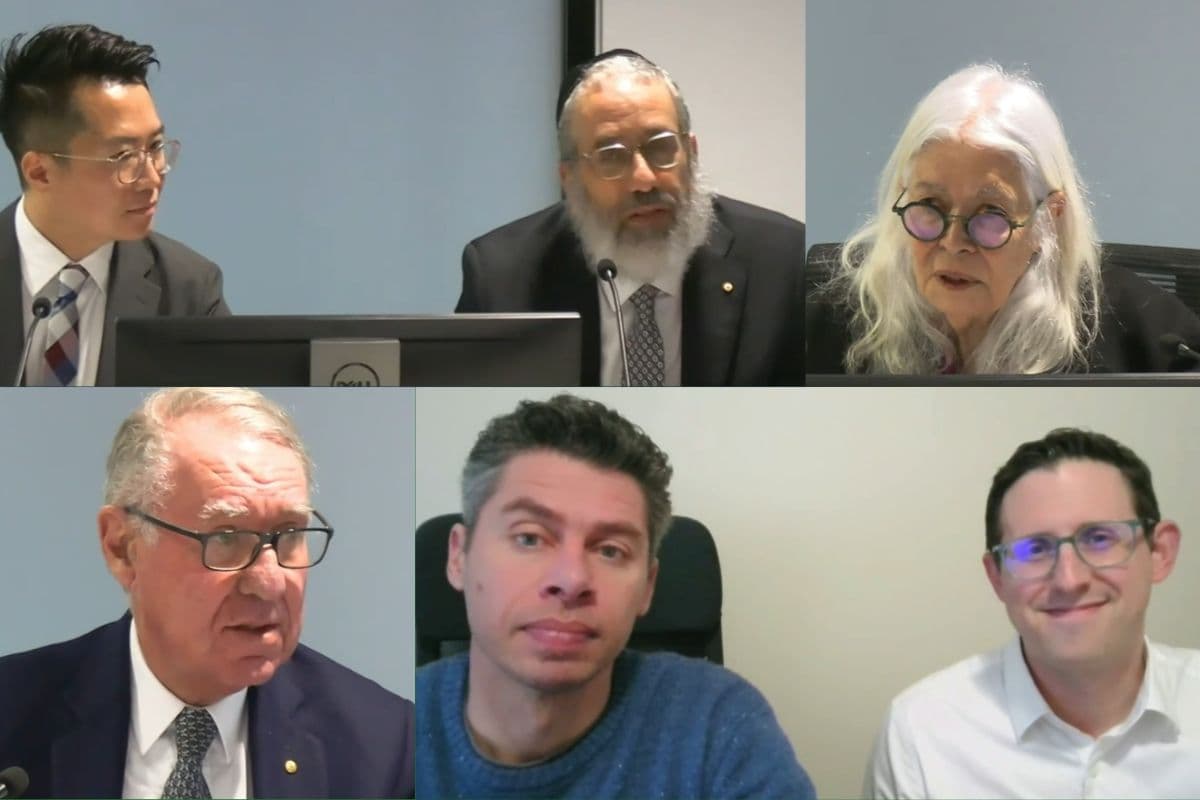
Among those who gave evidence at the Royal Commission this week were (clockwise from top left): Dr Beau Hu-Jia, Rabbi Zalman Kastel, Marcia Langton, David Gonski, Dr Farid Zaid, Dr Daniel Heller
Published: 20 August 2026
Last updated: 20 August 2026
Research institute the Scanlon Foundation shows that 15 per cent of Australians have negative attitudes about Jews. It’s a far cry from 2023, not so long ago in some ways, a different era in other ways. That year, the Jewish negativity index stood at 9 per cent. Even in 2024, it was 13 per cent.
It should be of no comfort to Jewish Australians, of course, but adverse views of other community groups have also deepened. Attitudes to Muslims worsened from 27 per cent in 2023 to 35 per cent last year, and Sikhs and Hindus were also viewed less positively.
That sobering testimony came from Scanlon academics Anthea Hancocks, the foundation’s CEO, and colleague Professor John van Kooy, figured among hearings this week, which focused on strategies for strengthening and deepening social cohesion in Australia.
How can it be understood and measured, and how does it sit within Australia’s human rights framework? What initiatives and programs can be undertaken by various communities, religious groups and organisations across Australia, to strengthen social cohesion?
Impact of holding a Royal Commission
On a positive note, it’s well to remember that Australia is the first country to hold a comprehensive government inquiry into antisemitism in the nation.
David Gonski, appointed late last year to chair the Prime Minister’s antisemitism education taskforce, made a powerful point to Commissioner Virgina Bell: “Commissioner, I think the existence of your commission has already done something, and I compliment all those who come in here each day … I think talking about it is very important … [it] will help people understand that a fair go is something for everybody.”
And rousing words of interfaith cohesion came from Archbishop Peter Commensoli, of the Catholic Archdiocese of Melbourne. He was taken by Leon Zwier, counsel for the Jewish Community Council of Victoria and other Jewish organisations, to sentiments he had expressed to a rabbi in the aftermath of the Bondi Beach Chanukah massacre. At the time, he had called the rabbi his “big brother.”
The Archbishop told the Royal Commission (RC), “It’s part of my belief in our Christian tradition that the Jewish people remain God’s chosen people,” he said, adding that since the papacy of John XXIII, the church had spoken of the Jewish people as “our elder brothers and sisters”.
On his words to the rabbi, Commensoli recalled, “I said, you are my brother, my older brother, and I wanted to say that. And this is not just about hatred that had been expressed on that day, but something that was built up over the period since 2023. This was not something that had come out of the blue.”
Jews and other Middle East communities
On Monday, Rana Dadpour, co-founder of Iranian-Australian advocacy group AusIran, made three recommendations on how Australia can become a more inclusive society.
Firstly, government and society must work to create closer ties between Jewish Australians and other communities originating in the Middle East. This was particularly crucial for younger people, she emphasised.
Secondly, education must be implemented far more effectively, particularly the history of the Holocaust, but also the histories of a broad array of Middle Eastern communities.
Thirdly, Dadpour issued a plea about Iranian Australians and Iran. While not comparing the governmental systems of Iran and Israel, her argument broadly mirrors what is often said by some Diaspora Jews in relation to decisions by Israel’s government. She urged that Iranian Australians not be judged by the actions of the Islamic Republic.
She was emphatic about distinguishing Australians of Iranian background from the Tehran regime. “Millions of Iranians have left Iran, and they seek refuge in other countries, including Australia, because of the human rights violations in Iran and the oppression that exists,” Dadpour said. “One of the pillars of its ideology is basically [being] anti-Jewish, and antisemitism.”
Jewish issues, brave conversations, classroom comfort
How the education sector is handling the Israel-Palestine conflict was a strong focus this week. During testimony from Dr Daniel Heller, Commissioner Bell asked the noted Monash University historian whether he thought educators avoided Jewish political and historical issues out of concern for their students. Heller said some teachers shrank from controversial topics in their classrooms out of fear of being attacked on social media.
Distinguishing “facts” and their interpretation by individual educators, Heller, a teacher of Israeli and Palestinian history and co-director of the Brave Conversations Project, reflected that it is common for teachers to add their own biases, whether they do it consciously or not.
In fact, Heller said his message to students is not to take him at face value, because he did not take himself that way, being conscious of limitations around his knowledge, different languages, and a plethora of sources.
Testifying alongside Heller was his Brave Conversations colleague Dr Farid Zaid, a cognitive scientist and senior lecturer in psychology, who said he finds an inability of students to differentiate between “discomfort” and “distress”. He said the former is an essential learning tool.
Zaid has seen two very different responses to discomfort over classroom topics relating to the Israel-Palestine conflict – “self-censorship and silence” at one extreme and a performative “certainty” at the other, where students believe they know what’s virtuous, what’s moral, what’s right, and anyone who disagrees is, in one way or another, morally reprehensible.
‘Connection across culture’
Rabbi Zalman Kastel, founder of interfaith education organisation Together for Humanity, said, “Content and skill is not the whole picture. It’s actually the character of teachers, their capacity to make ethical professional judgments, their capacity to develop connection across culture. Reforming the standards would flow through to university teacher education and professional development.”
The organisation’s program coordinator Dr Beau Hu-Jia called for mandated record-keeping and reporting of incidents relating to racism, antisemitism and Islamophobia. “Education is important and plays a very important part in creating social cohesion. But education alone is not sufficient,” he said, calling for a whole-of-society approach to challenges facing today’s youth.
Herbert Um, CEO of Faith Values, an Australian Christian organisation that works with multifaith and multicultural communities to promote social cohesion, described a pilot program, which has already engaged with some 1,200 students in 15 independent secondary schools, a Jewish and a Muslim school among them.
The program includes eight lesson plans aligned to the Victorian Curriculum 2.0 civics and citizenship strand for Year 7 and 8 students, a teacher’s guide and in-person professional learning about Judaism, Islam, Buddhism, Christianity, Hinduism and Sikhism.
Universities and antisemitism definitions
Emphasising that he was speaking in a personal capacity, David Gonski said Australian universities should adopt either the IHRA antisemitism definition or the Universities Australia (UA) definition.
The emeritus UNSW professor and its former chancellor said the report generated by the Group of Eight’s Expert Advisory Committee on Combating Antisemitism, chaired by eminent Australian Dr Alan Finkel, had argued compellingly for UA to adopt its own definition.
“There are many who prefer the IHRA definition, and indeed the federal government has adopted that definition, and a number of state governments have too,” said Gonski. “So I don’t think it’s for me to say which one.” But he said it would be good if universities were given the option of adopting either definition.
Comments that appeared to echo what we often hear from Jewish Australians – that the mainstream community knows little about Jews or Judaism – came from Laureate Professor Marcia Langton in reference to Indigenous Australians. Testifying on Wednesday, Langton spoke of her long battle to reform the teaching of Indigenous content in Australian classrooms.
Langton, a member of the Yiman and Bidjara people, said many tertiary students were largely ignorant about Aboriginal and Torres Strait Islander people. For example, some did not believe Indigenous Australians still spoke in their specific languages. In response, she developed Garma Fieldwork, a course which over a period of seven years took students to the Garma Festival in Arnhem Land for a week of cultural immersion.
Jews and First Australians
Not enough is taught in Australia about the commonalities shared by Jewish Australians and Indigenous communities, said Langton, and about the many decades of cooperation between the two peoples.
Langton described the 1938 protest march of the Australian Aborigines’ League to the German consulate in Melbourne after Kristallnacht as a cornerstone event in the histories of the two communities. “Still to this day in Melbourne, that protest is acknowledged.”
The bond deepened down the decades, she said, with Jewish arrivals joining Aboriginal advancement organisations.
When Commissioner Bell made a point about the prominent role of Jewish lawyers at the forefront of Indigenous struggles, Langton responded, “I don’t think enough is made of this. And this is really important for curriculum.”
As examples, Langton referred to Ron Castan and others in the Mabo Number Two High Court case and the involvement of Ron Merkel SC in the landmark legal battle over returning stolen Aboriginal remains from the University of Melbourne.
A special envoy for multiculturalism and social cohesion is a development that Mohammed Hassan, president of the Somali Society of NSW, hopes the RC will recommend to the Federal Government. As the representative of a relatively small community in Australia, Hassan feels its needs are often overlooked.
Indeed, he feels that his community and other smaller communities are often not viewed as prospective partners in cohesion, but as the targets of public policy.
Hassan made the often-heard lament that news is inherently negative. Where is the coverage of success stories from African immigrant communities, was his argument. “When the news comes, and you see an African person who is doing well in life, you won’t see it on the major news. But when you see someone who has made a mistake, all the communities will be questioned.”
Democracy fading from favour
Two Australian National University (ANU) academics came to this week’s hearings with alarming findings – under 50 per cent of Australians aged 18-24 believe that democracy is consistently the better choice of how countries are governed.
Professor Nicholas Biddle of the ANU School of Politics and International Relations and Professor Matthew Gray of the ANU Centre for Social Policy Research told counsel Zelie Heger SC about their research paper of March this year, based on a survey of about 3,500 people, which has been conducted several times a year for the past 18 years and is calibrated against demographic targets.
Older Australians are more accepting of democracy as a bedrock value, the findings showed. While fewer than 44 per cent in the 18-24 age group accepted the foundational role of democracy, at the other end of the age range, for those 75 and older, the figure was at more than 89 per cent, with a steady upswing between the two age ranges.
Gray and Biddle’s paper made four recommendations. Measures towards cohesion had to be specific, not universal; the cornerstone institutions of Australia, including government and education, needed more transparency and accountability; social media has become a source of polarisation, scepticism and silos of extremist thought; and law enforcement is no substitute for preventative measures.
That last point echoed the testimony of Heather Jackson in Hearing Block 8, when the NSW Department of Communities and Justice reflected, “I think there needs to be more function and focus on primary prevention.” And Brendan Dowling, coordinator of counter-terrorism at the Department of Home Affairs, had last week described law enforcement as “the pointy end” where preventative measures have failed.
If the news on social cohesion appears grim, a look at how Australia operates at the neighbourhood level is good reason to be more optimistic. That was the argument from Scanlon’s Anthea Hancocks and John van Kooy.
The RC heard about Scanlon’s Mapping Social Cohesion report, released last year, which indicated that residents in close-knit neighbourhoods, where there is recognition, trust and awareness of neighbours, are also most likely to appreciate a broader scale of national identification and have a deeper commitment to foundational Australian values, including diversity. Hancocks saw a greater role for local government in fostering those values.
And contrary to John Lennon’s Imagine sentiment about the societal divisiveness of religion, the institute found that people of faith also seem to have more commitment to cohesion. “There’s more civic activity. There’s more interaction with the broader community, and they’re making friends from a broad range of different backgrounds.”
About the author
Peter Kohn is an Australian journalist who began his career at the Herald & Weekly Times. For 43 years, he was associated with The Australian Jewish News. For the past decade, he held the title of Senior Journalist at the newspaper. He is the author of two novels. Rachel’s Chance is the story of his family’s experiences as Jewish refugees in Shanghai during World War II, and View From A Sandcastle is based on his own story, growing up in Melbourne suburbia during the 1960s and 1970s.