Aa
  • Read, Watch, Listen
  • TJI Series
  • Community Action
  • Events
  • Zedi
Follow us and continue the conversation
  • LinkedIn
  • Instagram
  • FaceBook
  • X
  • YouTube
Test yourself with the TJI Quiz!

Adjust size of text

Aa

Follow us and continue the conversation

  • LinkedIn
  • Instagram
  • FaceBook
  • X
  • YouTube

Your saved articles

You haven't saved any articles

What are you looking for?

Original reporting, insightful analysis and diverse views, delivered straight to your inbox

  • LinkedIn
  • Instagram
  • FaceBook
  • X
  • YouTube
Your support fuels our mission to inform, entertain and inspire.

The Jewish Independent is bound by the Standards of Practice of the Australian Press Council. If you believe the Standards may have been breached, you may approach The Jewish Independent or make a complaint to the Australian Press Council in writing at www.presscouncil.org.au. The Council may also be contacted on 1800 025 712.

  • Our Story
  • Contact us
  • Our Team
  • Support us
  • Guidelines
  • Pitch your idea
  • Republishing us
  • Community Action
  • Our Awards
  • LinkedIn
  • Instagram
  • FaceBook
  • X
  • YouTube
Aboriginal FlagTorres Strait Islanders Flag

The Jewish Independent acknowledges Aboriginal and Torres Strait Islander peoples as the Traditional Owners and Custodians of Country throughout Australia. We pay our respects to Elders past and present, and strive to honour their rich history of storytelling in our work and mission.

© The Jewish Independent 2026All Rights Reserved
Website design and development by Your Creative, MelbourneTerms & ConditionsPrivacy Policy
HomeRead, Watch, ListenArts & Culture
Israel Hamas WarFeatureArts & Culture

Design in Arabic: a safe space for Palestinian-Israelis

Against a backdrop of the Gaza war, The Israel Museum's Design in Arabic exhibit – which brings together the works of five minority artists – is challenging ignorance and prejudice across the country.
Ben Lynfield
Print this
Copy of Article illustration template (7)

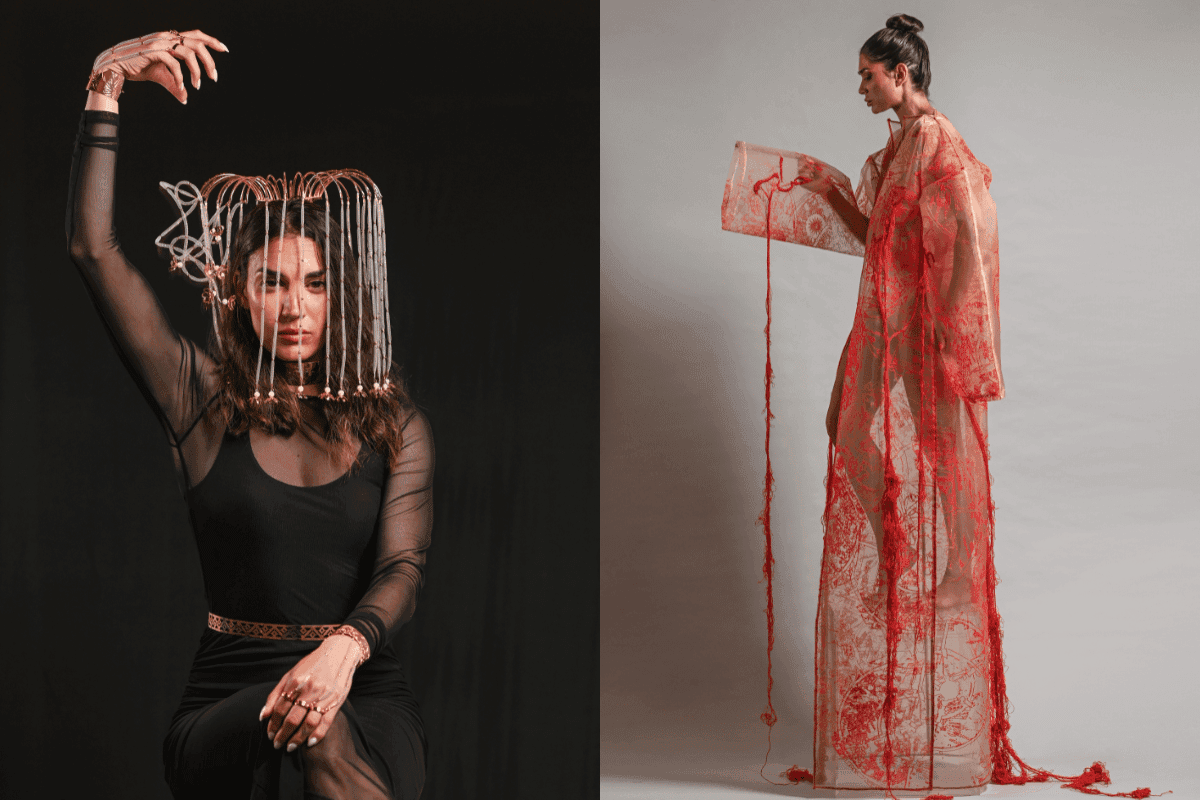
Pieces from The Israel Museum’s Design in Arabic exhibit (Image: Lior Horesh/The Israel Museum, Jerusalem).

Published: 28 May 2024

Last updated: 30 May 2024

When Israel’s right-wing leaders discover what The Israel Museum is showing in Jerusalem, they may want to ban it.

It’s not that the Design in Arabic exhibit, bringing together the works of five young designers from the minority that makes up a fifth of Israel’s population, is particularly radical – but it is threatening to ignorance, prejudice and stereotypes. 

The exhibit offers a safe space for exploring and expressing identity questions and self-criticism among Palestinian-Israelis, whose views the government and large segments of the Jewish public appear to be trying to suppress in the aftermath of October 7.

Curator Rami Tareef says the exhibit “swims against the current” that has been prevalent in Israel both before and during the Gaza war. It launched last summer and will run until the end of June.

For some Arabs, the months since the war have brought a curtailment of freedom of speech and accentuated their feelings of being second-class citizens. For the most right wing coalition in Israeli history, a tougher stance against alleged incitement is required because Israel is in a struggle for survival against Arab enemies.

Somehow, The Israel Museum has been able to offer a calm environment within this maelstrom. "It’s freer in the visual and artistic realms to say what you think than on social media," Tareef added.

A fresh sign of censoring the Arab minority came last week when a Palestinian-Israeli teacher, Sabrin Masarwa, was suspended because she joined a march commemorating the displacement of Palestinians from their villages in 1948 as part of the Nakba. First parents complained about her, and then the education ministry backed them up.

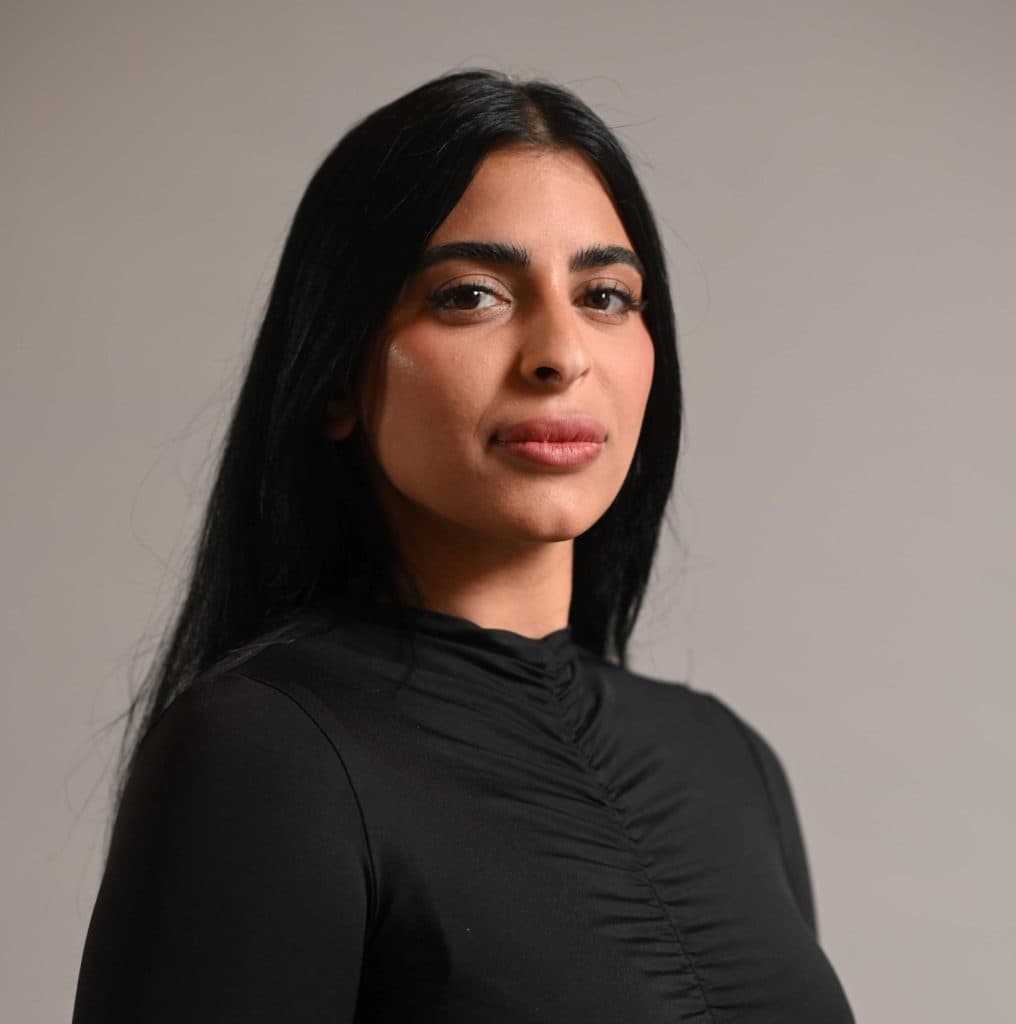
“I used to identify myself as an Arab-Palestinian-Israeli. In recent years, I define myself as being undefined. I don’t want these definitions. They are very limiting, especially in the recent period of the war.”

Artist Hazar Grably

Campuses are also often less than friendly to students who openly oppose the war. Authorities are not just targeting those who posted support for the Hamas massacre, but according to rights groups, students have faced police action merely for posting messages of solidarity with Palestinian civilians in Gaza, who are confronting famine and relentless airstrikes that take a heavy toll on noncombatants.

By contrast, freer expression prevails at the museum on several levels. Some designers look inward at their society, for example Hazar Grably of Jaffa’s battle against patriarchal norms that enslave Arab women. Others turn outward, as in goldsmith-designer Gadeer Slayeh’s use of jewellery to explain her Palestinian identity to Israeli Jews.

Grably’s “blood dress” with the Arabic word “sharmuta”, meaning slut, embroidered in red, grabs one’s attention at the start of the exhibit. Its trickling red laces are an allusion to family honor killings rampant in Palestinian-Israeli society.

Hazar Grably’s “blood dress” references the battle against patriarchal norms that enslave Arab women (Image: Lior Horesh/The Israel Museum, Jerusalem).

But it is not only the extreme example of death that Grably is concerned with. Rather, she highlights a process of enslavement throughout life, to one’s father and then to one’s husband. In her designs, she takes issue with repressive words and phrases that she says much of Palestinian society hurls at women –such as “forbidden" (or "haram" in Arabic), “sit nicely”, “keep your legs together”, “if your father agrees” and “if your husband agrees”. She also rejects the jalabiya garment for taking away a woman’s form and opts for a see-through dress instead.

Grably, 33, hails from a Muslim family that she describes as “open and supportive”.

“But the society has a hard time with me,” she told The Jewish Independent. “If they think I don’t dress as I’m supposed to or if I come back late, the neighbors will talk about it. All the time you have to satisfy the society and think about what people will say and how they will accept you. You start to live a double life in which you hide what you are doing.”

Grably says some Arab men have a hard time with the words she chooses in her pieces. “It’s a bit hard for them to understand the place of a woman who studies and does what she wants,” she said.

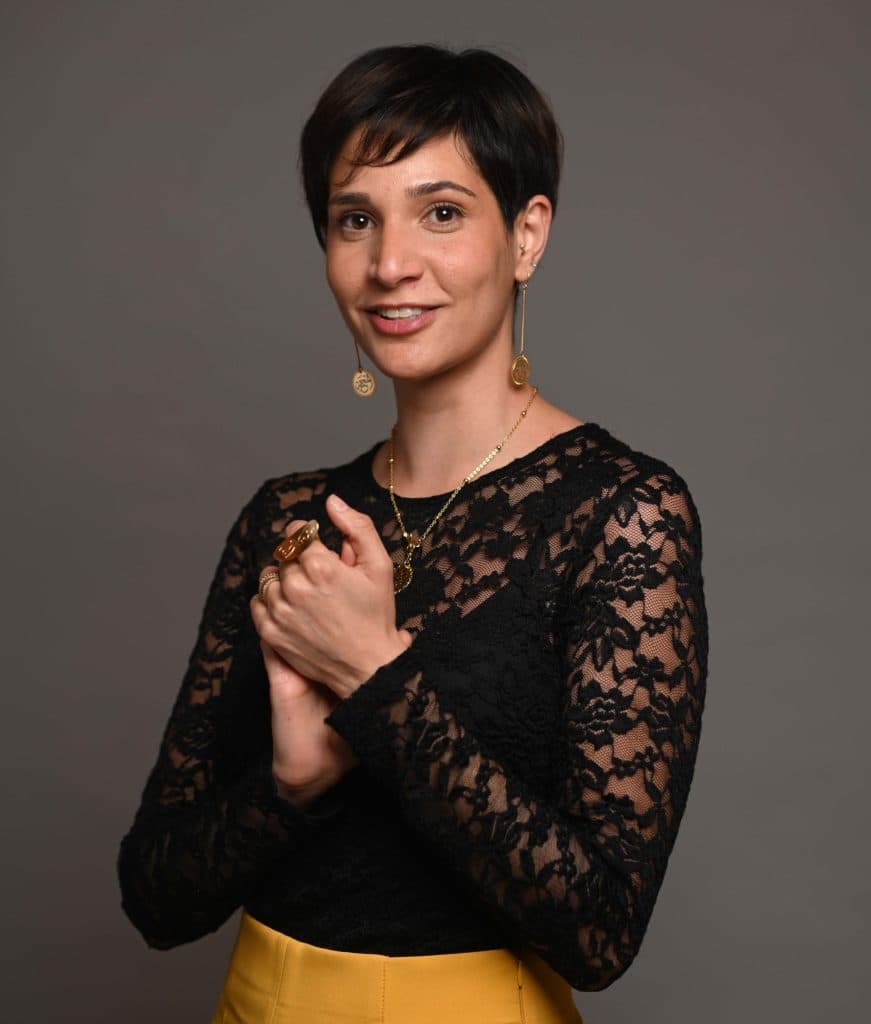
Artist Hazar Grably (Image: Lior Horesh/The Israel Museum, Jerusalem).

Grably began to grapple with identity questions when she was one of three Arab students at a high school in Tel Aviv. “I started asking myself, what am I? Who am I? What am I doing?”.

Then, when she studied design at Shenkar College in Ramat Gan, many of her projects touched on identity. “I used to identify myself as an Arab-Palestinian-Israeli. In recent years, I define myself as being undefined. I don’t want these definitions. They are very limiting, especially in the recent period of the war.”

Grably is uneasy with the war’s impact on freedom of expression among Arabs. “The war does have an effect. There is fear to mention the word Palestinian. They are taking people for investigation because they said that what is happening in Gaza is not humane. This is an atmosphere that goes against creativity.”

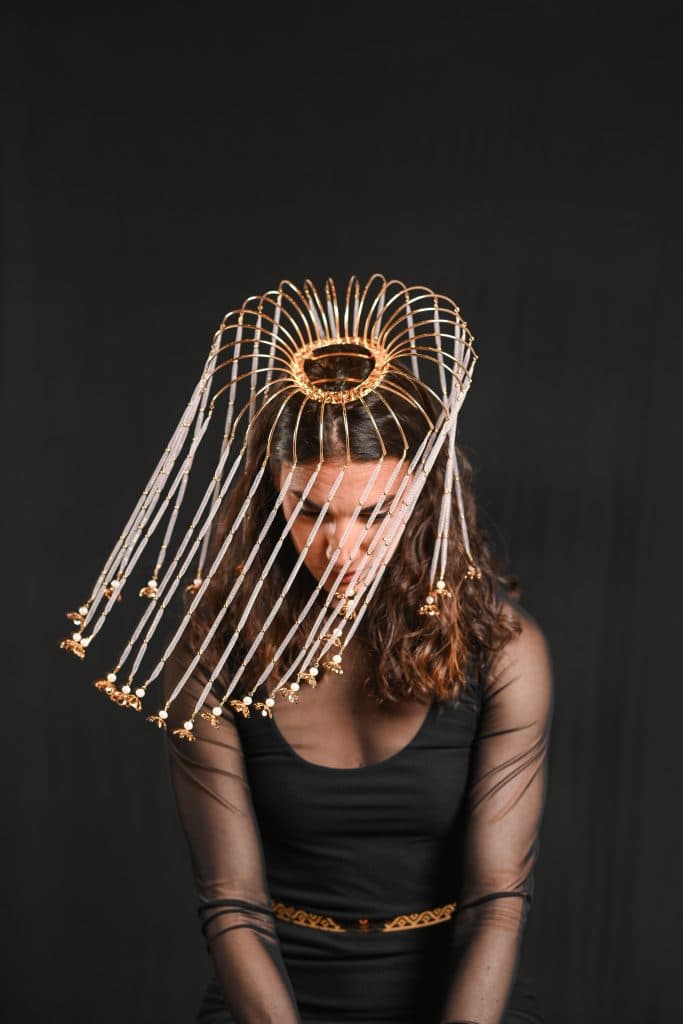
Slayeh, originally from Eilabun village in the Galilee, chose to make a golden head band that unites threads carrying calligraphic letters of the Arabic alphabet. This reflects an effort by Slayeh to make the Arabic language more prominent in Israel.

Slayeh uses jewellery to explain her Palestinian identity to Israeli Jews (Image: Lior Horesh/The Israel Museum, Jerusalem).

Slayeh explains that the ornament with the letters is foremost a way to express herself after the death and funeral of fellow Palestinian, Shireen Abu Akleh, the West Bank correspondent for al-Jazeera known throughout the Arab world for conveying the lives and deaths of people under occupation.

Abu Akleh was shot two years ago during an Israeli raid on the Jenin refugee camp, with the Israeli army eventually conceding that there was a “high possibility” troops shot her by “accident”. Palestinians were horrified as police assaulted mourners at her funeral in Jerusalem.

“I had very intensive mixed feelings, I was lost. So I decided to work on a project,” Slayeh said in a video that accompanies her exhibit. She couldn’t express her feelings about Abu Akleh’s death verbally, so she turned to the Arabic letters.

Artist Gadeer Slayeh (Image: Lior Horesh/The Israel Museum, Jerusalem).

Slayeh hopes her exhibit will give Jewish Israelis a chance to understand better the difficult situations Palestinian citizens must confront, especially security tensions.

She named her exhibit “Belonging?” to signify her wrestling with how she fits in – or doesn’t – with Israeli Jewish society. This started to become an issue for her when she moved to Tel Aviv as an 18-year-old. “I was struggling to identify where I came from,” she concluded.

Slayeh later found her answer: "I’m a Palestinian Arab living in Israel".

You might also like
  • Israel election explainer: the main parties
    Shahar Burla
  • Sanctioning settlements is a defence of Israel, not an attack
    Elisheva Madar
  • Sanctions must influence, not just perform disapproval
    Adam Slonim
logomark.67a07ee3
We believe in the free flow of information

Republish our articles for free, online or in print, by using our Creative Commons licence

You might also like

    Copy of Website books template (2)
    FeatureArts & Culture

    The winning Jewish books by Australians in the past year

    Gideon Cohen
    jiff26-cancelled.jpg
    ReflectionArts & Culture

    On despair: A reflection after watching ‘Cancelled’

    Deborah Stone
    MJBW main
    FeatureArts & Culture

    Melbourne writers fest a place of connection both outward and inward

    Peter Kohn

About the author

Ben Lynfield

Ben Lynfield

Ben Lynfield covered Israeli and Palestinian politics for The Independent and served as Middle Eastern affairs correspondent at The Jerusalem Post. He writes for publications in the region and has contributed to the Christian Science Monitor, Foreign Policy and the New Statesman.

More from the author

FeatureIsrael

Fear of Netanyahu victory may drive big surge in Palestinian voter turnout

NewsIsrael

Abuse by IDF soldiers humiliates Muslim Palestinians

OpinionIsrael

Qusra siege exposes shared agenda of IDF and settler extremists

AnalysisIsrael

IDF ordered to evict West Bank camp in election show of strength

Comments

No comments on this article yet. Be the first to add your thoughts.