Aa
  • Read, Watch, Listen
  • TJI Series
  • Community Action
  • Events
  • Zedi
Follow us and continue the conversation
  • LinkedIn
  • Instagram
  • FaceBook
  • X
  • YouTube
Test yourself with the TJI Quiz!

Adjust size of text

Aa

Follow us and continue the conversation

  • LinkedIn
  • Instagram
  • FaceBook
  • X
  • YouTube

Your saved articles

You haven't saved any articles

What are you looking for?

Original reporting, insightful analysis and diverse views, delivered straight to your inbox

  • LinkedIn
  • Instagram
  • FaceBook
  • X
  • YouTube
Your support fuels our mission to inform, entertain and inspire.

The Jewish Independent is bound by the Standards of Practice of the Australian Press Council. If you believe the Standards may have been breached, you may approach The Jewish Independent or make a complaint to the Australian Press Council in writing at www.presscouncil.org.au. The Council may also be contacted on 1800 025 712.

  • Our Story
  • Contact us
  • Our Team
  • Support us
  • Guidelines
  • Pitch your idea
  • Republishing us
  • Community Action
  • Our Awards
  • LinkedIn
  • Instagram
  • FaceBook
  • X
  • YouTube
Aboriginal FlagTorres Strait Islanders Flag

The Jewish Independent acknowledges Aboriginal and Torres Strait Islander peoples as the Traditional Owners and Custodians of Country throughout Australia. We pay our respects to Elders past and present, and strive to honour their rich history of storytelling in our work and mission.

© The Jewish Independent 2026All Rights Reserved
Website design and development by Your Creative, MelbourneTerms & ConditionsPrivacy Policy
HomeRead, Watch, ListenIsrael
Israel Votes 2026FeatureIsrael

Fear of Netanyahu victory may drive big surge in Palestinian voter turnout

Arab leaders will push for turnout to unseat Netanyahu, although they are deeply pessimistic about his rivals.
Ben Lynfield
Print this
Arab Israeli Palestinian election vote

A young Arab Israeli woman votes during Israel’s parliamentary election at a polling station near Haifa in 2019 (AHMAD GHARABLI/AFP via Getty Images)

Published: 8 September 2026

Last updated: 8 September 2026

It’s not hard to grasp why Palestinian citizens of Israel might view Gadi Eisenkot, the former chief of staff who is mounting a formidable electoral challenge to Benjamin Netanyahu, as merely the lesser of two evils.

With Netanyahu’s coalition continuing its brutal attacks on Gaza, its enabling of settler violence and Palestinian displacement in the West Bank and its blind eye to soaring murder rates in Arab areas, anyone might seem better than Bibi.

Even Eisenkot, a man known best for his doctrine of disproportionate bombing in Lebanon as chief of staff and currently as a rejectionist of Palestinian statehood and of Arab parties as coalition partners, seems less egregious than Netanyahu.

“In these elections the options are the Netanyahu camp, which is offering genocide and the anti-Netanyahu camp, which is offering apartheid,” says Sami Abu Shehadeh, leader of Balad, an antizionist party that is one of three parties comprising the Joint List, which is polling as the largest Arab grouping in advance of the October 27 ballot.

“We don’t want either. We want a normal democracy where people get rights according to citizenship, an end to wars in the Middle East and equality, justice and freedom for everyone,” he told The Jewish Independent in his office in Jaffa on Tuesday.

But Abu Shehadeh stresses: “Unfortunately we are small, and on the margins, and the real options are genocide and apartheid.”

Within those parameters, he says, “apartheid is much less evil than genocide. Genocide means you won’t exist. Apartheid means you can at least stay and struggle for a better [situation]”.

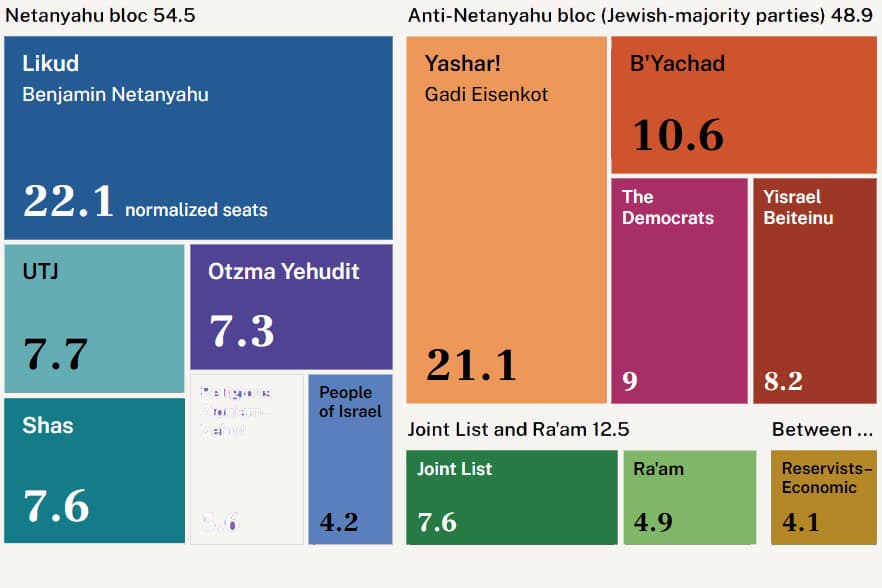
Balad’s partners are Hadash, led by Yousef Jabareen, and Ta’al, headed by Ahmed Tibi. Hadash’s start of the campaign has been marred by sexual harassment allegations involving one of its candidates, Jafar Farah, who denies any wrongdoing. Despite the scandal, the Joint List hopes it can boost turnout by showing unity.

Main goal is to stop the coalition from winning

“The main goal for the Joint List in this election is to prevent this criminal coalition from coming back again,” Abu Shehadeh said. “For the three parties on the list, there is total consensus on that.”

Balad is seen in mainstream politics as the most radical, with its espousal of a return of refugees from the 1948 nakba, or catastrophe of expulsion, something many Israeli Jews believe would result in an Arab majority.

Abu Shehadeh pauses briefly when asked about Eisenkot: “Until now he is not proposing a different agenda on core issues, not an end to occupation or a historic compromise. He insists on the Jewishness of the state. His whole career has been in the army and he sees only security issues with the perspective that violence is the solution. I hope he’ll be different than Netanyahu. Meanwhile, it doesn’t seem so.”

However, at another point in the interview, Abu Shehadeh was more optimistic. “Of course, there are differences and we see the different colours and that Yair Golan [leader of the left-wing Democrats party] as police minister is better than Ben-Gvir. We don’t say all the parties are the same and the leaders are the same. We know all the nuances and I think that Eisenkot has the chance after the elections to change [things].”

Referring to the former human rights lawyer, Gaby Lasky, who is running for the Democrats, he added: “There is nothing to compare someone like Gaby Lasky, with all the extremists in the coalition.”

Many centre-left Israeli Jews blame Balad for playing a role in Netanyahu’s return to power in 2022 by running on its own and not forming a joint list with other Arab parties. The party narrowly missed the threshold for getting into the Knesset. Abou Shahadeh rejects the criticism as “nonsense”.

“We didn’t vote for Ben Gvir and Smotrich. Those who brought the majority to the extreme right are the majority of the Jewish people. We were trying all the time to have the biggest [Arab] unity as possible. There were some crises I don’t want to go back to.”

Abu Shehadeh, 50, has, an embroidered map of Palestine pre-1948 on the wall behind him. His grandfather was one of the few Palestinians left in the Jaffa area after the nakba and he has always been attached to the city, writing a doctorate at Tel Aviv University on its history.

Balad’s rejection of the Jewish character of the state as being racist invariably leads to its disqualification by the Central Elections Committee. But the Supreme Court has always overturned the ban. With the court and public lurching rightwards in recent years, Abu Shehadeh says he is worried this could now change.

Ra'am may be biggest challenge

But the Joint List may have its biggest challenge in the form of the Ra’am party, a historically Islamist grouping under the leadership of Mansour Abbas who reasons that you need to be part of the coalition to wield influence.

It made history by being part of the short lived “change coalition” that briefly unseated anti-Netanyahu in 2021, the first Arab party ever in an Israeli government. Arab critics allege Ra’am sacrifices Palestinian principles while the right depicts the party as terrorist sympathisers.

Abbas is now trying hard to get Eisenkot and the Jewish public to accept it as a coalition partner despite the heightened anti-Arab climate in Israel after October 7. He significantly upped the ante this week when he brought Yoav Segalovich, a respected Zionist politician and former senior law enforcement officer, into the party.

Segalovich led a campaign against organised crime as a representative of the Yesh Atid party in the “Change coalition”, bringing down the murder rate in Arab communities until Ben-Gvir came to power and killings spiralled.

Abu Shehadeh views Abbas’s turn to Segelovich as a negative development. “The idea that an Arab cannot [fight crime] and that it is not good enough with an Arab and that you need a Jew to do it means that you are not combatting racism, you are compromising with it,” he says.

Arab vote could be a game-changer

Still, Abu Shahadeh says he is confident the votes of Arab citizens, who make up about a fifth of Israel’s population, can be a “game-changer” that will block Netanyahu’s return.

His premise is that fear of another Netanyahu term and the heavy price Arabs have paid during the last four years will prompt turnout to increase markedly from the 53 percent in the last election to 65-70 percent this time.

“I can see representation by Arabs rising from ten seats to 15 seats or more and then Netanyahu will have no chance of forming a new government,” he says.

However, Salim Brake, a political scientist at the Open University, says any larger Arab turnout won’t be as high as Abu Shahadeh envisions and that it could actually harm Eisenkot. In Brake’s view, there is no possibility Eisenkot would form a government relying on the Joint List because this would not be accepted by the public.

He adds that it is questionable that Balad would recommend to President Isaac Herzog that Eisenkot be tasked with forming the coalition. Abu Shehadeh, in this interview, attached many conditions for doing this.

“In the best case, Eisenkot can rely on Abbas and Segalovich but not on Balad and the Joint List. He would have no legitimacy for doing that,” Brake says.

Abu Shehadeh says he is “terrified” that the coalition will use violence to influence the outcome of the election, a worry that Brake says is justified. “Netanyahu is a very extreme and dangerous man who is ready to do anything to stay as prime minister,” Abu Shehadeh says. “I wouldn’t be surprised if he tries to kill people among our leadership or kill people on the streets to suppress our voting percentage.”

Guy Levy, a spokesman for Netanyahu’s Likud party dismissed the allegation as being completely baseless. “Israel is a democracy where the rights of Arabs and other minorities are enshrined in the law and we defend them. Voting is totally enshrined in the law for every person.”

You might also like
  • Who is Ofer Winter and could he upset Netanyahu’s election?
    Shahar Burla
  • Israel is cementing its control over the West Bank and East Jerusalem while the world is distracted
    Martin Kear
  • Bennett’s balancing act: can he win over the right without losing the centre?
    Shahar Burla
logomark.67a07ee3
We believe in the free flow of information

Republish our articles for free, online or in print, by using our Creative Commons licence

You might also like

    Erdogan Turkey
    AnalysisIsrael

    Turkey emerges as military threat to Israel

    Dror Doron
    altalena
    Israel Votes 2026OpinionIsrael

    The Altalena should be a warning, not a political weapon

    Shahar Burla 1
    Yoav Segalovitz Mansour Abbas
    Israel Votes 2026OpinionIsrael

    Because of my Zionist values, I’m joining an Arab party

    Yoav Segalovitz 1

About the author

Ben Lynfield

Ben Lynfield

Ben Lynfield covered Israeli and Palestinian politics for The Independent and served as Middle Eastern affairs correspondent at The Jerusalem Post. He writes for publications in the region and has contributed to the Christian Science Monitor, Foreign Policy and the New Statesman.

More from the author

NewsIsrael

Abuse by IDF soldiers humiliates Muslim Palestinians

OpinionIsrael

Qusra siege exposes shared agenda of IDF and settler extremists

AnalysisIsrael

IDF ordered to evict West Bank camp in election show of strength

FeatureIsrael

Abuse of Palestinian detainees a ‘systemic issue’, say Israeli doctors

Comments

No comments on this article yet. Be the first to add your thoughts.