Aa
  • Read, Watch, Listen
  • TJI Series
  • Community Action
  • Events
  • Zedi
Follow us and continue the conversation
  • LinkedIn
  • Instagram
  • FaceBook
  • X
  • YouTube
Test yourself with the TJI Quiz!

Adjust size of text

Aa

Follow us and continue the conversation

  • LinkedIn
  • Instagram
  • FaceBook
  • X
  • YouTube

Your saved articles

You haven't saved any articles

What are you looking for?

Original reporting, insightful analysis and diverse views, delivered straight to your inbox

  • LinkedIn
  • Instagram
  • FaceBook
  • X
  • YouTube
Your support fuels our mission to inform, entertain and inspire.

The Jewish Independent is bound by the Standards of Practice of the Australian Press Council. If you believe the Standards may have been breached, you may approach The Jewish Independent or make a complaint to the Australian Press Council in writing at www.presscouncil.org.au. The Council may also be contacted on 1800 025 712.

  • Our Story
  • Contact us
  • Our Team
  • Support us
  • Guidelines
  • Pitch your idea
  • Republishing us
  • Community Action
  • Our Awards
  • LinkedIn
  • Instagram
  • FaceBook
  • X
  • YouTube
Aboriginal FlagTorres Strait Islanders Flag

The Jewish Independent acknowledges Aboriginal and Torres Strait Islander peoples as the Traditional Owners and Custodians of Country throughout Australia. We pay our respects to Elders past and present, and strive to honour their rich history of storytelling in our work and mission.

© The Jewish Independent 2026All Rights Reserved
Website design and development by Your Creative, MelbourneTerms & ConditionsPrivacy Policy
HomeRead, Watch, ListenIsrael
FeatureIsrael

Best thing that ever happened to the Left – but not yet good enough to save Israel

Ittay Flescher
Print this

Published: 31 March 2023

Last updated: 5 March 2024

The liberal camp has won a battle but may lose the war. ITTAY FLESCHER assesses what the democracy movement has achieved and how it has failed so far.

History may be remember last Sunday night when Israel shut down in protest as a second Independence Day.

The protests drew 600,000 Israelis to the streets, after Prime Minister Benjamin Netanyahu fired Defence Minister Yoav Gallant who had the temerity to call for a pause to judicial overhaul. After 24 hours, Netanyahu finally announced that he was pausing the judicial overhaul until the Knesset resumes at the end of April.

According to the Torah, 600,000 is also the number of men who left Egypt, an event which Jews around the world will tell the story of at their seder tables next week.

For some of the protesters, the moment felt like a taste of freedom akin to the end of slavery, but this joy may be short lived. This moment was the victory at the end of an incredibly hard fought 12-week battle, but the war is yet to be won.

So what can we learn from success of the protest movement up to this point?

Just what the Left needed

In some ways, the most right-wing government in the history of Israel was the best thing that ever happened to the Israeli Left. For the past 20 years, Israel’s liberal camp has been plagued by a dearth of leadership, poor messaging and internal divisions that hampered success at the ballot box.

The past 12 weeks taught liberal Israelis that they believe with no less conviction than a Haredi believes in Torah.

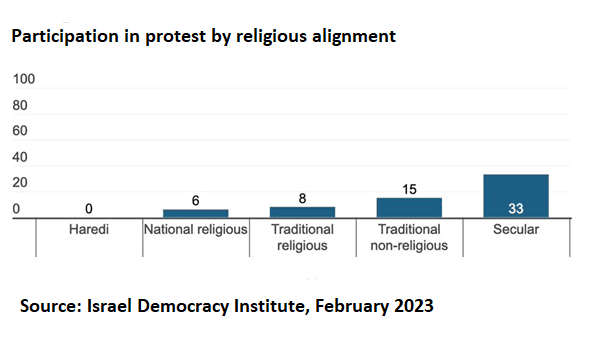
But from the moment Justice Minister Yariv Levin announced his plan to remove the only checks and balances on the power of his 64-seat Haredi-Nationalist coalition, an incredible 19% of all Israelis took part in at least one protest, calling for democracy and the protection of minority rights. That’s the equivalent of 3.25 million Australians.
A poll by the Israeli Democracy Institute found 66% of Israel's oppose the government's plans for judicial overhaul.

But the protest wasn’t about judicial reform, which many Israelis support in some form. Judicial independence was the catalyst, but the democracy movement was really spurred by the fact that the men leading the reform wanted to initiate many other terrifying policies against women and minorities. Israelis know that that the Supreme Court is the only power standing in their way.

Thus the resistance was born, and the liberal camp finally awoke from its slumber and began to fight for its values in a manner we have never seen before.

The majority of protestors were secular liberal Israelis who often define themselves by what they are not. In fact, Hebrew dictionaries define hiloni (secular) as “one who is not religious, or doesn’t observe the mitzvot of Judaism”.

The past 12 weeks taught liberal Israelis that they believe with no less conviction than a Haredi believes in Torah. The liberal camp took a huge leap towards breaking the stereotype that goes all the way back to the first meeting of the Hazon Ish with Ben Gurion, where he described secular Judaism as an “empty wagon” as opposed to the “full wagon” of the Haredim.

The Jewish Independent

This was not just Israel’s democratic spring, it was also what journalist Anshel Pfeffer called a “secular uprising.” Secular, liberal, humanist values were delivered with the potency of an Orthodox Jew crying ‘“Adonai is King” in the final moments of Yom Kippur, desperate to save himself from the evil decree.

Over the past few months, a generation of Israelis who probably didn’t know the first thing about judge selection and the powers of the attorney-general have had the civics lesson of their lives, with colour, drama and action that no classroom could ever deliver.

They learned that to be a secular Israeli is to proudly embrace the Zionist flag and the Declaration of Independence. They learned that despite the many problems here, this was a place worth fighting for. Israel ranks as one of the happiest countries in the world because our lives are filled with meaning and purpose.

They were also reminded what it means to have a home, which is why Ein Li Eretz Acheret (I have no other country) became the anthem of the protest movement.

The threat of extremism also taught liberal Israelis how to make the case for democracy, not just in the streets, but in conversations that permeated almost every encounter, in a manner that no political issue has done for years,

Israelis now have a vocabulary for democracy. They understand the importance of checks and balances, freedom of speech, the right to protest, a free media, and an independent judiciary.

Not time to celebrate

While all of this is a significant victory for the Left in terms of its identity and ability to communicate its values to a wider audience, the brief respite gives no reason to celebrate.

The concrete outcomes of recent weeks are terrible for those who care about democratic values, oppose extremism and still want to see the dying two-state solution became a reality.

  1. The only law that passed from all the reforms proposed so far blocks the Supreme Court from ordering a prime minister to take a leave of absence, effectively protecting Netanyahu while he is himself on trial on multiple corruption charges.
  2. Israel’s Left continues to be decimated politically while the National Unity party, which opposes the two-state solution, grows. A poll on March 27 showed that in a new election Labor would get no seats while the centre-Right National Unity, led by former IDF Chief of Staff Benny Gantz, would jump dramatically from its current 12 to 23 seats.
     
  3. Under a deal with the far-Right party Otzma Yehudit party to delay the judicial overhaul, Netanyahu promised that a national guard would be established under the sole authority of the National Security Minister, ultra-nationalist extremist Itamar Ben-Gvir, a move that the Association for Civil Rights in Israel, described as creating "a private, armed militia that would be directly under Ben-Gvir's control".

The Palestinian perspective

Perhaps one shouldn’t be surprised that these outcomes set back the quest for justice for Palestinians. The democracy protest was never about the Palestinians. Arab Israelis barely attended any protests to defend a supreme court they feel doesn’t defend them. 

While there were some Palestinian flags in the Tel Aviv protests, they were forbidden from the Jerusalem ones. On several occasions a single Palestinian flag in a sea of blue and white was violently confiscated.

Outside Israel, the democracy protests brought an extraordinary sight: Israeli and Palestinian flags waved in protest alongside one another. In Washington DC, where Bezalel Smotrich was visiting, and London, where Netanyahu visited, Palestinian solidarity groups and Israeli democracy supporters demonstrated in parallel, though separated by police, something that would have been unthinkable three months ago.

The real challenge for Israeli democracy

Ultimately, the greatest war on Israeli democracy is not how many MKs, judges or law professionals sit on the judge selection committee. The twin underlying problems are the lack of separation between religion and state and the failure to create a viable, autonomous Palestine.

The former empowers limitations on the freedom of women, the LGBT community and non-Orthodox Jews. The latter enables the military control of millions of Arabs and the continuous suppression of Palestinian rights in the name of security.

In today’s Israel, an end to both democratic threats seems as unlikely as the UIA inviting Arab MK Ayman Odeh to Australia for their next fundraising appeal.

So why not give up? Why keep protesting for democracy?

In response to this question, Israeli author David Grossman once said: “Each time I go to a demonstration or need to write a political article, I think of the man who stood for years and demonstrated against the Vietnam war in front of the White House. For years, every Friday, he stood there for his two hours, holding a sign. Eventually, a reporter approached him and, somewhat embarrassed, asked, 'Tell me, sir, you really think that you can change the world?' The man answered, 'No, I am just making sure that the world doesn't change me.' Sometimes, this is the most we can wish ourselves, at a twisted, distorted time such as this.”

At a time when no one knows whether any of the protests will change what fate has in store for the Zionist project, if nothing else, millions of Israelis will now be able to tell their children that in the moment of greatest crisis, they stood on the right side of history.

Photo: A demonstrator’s Israeli flag flies across a banner showing Prime Minister Benjamin Netanyahu during a protest (AP Photo/Ariel Schalit)

You might also like
  • Israel election explainer: the main parties
    Shahar Burla
  • Sanctioning settlements is a defence of Israel, not an attack
    Elisheva Madar
  • Sanctions must influence, not just perform disapproval
    Adam Slonim
logomark.67a07ee3
We believe in the free flow of information

Republish our articles for free, online or in print, by using our Creative Commons licence

You might also like

    Rozana Beit Oula
    PeacebuildingOpinionIsrael

    Peacebuilding through the eyes of a sceptic

    Ron Finkel
    Woman with land and houses behind her
    NewsAustralia

    Australia to increase sanctions against West Bank settlements

    Deborah Stone 2
    ISRAEL-LGBTQ-PRIDE-PARADE-PALESTINIAN-CONFLICT-HOSTAGES
    NewsIsrael

    LGBT asylum seekers caught between Palestinian violence and Israeli bureaucracy

    Jarod Rhine-Davis

About the author

Ittay Flescher

Ittay Flescher

Ittay Flescher is the Jerusalem Correspondent for The Jewish Independent. For over twenty years, he has worked as an educator, journalist, and peacebuilder in Melbourne and Jerusalem. His book, The Holy and the Broken: A Cry for Israeli-Palestinian Peace from a Land that Must Be Shared, was longlisted for the 2025 Walkley Book Awards.

More from the author

AnalysisIsrael

What ‘Zionism’ means in Israel:  it’s not what you think

AnalysisIsrael

From haven to hotbed: how Israel’s perception of Australia has changed

FeatureIsrael

New wave of Russian-speaking migrants may be key to Israel’s future

AnalysisIsrael

How a new International Peace Fund could make a tangible difference