Aa
  • Read, Watch, Listen
  • TJI Series
  • Community Action
  • Events
  • Zedi
Follow us and continue the conversation
  • LinkedIn
  • Instagram
  • FaceBook
  • X
  • YouTube
Test yourself with the TJI Quiz!

Adjust size of text

Aa

Follow us and continue the conversation

  • LinkedIn
  • Instagram
  • FaceBook
  • X
  • YouTube

Your saved articles

You haven't saved any articles

What are you looking for?

Original reporting, insightful analysis and diverse views, delivered straight to your inbox

  • LinkedIn
  • Instagram
  • FaceBook
  • X
  • YouTube
Your support fuels our mission to inform, entertain and inspire.

The Jewish Independent is bound by the Standards of Practice of the Australian Press Council. If you believe the Standards may have been breached, you may approach The Jewish Independent or make a complaint to the Australian Press Council in writing at www.presscouncil.org.au. The Council may also be contacted on 1800 025 712.

  • Our Story
  • Contact us
  • Our Team
  • Support us
  • Guidelines
  • Pitch your idea
  • Republishing us
  • Community Action
  • Our Awards
  • LinkedIn
  • Instagram
  • FaceBook
  • X
  • YouTube
Aboriginal FlagTorres Strait Islanders Flag

The Jewish Independent acknowledges Aboriginal and Torres Strait Islander peoples as the Traditional Owners and Custodians of Country throughout Australia. We pay our respects to Elders past and present, and strive to honour their rich history of storytelling in our work and mission.

© The Jewish Independent 2026All Rights Reserved
Website design and development by Your Creative, MelbourneTerms & ConditionsPrivacy Policy
HomeRead, Watch, ListenIsrael
AnalysisIsrael

From haven to hotbed: how Israel’s perception of Australia has changed

A wave of media coverage about antisemitism has rebranded Australia from laid-back paradise to frontier of surging hostility
Ittay Flescher
Print this
nurses 500 white

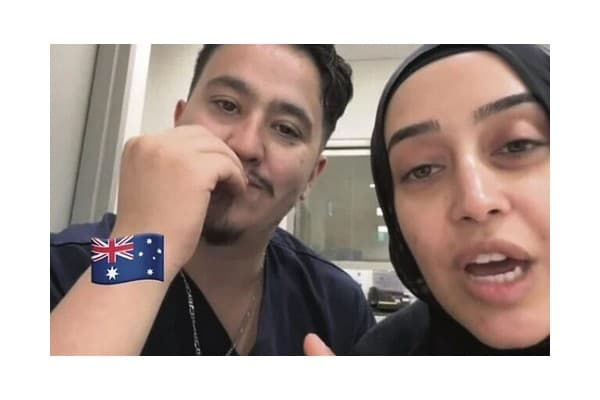
Nurses Ahmad Rashad Nadir and Sarah Abu Lebdeh who threatened not to treat Israeli patients

Published: 21 July 2026

Last updated: 21 July 2026

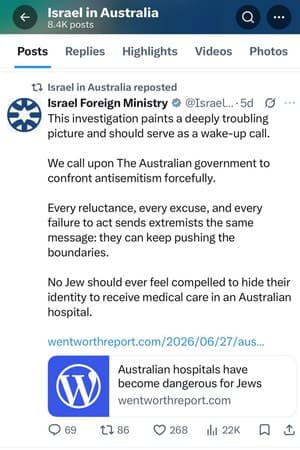
"Hospitalized in Australia? Don't Reveal You're Jewish." This alarming headline recently ran on ynet, one of Israel’s most read news sites, under a dramatic banner category flashing “Wave of Antisemitism”.

The article, adapting an investigation by The Australian, painted a grim picture of the Australian healthcare system since the October 7 attacks of 2023 and the destruction of Gaza in response. Backed by interviews with over 30 medical professionals, it detailed a hostile environment for Jewish staff and patients alike, including claims of painful IV insertions, withheld pain relief for labouring mothers, and offensive remarks.

For Israelis scrolling through their phones in Tel Aviv or Tiberias, this was not an isolated story. It was the latest piece of a frightening narrative. The message being conveyed is that Australia is no longer a laid-back haven of sunny beaches and post-army backpacking; it has been systematically rebranded as a dangerous frontier of surging hostility.

My analysis of 60 articles published about Australia on Mako/N12, a dominant Israeli news portal that is no mouthpiece for the government, over a nearly two-year period, reveals the scale and intensity of this messaging. Over half of these articles focused strictly on antisemitism, anti-Israel protests, or security threats.

This coverage consistently portrays a community under siege. For instance, Mako closely tracked a viral scandal where an Israeli whistleblower exposed Arab-Australian medical staff at Bankstown Hospital in Sydney, making threats against Jewish patients. It treated the legal saga like a major true crime event. Campus life is depicted as similarly hostile, with reports emphasising aggressive anti-Zionist rhetoric on Sydney campuses.

Hotbed of hostility

When Australia does not feature as a hotbed of hate, it is usually reduced to an economic escape hatch for tech workers or a regulatory anomaly, like the landmark under-16 social media ban.

The same phenomenon was also the case at ynet, where of the 55 articles published with the tag Australian in 2026, 27 dealt with antisemitism, and a further seven dealt with political extremism.

This reporting has consequences.

While I do not have hard data, I think this media coverage has changed the perception of Australia among Israelis. I meet hundreds of Israelis every month. Three years ago, whenever I would say I’m from Australia, people would always ask me about the beaches, tourism, quality of life, salaries, house sizes, that sort of thing. The implication in this line of questioning was that Australia was a place they may like to visit or even move to one day.

Over the past two years, when I disclose that I’m Australian, the only questions I’m asked are about antisemitism, how many Muslims live in Australia or why the government has turned on its Jews.

The Jewish Independent

In addition, this coverage – by focusing heavily on social and professional exclusion of Australian Jews, such as the case of the artist whose identity suddenly became a professional liability – demonstrates to readers that even in a supposed paradise, one is never safe from sudden alienation. Second, it feeds into long-standing Israeli beliefs about the diaspora.

Ultimately, this coverage reinforces the classic Zionist ethos that Israel remains the only true home for the Jewish people. By contrasting a struggling, disillusioned diaspora with an Israeli state that immediately steps up to protect its own, the narrative delivers a powerful ideological message: Israel may be a physical war zone, but it is the only place where Jewish lives are unconditionally defended.

Painful irony in media coverage

Yet, there is a sharp, painful irony in this media-driven promise; while Ynet portrays the state as an unwavering shield for Jews worldwide, this idealised narrative clashes directly with the profound sense of abandonment many Israelis felt by their own government on October 7, and the deeply painful treatment of the hostage families in the long months that followed.

The spike in antisemitism in Australia since October 7 is a stark, deeply concerning reality, and local Jewish leaders have rightfully sounded the alarm. Many Australian Jews are still carrying with them deep trauma, horror and pain following the brutal shooting attack on Bondi Beach. The fact that a Royal Commission has been launched with bipartisan support from both major political parties underscores the gravity of the situation.

Yet, by filtering the Australian-Jewish experience strictly through the lens of hostility, Israeli editors reduce a complex community to a flat caricature of misery, completely shutting out the vibrant, self-assured Jewish life thriving down under.

In reality, Australian Jewish life is active, visible, and proud. When Israeli readers only hear of boycotts, they miss out on Melbourne’s massive annual “In One Voice” street festival celebrating Jewish culture, the Jewish International Film Festival, which routinely packs major cinemas across the country, Tikkun Leil Shavuot, Comedy and Writers Festivals, and vibrant community gatherings like Limmud Oz or the Shalom Collective’s new Festival of the Spoken Word.

This media bias goes both ways. In the mainstream Australian press, Israel is often flattened into a two-dimensional landscape of perpetual conflict, where readers rarely see stories of Jewish-Arab grassroots solidarity, joint peace initiatives, or normal daily life. On both sides of the ocean, a hyper-focus on fear and friction sells audiences short.

Australian Jews are certainly navigating a much tougher social climate, but are doing so with their heads held high. Their community is far too vibrant to be defined solely by those who oppose it.

You might also like
  • Antisemitism, homophobia and a radical response to both
    Dennis Altman
  • Tame apologises – but with little grace
    Deborah Stone
  • Confronting Richard Flanagan and the myth of the Israel lobby
    Mary Garden
logomark.67a07ee3
We believe in the free flow of information

Republish our articles for free, online or in print, by using our Creative Commons licence

You might also like

    haredi street guitar
    Photo EssayArts & Culture

    Jerusalemites through the lens

    Sharon Gabay
    altalena
    Israel Votes 2026OpinionIsrael

    The Altalena should be a warning, not a political weapon

    Shahar Burla 1
    Arab Israeli Palestinian election vote
    Israel Votes 2026FeatureIsrael

    Fear of Netanyahu victory may drive big surge in Palestinian voter turnout

    Ben Lynfield

About the author

Ittay Flescher

Ittay Flescher

Ittay Flescher is the Jerusalem Correspondent for The Jewish Independent. For over twenty years, he has worked as an educator, journalist, and peacebuilder in Melbourne and Jerusalem. His book, The Holy and the Broken: A Cry for Israeli-Palestinian Peace from a Land that Must Be Shared, was longlisted for the 2025 Walkley Book Awards.

More from the author

AnalysisIsrael

What ‘Zionism’ means in Israel:  it’s not what you think

FeatureIsrael

New wave of Russian-speaking migrants may be key to Israel’s future

AnalysisIsrael

How a new International Peace Fund could make a tangible difference

Comments2

  • Avatar of Mark Ian

    Mark Ian6 August at 03:51 am

    The impression of many is that Australians were shocked and dismayed by the killing and wounding of Jewish People and Gentiles in the perceived “Safe from Terrorism” Continent even in gang wars “civilians “ are not to be killed or injured .
    There were many memorials and a Royal Commission into anti-Semitism and Social Cohesion was declared .
    As well as an examination of Security for Jewish Communities and all others at threat .
    But it is not wrong for Israel to want Aliyah to strengthen the Land against the many that declare “Death to Israel “ as well as “Death to the USA “ .

  • Avatar of Henry Kaye

    Henry Kaye27 July at 07:44 am

    “vibrant, self-assured Jewish life thriving down under” behind high fences, security guards outside schools and shuls, instructing kids to wear caps instead of kippot when walking through Bondi Junction. You are locked in the old dream of Australia as the “goldene medina.” The dream has turned into a nightmare. Wake up!