Aa
  • Read, Watch, Listen
  • TJI Series
  • Community Action
  • Events
  • Zedi
Follow us and continue the conversation
  • LinkedIn
  • Instagram
  • FaceBook
  • X
  • YouTube
Test yourself with the TJI Quiz!

Adjust size of text

Aa

Follow us and continue the conversation

  • LinkedIn
  • Instagram
  • FaceBook
  • X
  • YouTube

Your saved articles

You haven't saved any articles

What are you looking for?

Original reporting, insightful analysis and diverse views, delivered straight to your inbox

  • LinkedIn
  • Instagram
  • FaceBook
  • X
  • YouTube
Your support fuels our mission to inform, entertain and inspire.

The Jewish Independent is bound by the Standards of Practice of the Australian Press Council. If you believe the Standards may have been breached, you may approach The Jewish Independent or make a complaint to the Australian Press Council in writing at www.presscouncil.org.au. The Council may also be contacted on 1800 025 712.

  • Our Story
  • Contact us
  • Our Team
  • Support us
  • Guidelines
  • Pitch your idea
  • Republishing us
  • Community Action
  • Our Awards
  • LinkedIn
  • Instagram
  • FaceBook
  • X
  • YouTube
Aboriginal FlagTorres Strait Islanders Flag

The Jewish Independent acknowledges Aboriginal and Torres Strait Islander peoples as the Traditional Owners and Custodians of Country throughout Australia. We pay our respects to Elders past and present, and strive to honour their rich history of storytelling in our work and mission.

© The Jewish Independent 2026All Rights Reserved
Website design and development by Your Creative, MelbourneTerms & ConditionsPrivacy Policy
HomeRead, Watch, ListenArts & Culture
NewsArts & Culture

Spot the difference: Jewish addition for iconic artwork post-Bondi

Artist Anne Zahalka has recognised Jewish identity within one of her most celebrated works by adding a historic Hakoah badge
Michael Visontay
Print this
Bondi Bathers 800

The Bondi Bathers (2026), by Anne Zahalka (courtesy the artist)

Published: 3 June 2026

Last updated: 4 June 2026

One of Australia’s best-known artworks has been given a small but significant Jewish addition by its creator in response to the terror attack at Bondi Beach.

The Bathers, created in 1989 by Sydney photo-media artist Anne Zahalka, depicts an Australian beach scene designed to represent a mix of Anglo-Celtic-European-Australian faces. Now, following the attack that left 15 people dead, Zahalka has added a “Hakoah badge” to the bottom of the main bather’s swimming costume.

The reworked image “has evolved from a desire to recognise Jewish identity within one of my most celebrated works and to amend for my lack of recognition of Jews in Bondi in the original series,” Zahalka told The Jewish Independent. “It’s also to acknowledge Bondi more broadly and its community in a positive and celebratory way, particularly in light of the recent traumatic terror event.”
The Jewish Independent

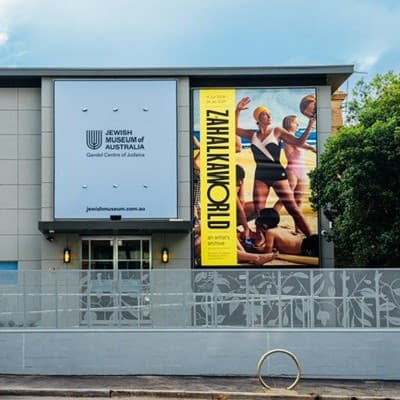
The revised image, now retitled The Bondi Bathers (2026), is the centrepiece of a major touring exhibition of the artist’s work, Zahalkaworld - an artist’s archive, that will open at the Jewish Museum of Australia (JMA) in Melbourne on June 11, and an enlarged version of the artwork will be placed on the façade of the museum for the duration.

“In the making of the [original] Bathers image, I realise I'd chosen my female bather because she was a recent migrant and a Jew. This reworking is, in part, an attempt to make that identity visible,” she explains. 
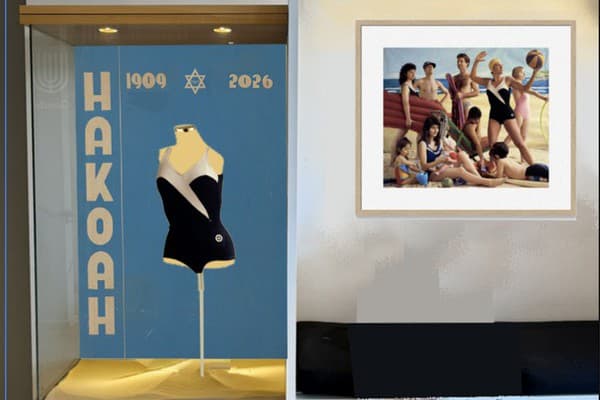
Costume with Hakoah badge in vitrine at the Museum (Anne Zahalka)

Zahalka’s Czech-Viennese Jewish background played a key role in the choice of the Hakoah badge. “It is based on one my mother wore in the mid-1930s, which I found while revisiting her archive of Hakoah memorabilia,” she explains. “Worn on the bather’s hip, where a sportswear logo like Speedo might appear, it affirms her Jewish identity. Hakoah, in Hebrew, means ‘the strength’ and evokes Jewish athleticism and resilience, while challenging long-standing stereotypes.”

The JMA exhibition will include an image of the original swimming costume with the Hakoah badge and signage behind in a vitrine as visitors enter the museum.

Historic Hakoah badges (Jewish Museum Vienna)

Zahalka said there is another connection to the word through the Hakoah Club in Bondi, “a place my mother loved to visit and play bridge, though the word’s origin was in Vienna, the city she grew up in before she was forced to flee.

The artist's mother's photo album with pre-war swimming images

“One of her best friends in Australia was a swimmer for the Hakoah swimming club in Vienna before WWII, Lucie Goldner, who later immigrated to Australia with my parents, as refugees.” Goldner disembarked in Melbourne, while the Zahalkas stayed on the ship and came to Sydney. “Their first port of call was Bondi Beach’s Astra Hotel.”

Zahalka says there is a double irony in the background of her first Bathers work, which was part of a series titled Bondi: Playground of the Pacific. “The series attempted to reflect and celebrate the cultural diversity of the times of the late '80s, as multiculturalism was beginning to be affirmed and supported within the country,” she says.

“For the original Bathers (1989), I invited a group of friends, lovers, colleagues, students as well as nieces and nephews, to perform a parody of the celebrated painting by Charles Meere from 1940, Australian Beach Pattern.”

The main figure holding the beach ball was chosen for her strong athletic physique and mixed ethnicity. “She occupies the space once held by the absurdly idealised woman in Meere's neo-classical style painting,” says Zahalka.

But that painting is itself a parody, painted as a reflection on the eugenics and propaganda imagery coming out of Nazi Germany at the time. “Like many, I thought Meere was really celebrating an idealised view of the nation but he was in fact, sending a warning,” says Zahalka.

Charles Meere's Australian Beach Pattern (1940)

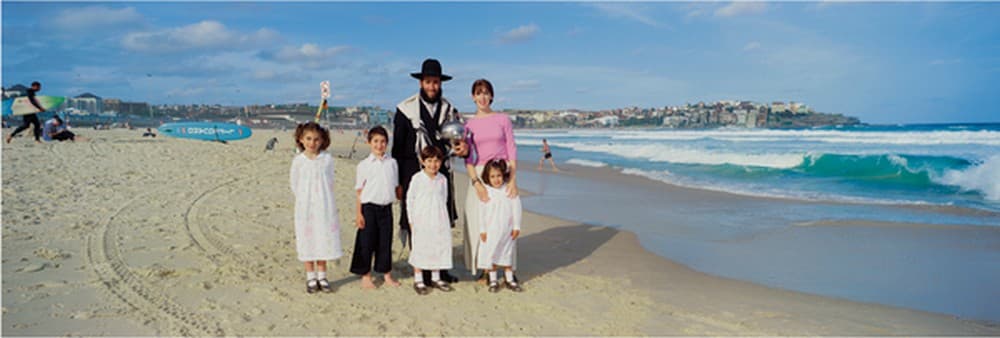
Another important inclusion in the exhibition to reflect the Jewish community in Bondi is a portrait of Rabbi Mendel Kastel and his family, which was commissioned by Sydney Airport in a body of work titled Welcome to Sydney 2002. “The inclusion of a Jewish family on Bondi Beach takes on greater meaning and poignancy now following the Kastel family’s enormous personal loss and the vulnerability that the whole community has faced,” Zahalka adds.

Rabbi Mendel Kastel and family, from Welcome to Sydney (2002), courtesy JMA

You might also like
  • Confronting Richard Flanagan and the myth of the Israel lobby
    Mary Garden
  • Prime minister’s absence exposes weakness in Royal Commission hearings
    Michael Visontay
  • Safety not just security: the last word to the Royal Commission
    Yehoram Ulman
logomark.67a07ee3
We believe in the free flow of information

Republish our articles for free, online or in print, by using our Creative Commons licence

You might also like

    Jewish word map
    FeatureArts & Culture

    Was the barmi a shemozzle? How Australians use Jewish words 

    Caroline Hendy & Emma Breslow 1
    why main 4th
    PodcastArts & Culture

    Why we need to find our why now: new TJI podcast

    Ittay Flescher and Courtney Winter-Peters 1
    Amidah main
    FeatureArts & Culture

    A circle of communal healing on stage, with a dash of humour

    Miriam Hechtman

About the author

Michael Visontay

Michael Visontay

Michael Visontay is Commissioning Editor of TJI and was Editor-in-Chief from 2017-22. Michael is a former Assistant Editor of The Sydney Morning Herald and columnist with The Australian Jewish News. He has written six books, including Who Gave You Permission? with Manny Waks, and Welcome to Wanderland: Western Sydney Wanderers and the Pride of the West. His most recent book is Noble Fragments: the Maverick who broke up the world's greatest book (Scribe, 2024).

More from the author

ReflectionWorld

My memory of Gloria Steinem

NewsAustralia

No action to stop Hezbollah ally beaming antisemitic and anti-Israel content into Australia

NewsAustralia

Beinart takes a wrecking ball to Israel

AnalysisAustralia

Prime minister’s absence exposes weakness in Royal Commission hearings

Comments

No comments on this article yet. Be the first to add your thoughts.