Aa
  • Read, Watch, Listen
  • TJI Series
  • Community Action
  • Events
  • Zedi
Follow us and continue the conversation
  • LinkedIn
  • Instagram
  • FaceBook
  • X
  • YouTube
Test yourself with the TJI Quiz!

Adjust size of text

Aa

Follow us and continue the conversation

  • LinkedIn
  • Instagram
  • FaceBook
  • X
  • YouTube

Your saved articles

You haven't saved any articles

What are you looking for?

Original reporting, insightful analysis and diverse views, delivered straight to your inbox

  • LinkedIn
  • Instagram
  • FaceBook
  • X
  • YouTube
Your support fuels our mission to inform, entertain and inspire.

The Jewish Independent is bound by the Standards of Practice of the Australian Press Council. If you believe the Standards may have been breached, you may approach The Jewish Independent or make a complaint to the Australian Press Council in writing at www.presscouncil.org.au. The Council may also be contacted on 1800 025 712.

  • Our Story
  • Contact us
  • Our Team
  • Support us
  • Guidelines
  • Pitch your idea
  • Republishing us
  • Community Action
  • Our Awards
  • LinkedIn
  • Instagram
  • FaceBook
  • X
  • YouTube
Aboriginal FlagTorres Strait Islanders Flag

The Jewish Independent acknowledges Aboriginal and Torres Strait Islander peoples as the Traditional Owners and Custodians of Country throughout Australia. We pay our respects to Elders past and present, and strive to honour their rich history of storytelling in our work and mission.

© The Jewish Independent 2026All Rights Reserved
Website design and development by Your Creative, MelbourneTerms & ConditionsPrivacy Policy
HomeRead, Watch, ListenIsrael
AnalysisIsrael

For Israel’s sake, Netanyahu must think beyond ‘reciprocity’ with Iran

Having blunted the missile onslaught so effectively, Netanyahu now has an opportunity to deflate Iran's larger amibtion: turning the Global South against Israel.
Colin Shindler
Print this
red sky, drones, smoke

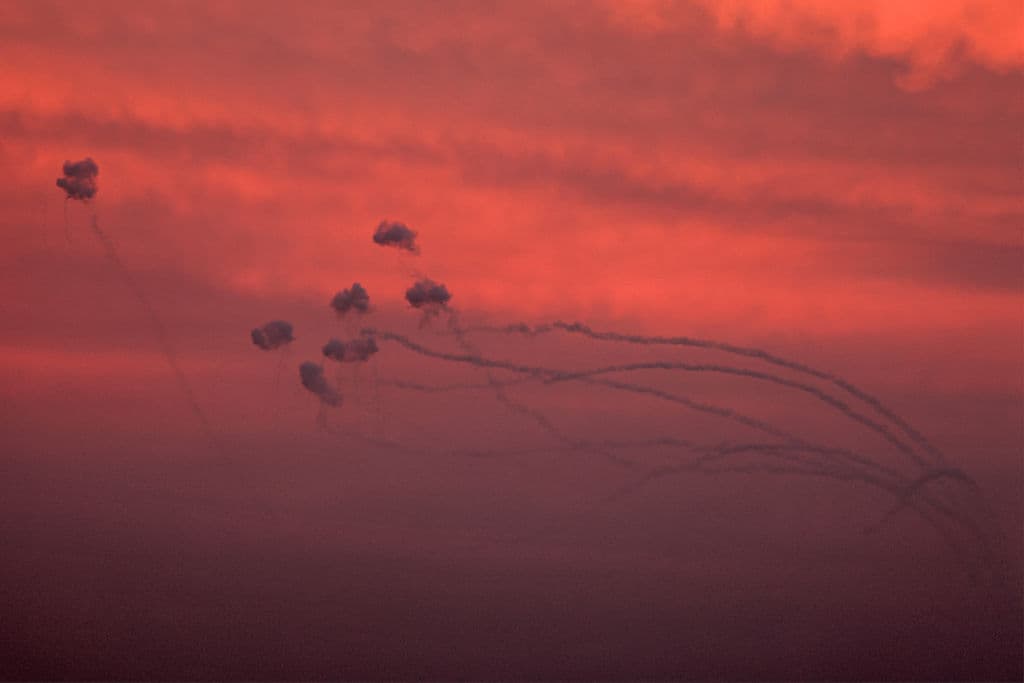
Israel’s Iron Dome missile defence system intercepts a salvo of missiles (SAID KHATIB / AFP) (Photo by SAID

Published: 15 April 2024

Last updated: 16 April 2024

Sunday's attack on Israel by Iran involved 185 drones, 36 cruise missiles and 110 surface-to-surface missiles, according to leaked Israel reports to the New York Times. Most came from the Iranian mainland with a few fired by proxies in Iraq and Yemen. Israel, in conjunction with the armed forces of the US, UK, France and Jordan, defended itself by employing the home-made Iron Dome and David's Sling as well as the American manufactured Arrow system to shoot down the ayatollahs' lethal visitors.

This followed an attack a couple of weeks ago, on a building in Damascus, situated between the Iranian and Canadian Embassies. Key Iranian commanders, General Mohammed Reza Zahedi and his deputy were killed, along with their staff. Both had been heavily involved in providing arms to Hezbollah — and almost certainly smuggling arms and expertise to Hamas operatives in Gaza over many years.

Zahedi was a commander with the al-Quds Force of the Revolutionary Guards in Lebanon. He was only brought back to Syria in December because the experienced Revolutionary Guards commander, Sayyed Razi Mousavi, had similarly been killed — and this in turn followed the assassination of the legendary al-Quds Force leader, Qasem Soleimani, by the Americans in 2000.

So the elimination of pivotal Iranian military figures is not a new occurrence. After all, the Director of Iran's nuclear program, Professor Mohsen Fakhrizadeh, was killed in an ambush in 2020 — almost certainly instigated by Israel.

According to the Israeli media, the killing of Zahedi on April 1 would have involved “the whole chain of (Israeli) authorisation to decide to attack”. Did the Iranian response of a calibrated but mass attack from Iranian soil therefore catch Israel by surprise? Did a reckless Netanyahu miscalculate once again?

Appearances can be misleading. Netanyahu's guiding mantra has always been encapsulated in the term, “reciprocity”. He utilised this to thwart the Oslo peace process after he became prime minister for the first time in 1996. Iran, too, mustered all the Palestinian rejectionists, including Hamas, at that time to snuff out any reconciliation between Israelis and Palestinians. For his part, Netanyahu then propagated a wave of accusations against the Palestinian Authority. The trust built by Yitzhak Rabin and Yasser Arafat was thrown to the winds.

Even so, Netanyahu could point to Tractate Sanhedrin in the Babylonian Talmud: “If someone comes to kill you, rise up and kill him first”. After all, Israel did not wait to be overwhelmed by the Egyptian army during the Six Day War in June 1967 but attacked first and comprehensively destroyed Nasser's air force on the ground.

Netanyahu, wrapped in the robe of “total victory” in Gaza, however, does not possess Ben-Gurion's sense of the political and military reality or Peres's understanding of subtle diplomacy.

Iran's explanation for its mass attack on Israel was that Israel had attacked “Iranian territory” in Damascus rather than its military commanders in Syria and Lebanon. But its angst is more likely linked to Tehran's desire to maintain its standing in the developing world — and in particular to replace the United States in the Global South in Africa and Latin America.

It has previously operated through its proxies and stood on the sidelines during the tortuous Gaza conflict and let others do the fighting. Now the losses clearly outweigh the gains with regard to this backroom approach and Iran has had to come into the open to bolster its faltering position and to restore its understanding of deterrence.

In August 2021, Ebrahim Raisi became President of Iran and adopted a much lower profile than  his predecessors. However, he had followed a murderous path during the 1980s, when he ruthlessly liquidated thousands of opponents of the Islamic regime in the service of Ayatollah Khomeini.

Iran's angst is more likely linked to Tehran's desire to replace the United States in the Global South in Africa and Latin America.

One of Raisi's prerogatives on coming to power was to cement the Global South into a pro-Iranian outlook. It thus cultivated existing ties with major players in the developing world such as South Africa. Since the very early days of the struggle against apartheid, there was contact between the African National Congress (ANC) and the ayatollahs of Tehran.

Opposing apartheid was a cause espoused not only by pro-Western liberals who believed in human rights and the rule of law, but also by the far Left. The ANC described itself as “an international movement to liberate humanity from the bondage of imperialism and neo-colonialism” in a statement in October 2015. Elements within the ANC had few qualms, therefore, in cooperating with Iran.

Even so, Iran was sufficiently content to sell oil to the apartheid regime in South Africa in 1985. In return, Iran received South African arms to fight Saddam Hussein's forces during the decade long Iran-Iraq war. The infamous anti-racism Conference in Durban in 2001 saw Iran pulling the strings in promoting a “Zionism is Racism” resolution, downgrading the uniqueness of the Shoah and using incendiary language, designed to hammer in the final nails into the coffin of the Oslo Accords.

The South African press has been rife with suspicion that South Africa's accusation of Israel of genocide is linked to Iran bailing out a cash-strapped ANC.

As the ANC distanced itself from Mandela's conduct and plunged headlong into moral corruption, the historic ties with Iran were used to dilute opposition to Tehran's nuclear progress. The ANC became a byword for mismanagement, incompetence and bankruptcy.

Tehran paid the bills in a country where the poverty rate was 63% in 2022. Three years earlier, Mohammedreza Karbasi, an official of the Iranian Chamber of Commerce, estimated that Tehran's foreign direct investment in South Africa amounted to more than $US135 billion.

The South African press in recent weeks has been rife with suspicion that South Africa's abrupt volte-face towards the Jewish state in recent times and its prominence in accusing Israel of genocide in Gaza at the International Court of Justice in the Hague is linked to Iran bailing out a cash-strapped ANC. It is likely to lose heavily in the South African election at the end of next month.

Similarly, Nicaragua has called on the International Court of Justice to halt German military and other aid to Israel, arguing that Berlin's support was enabling acts of genocide and breaches of international humanitarian law. Authoritarian regimes in Latin America, such as Venezuela and Colombia, have also supported this approach and they, too, have close ties with Teheran. All this came ironically at the same time when Argentina's Court of Cassation has deemed Iran and Hezbollah responsible for the bombing of the AMIA headquarters of the Jewish Community in Argentina in July 1994.

Israel has said that it will retaliate for Iran's attack, but what this means in reality is anyone's guess. If Netanyahu dons his Likud warrior clothing and launches a belligerent or full-frontal assault, he risks opening a new front with no obvious exit strategy. It is to be hoped that wiser military heads will prevail, as Israel’s friends from the US have been advising. If he takes stock and looks at the longer term, a clever management of the crisis could eventually deflate Iran's bid for influence in the Global South and see the ayatollahs and their acolytes returned to their medieval cave to reside in splendid isolation.

RELATED ANALYSIS

How will Israel respond to Iran’s attack and could it cope with a war? (Bethan McKernan, Guardian)
A red line has been crossed from an Israeli security standpoint but none of the options for retaliation are without risk

A pivotal moment on Iran — but also on Gaza (Dan Perry, Forward)
Calls are mounting for a rethink of the war on Hamas. Could the attack from Iran provide an opportunity?

Fending off Iran attack is a major Israeli achievement. Retaliation would risk an all-out regional war (Amos Harel, Haaretz)
Biden is pressuring Netanyahu to avoid a retaliatory airstrike in Iran, urging him to instead focus on the successful interception of drones and rockets. If Netanyahu does not abide, Hezbollah will unleash its forces and join the war - just as Sinwar has been aiming for since Oct. 7

After Iran’s drone attack on Israel, the world must act: this is a crisis that threatens us all (Simon Tisdall, Guardian)
Netanyahu wanted a wider conflict, and Tehran has walked into his trap. The major powers must immediately head this off

Biden's 'Don't' message is now directed at Israel (Alon Pinkas, Haaretz) 
Even after Tehran's direct attack, for the United States, preventing an escalation between Israel and Iran is still the name of the game. Despite what Benjamin Netanyahu may hope, Washington has no intention of being dragged into a war in the Middle East

A Middle East defence alliance is as vital for Israel as the air we breathe (Tal Schneider, Times of Israel)
It’s time for Israel to face reality: If it weren’t for our regional partners including Jordan, the country would look completely different this morning

You might also like
  • Terror plot to kill hundreds of Arab Israelis thwarted
    Ben Lynfield
  • Joni Fleischer: Connecting charities with tech talent
    Gideon Cohen
  • Stalemate likely in Israel’s election: latest polls
    Shahar Burla
logomark.67a07ee3
We believe in the free flow of information

Republish our articles for free, online or in print, by using our Creative Commons licence

You might also like

    Passengers From Diverted Flydubai Flight To Arrive In Israel
    FeatureIsrael

    How ‘jihadist terror attack’ was averted on Israel-bound flight

    Tomer Almagor 2
    Oded, one of five protaganists, in the film Rising: Voices of Hope and Protest speaks into a public address system and raises his arm in protest.
    Israel Votes 2026OpinionIsrael

    The leadership a wounded society needs

    Esther Takac 2
    IOct 7 anniversary
    Israel Hamas WarEditorialIsrael

    Three years after Oct 7: an anniversary of reckoning

    The Jewish Independent

About the author

Colin Shindler

Colin Shindler

Colin Shindler is an emeritus professor of Israel Studies at SOAS, University of London. He is the author of several books about Israel: the latest "A Forever War: Israel, Palestine and the Struggles for Statehood" was published in 2026.

More from the author

AnalysisWorld

New evidence points to Iranian responsibility for Diaspora antisemitic attacks

AnalysisWorld

UK’s dramatic policy change on Israel-Palestine

AnalysisWorld

Diaspora leadership must be candid about its disillusion with Netanyahu

AnalysisWorld

Burnham and Miliband will have trust issues with future Israeli government