Aa
  • Read, Watch, Listen
  • TJI Series
  • Community Action
  • Events
  • Zedi
Follow us and continue the conversation
  • LinkedIn
  • Instagram
  • FaceBook
  • X
  • YouTube
Test yourself with the TJI Quiz!

Adjust size of text

Aa

Follow us and continue the conversation

  • LinkedIn
  • Instagram
  • FaceBook
  • X
  • YouTube

Your saved articles

You haven't saved any articles

What are you looking for?

Original reporting, insightful analysis and diverse views, delivered straight to your inbox

  • LinkedIn
  • Instagram
  • FaceBook
  • X
  • YouTube
Your support fuels our mission to inform, entertain and inspire.

The Jewish Independent is bound by the Standards of Practice of the Australian Press Council. If you believe the Standards may have been breached, you may approach The Jewish Independent or make a complaint to the Australian Press Council in writing at www.presscouncil.org.au. The Council may also be contacted on 1800 025 712.

  • Our Story
  • Contact us
  • Our Team
  • Support us
  • Guidelines
  • Pitch your idea
  • Republishing us
  • Community Action
  • Our Awards
  • LinkedIn
  • Instagram
  • FaceBook
  • X
  • YouTube
Aboriginal FlagTorres Strait Islanders Flag

The Jewish Independent acknowledges Aboriginal and Torres Strait Islander peoples as the Traditional Owners and Custodians of Country throughout Australia. We pay our respects to Elders past and present, and strive to honour their rich history of storytelling in our work and mission.

© The Jewish Independent 2026All Rights Reserved
Website design and development by Your Creative, MelbourneTerms & ConditionsPrivacy Policy
HomeRead, Watch, ListenIsrael
PeacebuildingFeatureIsrael

How training Israeli and Palestinian nurses can help bring peace

Project Rozana has received $US2.35 million from the US Government for a landmark program that uses nurses as ambassadors for peace.
Deborah Stone
Print this
nursetraining rozana

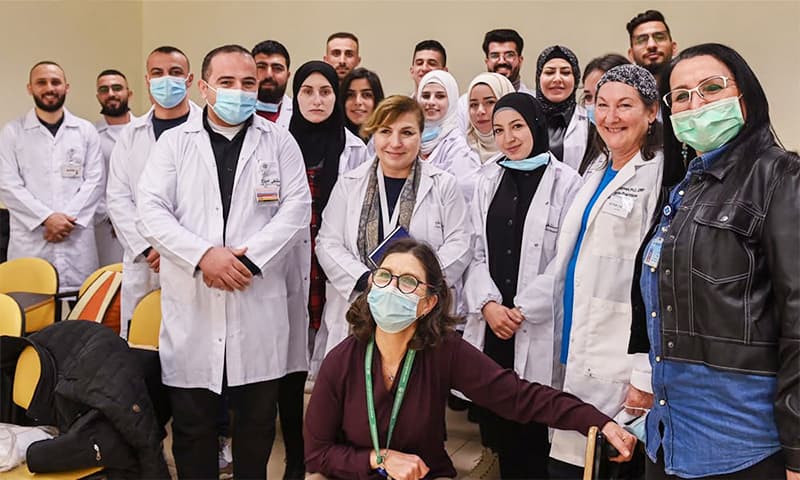
A nurse training group of Palestinians and Israelis (Rozana)

Published: 7 October 2022

Last updated: 9 May 2025

The average nurse cares for 100 patients a year. In a 40-year career that’s 4000 patients, not counting her family, friendship and community connections.

She – it is usually she – is highly respected, well-integrated in her community and has remarkable potential for positive impact.

Train 480 Israeli and Palestinian nurses together, teaching them peacebuilding as well as clinical skills, and you have the potential to touch hundreds of thousands of people with a greater understanding of co-existence and mutual wellbeing.

That’s the arithmetic of peace behind a new peacebuilding program for nurse training that has just received a $US2.35 million ($A3.63 million) grant from the Middle East Partnership for Peace Act (MEPPA) through USAID.

The Palestinian-Israeli Specialist Nursing Hub will train 16 cohorts of 30 Palestinian and Israeli nurses at eight hospitals on both sides of the border, providing them with both clinical training and specialist relationship and peacebuilding skills.

A twinning program will form the basis of a Peacebuilding and Professional Nursing Hub that facilitates peacebuilding seminars, collective activities, medical language training, and real-time consultations, and ongoing case-sharing between the nurses.

The three-year program will contribute to closing nursing gaps in the Palestinian health system. Palestinian and Israeli nurses will also conduct joint research and receive training to train other nurses in “Positive Peace” workshops.


"Whatever is going on at a macro level, there are some really significant steps at a human level which can make a difference.”

Ron Finkel, founder Project Rozana

The peacebuilding element of the training will be based on systems developed by the Institute for Economics and Peace, an Australian-based think tank which develops frameworks for building and measuring peace.

Founder and Chair of Project Rozana Ron Finkel said the MEPPA grant was a huge vote of confidence in the work of Project Rozana.

“USAID is to development what the FDA (Federal Drug Administration) is to drugs. It’s the standard bearer. If you get the positive tick from them, it’s a strong message that what you are doing is important.”

The program is based on a pilot which Project Rozana ran training for 170 Palestinian nurses from Augusta Victoria Hospital (AVH) in East Jerusalem and Israeli nurses from Hadassah Hospital in West Jerusalem together.

Finkel said nurses were ideal vehicles for peacebuilding because of their potential for impact on their communities.

“We see nurses as a beachhead because of their importance in the community. The nurses become ambassadors for peace, not only in terms of the direct relationships that are developed but on the communities these nurses are part of. Anybody in the Palestinian community who has direct experience with Israelis, getting to know them passes that message on to others and that has a lot of potential to do good. The multiplier effect is very significant.”

Finkel said at a time when the peace process on a political level has stalled, grassroots peacebuilding could keep the belief in peace alive.

“I like to think we are lighting a light. Whatever is going on at a macro level, there are some really significant steps at a human level which can make a difference.”

The project has the support of high-profile figures within both the political and nursing worlds.

Former Obama Israeli-Palestinian envoy, Ambassador Martin Indyk, a member of the Project Rozana Advisory Council, said the announcement was a “powerful endorsement of Project Rozana’s peacebuilding efforts.

“These USAID funds are being deployed to strengthen essential, broad-based people-to-people engagements. This helps lay the foundation for sustainable peace-making,” he said.

Professor Dame Anne Marie Rafferty, Chair of the Project Rozana Nurses Committee, and immediate past president of the UK Royal College of Nursing, emphasised the capacity of nurses to influence their communities.

“Nurses are at the forefront of building health capacity globally. Doing it in a context where there is the added benefit of strengthening cross-border professional relationships, as planned by Project Rozana, is a significant bonus. Nurses are highly respected in their communities and positive influencers.”

RELATED STORY

Building Bridges between East and West Jerusalem through medicine (The Jewish Independent)

Photo: Palestinian nurses from Augusta Victoria Hospital, East Jerusalem, receiving specialist nursing training at Hadassah Hospital, Israel, as part of a pilot program on which the USAID funded Palestinian-Israeli Specialist Nursing Hub project is based (supplied)

You might also like
  • ‘Israel is systemically eliminating Palestinian collective life’:  B’Tselem
    Deborah Stone
  • Tame apologises – but with little grace
    Deborah Stone
  • Confronting Richard Flanagan and the myth of the Israel lobby
    Mary Garden
logomark.67a07ee3
We believe in the free flow of information

Republish our articles for free, online or in print, by using our Creative Commons licence

You might also like

    altalena
    Israel Votes 2026OpinionIsrael

    The Altalena should be a warning, not a political weapon

    Shahar Burla 1
    Rozana Beit Oula
    PeacebuildingOpinionIsrael

    Peacebuilding through the eyes of a sceptic

    Ron Finkel
    ISRAEL-LGBTQ-PRIDE-PARADE-PALESTINIAN-CONFLICT-HOSTAGES
    NewsIsrael

    LGBT asylum seekers caught between Palestinian violence and Israeli bureaucracy

    Jarod Rhine-Davis

About the author

Deborah Stone

Deborah Stone

Deborah Stone is Editor-in-Chief of TJI. She has more than 30 years experience as a journalist and editor, including as a reporter and feature writer on The Age and The Sunday Age, as Editor of the Australian Jewish News and as Editor of ArtsHub.

More from the author

NewsIsrael

‘Israel is systemically eliminating Palestinian collective life’:  B’Tselem

Australia

Tame apologises – but with little grace

NewsAustralia

Australia to increase sanctions against West Bank settlements

NewsAustralia

Humanitarian organisations fail on antisemitism: new research