Aa
  • Read, Watch, Listen
  • TJI Series
  • Community Action
  • Events
  • Zedi
Follow us and continue the conversation
  • LinkedIn
  • Instagram
  • FaceBook
  • X
  • YouTube
Test yourself with the TJI Quiz!

Adjust size of text

Aa

Follow us and continue the conversation

  • LinkedIn
  • Instagram
  • FaceBook
  • X
  • YouTube

Your saved articles

You haven't saved any articles

What are you looking for?

Original reporting, insightful analysis and diverse views, delivered straight to your inbox

  • LinkedIn
  • Instagram
  • FaceBook
  • X
  • YouTube
Your support fuels our mission to inform, entertain and inspire.

The Jewish Independent is bound by the Standards of Practice of the Australian Press Council. If you believe the Standards may have been breached, you may approach The Jewish Independent or make a complaint to the Australian Press Council in writing at www.presscouncil.org.au. The Council may also be contacted on 1800 025 712.

  • Our Story
  • Contact us
  • Our Team
  • Support us
  • Guidelines
  • Pitch your idea
  • Republishing us
  • Community Action
  • Our Awards
  • LinkedIn
  • Instagram
  • FaceBook
  • X
  • YouTube
Aboriginal FlagTorres Strait Islanders Flag

The Jewish Independent acknowledges Aboriginal and Torres Strait Islander peoples as the Traditional Owners and Custodians of Country throughout Australia. We pay our respects to Elders past and present, and strive to honour their rich history of storytelling in our work and mission.

© The Jewish Independent 2026All Rights Reserved
Website design and development by Your Creative, MelbourneTerms & ConditionsPrivacy Policy
HomeRead, Watch, ListenIsrael
Israel

Building Bridges between East and West Jerusalem through medicine

Ittay Flescher
Print this

Published: 15 July 2022

Last updated: 5 March 2024

Project Rozana has launched two new health programs to fill the gaps in the Palestinian health system and share knowledge between Israelis and Palestinians

Much of the focus of the Israeli media surrounding President Biden’s visit to the Augusta Victoria Hospital (AVH) in East Jerusalem this week surrounded the politics of a US President visiting a Palestinian Hospital unaccompanied by an Israeli official, challenging the status of Jerusalem as Israel’s undivided capital.

Yet something far more meaningful is happening that the hospital that will bear fruit long after the President jets off to Saudi Arabia. At the visit, the US government pledged $100 million to the East Jerusalem Hospital Network which aims to build the capacity of the Palestinian health system.

With less fanfare but considerable on-ground impact, Project Rozana this week launched a nurses’ training program at AVH and a women’s health program in remote villages in the West Bank, working with Hadassah and Sheba to cultivate trust between Israelis and Palestinians.

The new initiative in Jerusalem focuses on cultivating peaceful coexistence between Israelis and Palestinians while bridging critical healthcare delivery gaps in the nursing field. While Palestinians make up 38% of Jerusalem’s residents, only 5% have Israeli citizenship. Palestinian-dominated East Jerusalem has inferior health care and infrastructure compared to West Jerusalem.

“Enabling Palestinians to provide healthcare in their remote communities lays the groundwork for an empowered people"

Ronit Zimmer, Executive Direct, Project Rozana

The new program provides an opportunity for nurses from Augusta Victoria Hospital in East Jerusalem, to receive hospital-based training in specialty and sub-specialty fields including Nephrology and Dialysis, Oncology, Geriatric and Critical Care, delivered by Hadassah Medical Center's world-renowned nursing school which is located in West Jerusalem.

The comprehensive program was developed to fill skills gaps at Augusta Victoria Hospital and the Palestinian nursing sector in general, and to respond to patient distribution and needs.
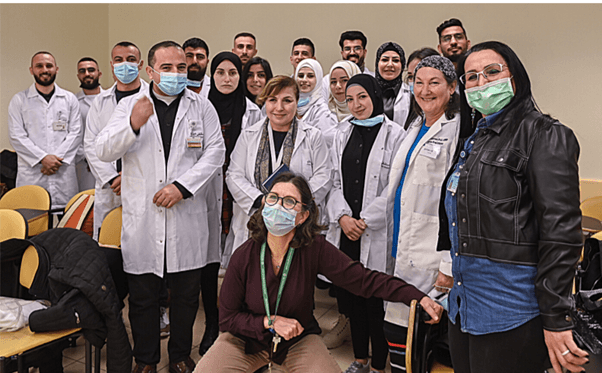
Palestinian Nurse Faten, who is a participant in the program, said in an interview at the Hadassah oncology ward, that being part of the initiative would broaden her knowledge of how other hospitals functioned.

 “[It} allows me to deal with other hospitals, to know what their strategies and policies are and see the difference between Hadassah and our hospital (Augusta Victoria) and to know what are the new things that we can add to our hospital, to give more to our patients with leukemia.”

The first in-person training session held at Hadassah Medical Center on March 10, 2022 (supplied)

It is hoped that building the capacity of nurses working in AVH's departments will improve the quality of nursing services at AVH while enabling nurses from both sides to engage with patients on the 'other side'.

Project Rozana also launched a new women’s telehealth program at Sheba Medical Center in early July. This program is designed to reduce the mortality rate of babies born in Gaza and the West Bank due to complications that may arise from inadequate medical core, overstretched healthcare facilities, poverty and a lack of access to nutritious food, as well as the impact of the ongoing conflict.

“Enabling Palestinians to provide healthcare in their remote communities lays the groundwork for an empowered people,” said Ronit Zimmer, Executive Director of Project Rozana. “The training at Sheba will enable local healthcare workers to operate virtual clinics in remote areas, eliminating many logistical, bureaucratic, and security obstacles for rural residents seeking quality healthcare.”

Project Rozana chose to implement the Women’s Health Initiative with Sheba, building on its world leading Femtech platform OB-GYN Remote. Under the Sheba Medical Center’s OB-GYN Beyond initiative, Palestinian healthcare workers were trained to use telehealth technologies that will enable them to remotely monitor the health of both the mothers and their foetuses.

They will be using technology from the Netanya based HeraMED company, which was recently floated on the Australian Stock Exchange (ASX:HMD) and is currently in a long term agreement with the Joondalup Health Campus in Western Australia to offer its HeraCARE pregnancy monitoring solution to expectant mothers.

Photo: Palestinian healthcare workers are trained in remote care for pregnant women at Sheba Medical Center (supplied)  

You might also like
  • ‘Israel is systemically eliminating Palestinian collective life’:  B’Tselem
    Deborah Stone
  • Tame apologises – but with little grace
    Deborah Stone
  • Confronting Richard Flanagan and the myth of the Israel lobby
    Mary Garden
logomark.67a07ee3
We believe in the free flow of information

Republish our articles for free, online or in print, by using our Creative Commons licence

You might also like

    Erdogan Turkey
    AnalysisIsrael

    Turkey emerges as military threat to Israel

    Dror Doron
    Segalovitz Abbas
    Israel Votes 2026AnalysisIsrael

    Segalovitz decision to join Arab party is a paradigm change for Israel

    Eetta Prince-Gibson
    altalena
    Israel Votes 2026OpinionIsrael

    The Altalena should be a warning, not a political weapon

    Shahar Burla 1

About the author

Ittay Flescher

Ittay Flescher

Ittay Flescher is the Jerusalem Correspondent for The Jewish Independent. For over twenty years, he has worked as an educator, journalist, and peacebuilder in Melbourne and Jerusalem. His book, The Holy and the Broken: A Cry for Israeli-Palestinian Peace from a Land that Must Be Shared, was longlisted for the 2025 Walkley Book Awards.

More from the author

AnalysisIsrael

What ‘Zionism’ means in Israel:  it’s not what you think

AnalysisIsrael

From haven to hotbed: how Israel’s perception of Australia has changed

FeatureIsrael

New wave of Russian-speaking migrants may be key to Israel’s future

AnalysisIsrael

How a new International Peace Fund could make a tangible difference