Aa
  • Read, Watch, Listen
  • TJI Series
  • Community Action
  • Events
  • Zedi
Follow us and continue the conversation
  • LinkedIn
  • Instagram
  • FaceBook
  • X
  • YouTube
Test yourself with the TJI Quiz!

Adjust size of text

Aa

Follow us and continue the conversation

  • LinkedIn
  • Instagram
  • FaceBook
  • X
  • YouTube

Your saved articles

You haven't saved any articles

What are you looking for?

Original reporting, insightful analysis and diverse views, delivered straight to your inbox

  • LinkedIn
  • Instagram
  • FaceBook
  • X
  • YouTube
Your support fuels our mission to inform, entertain and inspire.

The Jewish Independent is bound by the Standards of Practice of the Australian Press Council. If you believe the Standards may have been breached, you may approach The Jewish Independent or make a complaint to the Australian Press Council in writing at www.presscouncil.org.au. The Council may also be contacted on 1800 025 712.

  • Our Story
  • Contact us
  • Our Team
  • Support us
  • Guidelines
  • Pitch your idea
  • Republishing us
  • Community Action
  • Our Awards
  • LinkedIn
  • Instagram
  • FaceBook
  • X
  • YouTube
Aboriginal FlagTorres Strait Islanders Flag

The Jewish Independent acknowledges Aboriginal and Torres Strait Islander peoples as the Traditional Owners and Custodians of Country throughout Australia. We pay our respects to Elders past and present, and strive to honour their rich history of storytelling in our work and mission.

© The Jewish Independent 2026All Rights Reserved
Website design and development by Your Creative, MelbourneTerms & ConditionsPrivacy Policy
HomeRead, Watch, ListenIsrael
ExplainerIsrael

Israel weighs West Bank annexation in retaliation for Palestine recognition

It flouts international law and security recommendations, but Israel's government is seriously considering annexing the West Bank. Here's what you need to know.
TJI Wrap
Print this
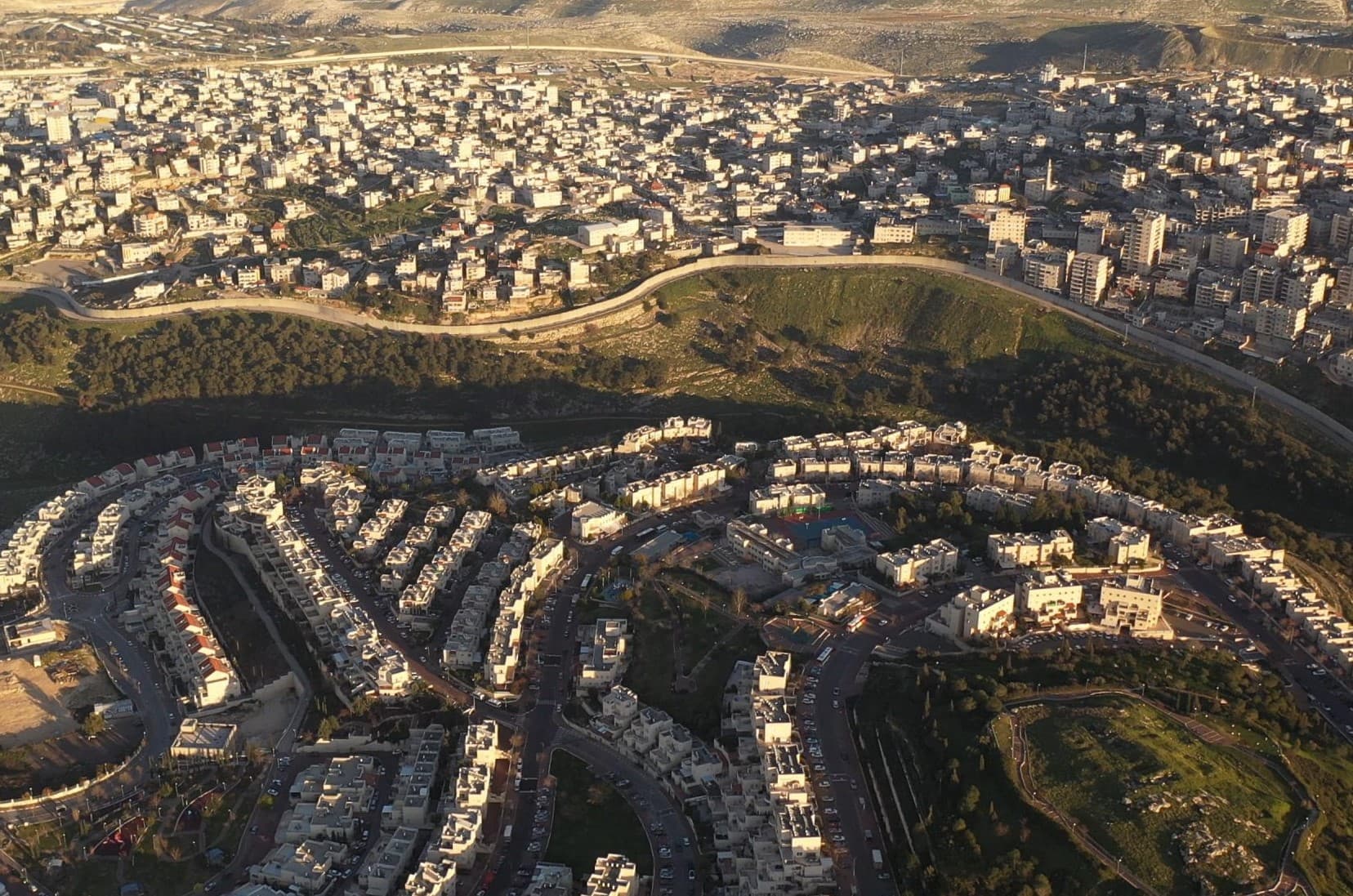
The security barrier dividing the Jewish neighborhood of Pisgat Ze’ev in East Jerusalem from the Palestinian village of Anata in the West Bank

West Bank annexation would destroy the legal division marked by the security barrier, seen here dividing the Jewish neighborhood of Pisgat Ze’ev in East Jerusalem from the Palestinian village of Anata in the West Bank (Israel Policy Forum)

Published: 4 September 2025

Last updated: 4 September 2025

The Israeli government is considering annexing parts of the occupied West Bank in retaliation for the imminent recognition of Palestine by several Western countries at the UN General Assembly in late September. Israel’s security cabinet briefly discussed potential annexation on Sunday during a six-hour session that focused mainly on plans for a major offensive in Gaza City. At a meeting in Washington last week, Foreign Minister Gideon Saar also updated US Secretary of State Marco Rubio on the government’s intentions.

Israel’s top security officials are resisting annexation efforts. Security sources told Al-Monitor that Mossad chief David Barnea has warned the government that, after two years of war that have devastated Gaza, annexation would further erode Israel’s international standing. Other senior officials cautioned the move could spark widespread unrest across the Middle East, including violent protests in Arab states that could destabilise regimes friendly to Israel.

An illegal move

Annexing any part of the occupied West Bank by applying Israeli sovereignty would breach multiple UN Security Council resolutions and provoke an enormous diplomatic backlash. Israeli settlements in the West Bank are considered illegal under international law. The United Nations reinforced that designation in 2016 with Security Council Resolution 2334, which declared that Jewish settlements in occupied territory are a “flagrant violation” of international law and have “no legal validity”.
The US position

The decision on annexation may ultimately hinge on US President Donald Trump. In 2020, he appeared open to limited annexation but quickly withdrew his support. Although the Trump administration has not yet taken an official stance on the current initiative, it appears closely coordinated with Israel in efforts to block recognition of a Palestinian state.

According to diplomatic sources who spoke with Al-Monitor, Secretary of State Rubio, in his recent meeting with Foreign Minister Saar, did not object to the Israeli government’s plans. Netanyahu’s close confidant, Strategic Affairs Minister Ron Dermer, a leading force behind the initiative, has mobilised support among pro-Israel figures within the administration. Nonetheless, strong public protests against annexation from Washington’s Gulf partners, particularly Saudi Arabia, would likely dampen enthusiasm within the administration for such a move.

Why now?

Plans to annex all or parts of the West Bank have surfaced many times over the years but have never materialised, largely due to strong domestic and international resistance — including from Prime Minister Benjamin Netanyahu himself. Yet the current drive for annexation, led by Ron Dermer and members of Israel’s most right-wing government in history, combined with moves by several European and other states to recognise a Palestinian state at the UN General Assembly in late September, may now push Netanyahu to act.

“In the past, Netanyahu would have blocked such [annexation] initiatives,” a minister in the prime minister’s Likud party told Al-Monitor on condition of anonymity. “He would have distanced himself and the state [of Israel] from such moves that risk turning Israel into an international pariah,” the source said, adding that the premier “has become more radical than even his most right-wing allies.”

“It’s a bit childish,” an Israeli diplomatic source told Al-Monitor on condition of anonymity. “The solution to this recognition initiative is not to prevent Abbas from coming [to New York], but to convince the initiating countries that such a move would be detrimental to the prospects of Israeli–Palestinian peace and would destabilise the region.”

What annexation could look like

Netanyahu is considering a phased and gradual annexation plan, starting with a selected territory Israeli official told CNN. A phased plan, the official added, would allow Israel to step back from full annexation in exchange for normalisation with Saudi Arabia.

A senior Israeli diplomatic official told Al-Monitor that two possible scenarios are being examined: applying Israeli sovereignty to roughly 130 settlements across the West Bank or annexing the Jordan Valley.

Annexation of the Jordan Valley is emerging as the most likely option. Israel had planned to annex the area in 2020 but abandoned the move to secure the Abraham Accords after opposition from the Arab states involved.

The Jordan Valley, which makes up about 30 per cent of the West Bank, enjoys relatively broad support in Israel because of its small Palestinian population and perceived strategic importance on the country’s eastern flank. Two officials said annexation of the Jordan Valley — a strip of land along the Jordan River — is one of the main options under consideration. They noted that presenting it as a security perimeter would make it easier to justify to the international community — and, crucially, to Washington.

However, Netanyahu’s far-right allies, including ministers Bezalel Smotrich and Itamar Ben Gvir as well as settler leaders, oppose partial annexation involving specific strips or settlement blocs. They are pressing for a maximalist approach: applying Israeli sovereignty over all territory not inhabited by Palestinians. Such a move would allow Israel to encircle Palestinian population centres, further undermining the viability of a contiguous Palestinian state.

Applying sovereignty to areas with Palestinian inhabitants could obligate Israel to grant citizenship or residency to the roughly three million Palestinians living in the West Bank.

UAE warns annexation is a ‘red line’

The United Arab Emirates has warned that any move to annex parts of the West Bank would cross a red line for Abu Dhabi and gravely undermine the Abraham Accords, which normalised ties between the two countries.

“From the outset, we saw the Accords as a means to continue supporting the Palestinian people and their legitimate aspiration for an independent state,” said Lana Nusseibeh, the UAE’s Assistant Minister for Political Affairs and Envoy of the Minister of Foreign Affairs.

“That was our stance in 2020, and it remains our stance today.” Her comments marked the UAE’s strongest rebuke of Israel’s conduct since the Gaza war began.

The Abraham Accords, brokered during Donald Trump’s first term as US president, brought Israel into formal diplomatic relations with the UAE, Bahrain and Morocco.

“We urge the Israeli government to halt these plans. Extremists of any kind must not be allowed to shape the region’s future. Peace demands courage, perseverance, and a determination not to let violence dictate our choices,” Nusseibeh said.

READ MORE

Israel weighs West Bank annexation over Western nations’ recognition of Palestinian state (Tal Shalev, CNN)

Netanyahu eyes West Bank annexation as Palestine recognition grows, Trump holds final say (Paywall, Al-Monitor)

UAE official warns Israel West Bank settlement plans cross 'red line' (Reuters)

Israeli forces arrest Hebron mayor, conduct raids across West Bank (Ynetnews)

Belgium to recognize Palestinian state at UN General Assembly, impose sanctions on Israel (Times of Israel)

You might also like
  • Israel election explainer: the main parties
    Shahar Burla
  • Sanctioning settlements is a defence of Israel, not an attack
    Elisheva Madar
  • Sanctions must influence, not just perform disapproval
    Adam Slonim
logomark.67a07ee3
We believe in the free flow of information

Republish our articles for free, online or in print, by using our Creative Commons licence

You might also like

    altalena
    Israel Votes 2026OpinionIsrael

    The Altalena should be a warning, not a political weapon

    Shahar Burla 1
    haredi street guitar
    Photo EssayArts & Culture

    Jerusalemites through the lens

    Sharon Gabay
    Erdogan Turkey
    AnalysisIsrael

    Turkey emerges as military threat to Israel

    Dror Doron

Comments

No comments on this article yet. Be the first to add your thoughts.

About the author

TJI Wrap

TJI Wrap

TJI wraps consolidate essential news and analysis from multiple sources into digestable summaries.

More from the author

NewsAustralia

War crimes allegations against Australian IDF soldier

NewsWorld

Wave of attacks on Jewish sites sparks international alarm

AnalysisIsrael

Gaza, Lebanon, Syria, Iran: Israel’s tense security landscape

AnalysisIsrael

Middle East on edge as Iran and Israel inch closer to another war