Aa
  • Read, Watch, Listen
  • TJI Series
  • Community Action
  • Events
  • Zedi
Follow us and continue the conversation
  • LinkedIn
  • Instagram
  • FaceBook
  • X
  • YouTube
Test yourself with the TJI Quiz!

Adjust size of text

Aa

Follow us and continue the conversation

  • LinkedIn
  • Instagram
  • FaceBook
  • X
  • YouTube

Your saved articles

You haven't saved any articles

What are you looking for?

Original reporting, insightful analysis and diverse views, delivered straight to your inbox

  • LinkedIn
  • Instagram
  • FaceBook
  • X
  • YouTube
Your support fuels our mission to inform, entertain and inspire.

The Jewish Independent is bound by the Standards of Practice of the Australian Press Council. If you believe the Standards may have been breached, you may approach The Jewish Independent or make a complaint to the Australian Press Council in writing at www.presscouncil.org.au. The Council may also be contacted on 1800 025 712.

  • Our Story
  • Contact us
  • Our Team
  • Support us
  • Guidelines
  • Pitch your idea
  • Republishing us
  • Community Action
  • Our Awards
  • LinkedIn
  • Instagram
  • FaceBook
  • X
  • YouTube
Aboriginal FlagTorres Strait Islanders Flag

The Jewish Independent acknowledges Aboriginal and Torres Strait Islander peoples as the Traditional Owners and Custodians of Country throughout Australia. We pay our respects to Elders past and present, and strive to honour their rich history of storytelling in our work and mission.

© The Jewish Independent 2026All Rights Reserved
Website design and development by Your Creative, MelbourneTerms & ConditionsPrivacy Policy
HomeRead, Watch, ListenIsrael
Israel Votes 2026ExplainerIsrael

Stalemate likely in Israel’s election: latest polls

With only three weeks to go, anxiety is growing among change bloc voters with no clear path to an alternative government
Shahar Burla
Print this
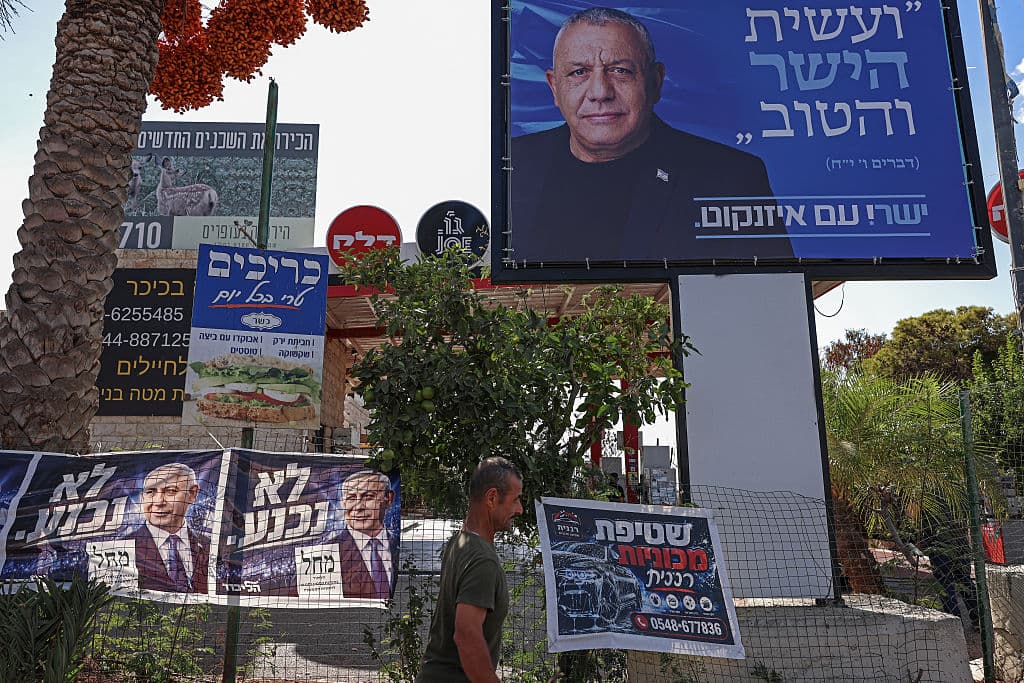
Israel election posters

Competing campaign posters ahead of Israel’s election on October 27 (Zain Jaafar/AFP via Getty Images)

Published: 7 October 2026

Last updated: 7 October 2026

Israel’s latest polls are producing an increasingly uncomfortable picture for voters hoping to replace Benjamin Netanyahu: the change bloc may be competitive with the prime minister’s camp, but it still has no clear path to a majority government without relying on Arab parties.

That arithmetic is beginning to translate into anxiety. A new survey conducted by political consultant Yossi Tatika and published by Zman Israel found 73 per cent of opposition voters were “very worried” about the emerging election result, with another 15 per cent somewhat worried. Among coalition voters, 48 per cent were very worried and 21.5 per cent somewhat worried.

The concern reflects a striking feature of recent polling. Netanyahu’s bloc and the change bloc remain relatively close, but neither approaches the 61 seats required to govern alone. Meanwhile, the Joint List and Ra’am together command around 13 seats, while the new alliance between Yoaz Hendel and economist Yaron Zelekha is hovering around the electoral threshold and could hold another four.

For the change bloc, the problem is political as much as mathematical. Several of its leaders have ruled out forming a coalition with either Ra’am or the Joint List. Unless those positions change, even a clear electoral defeat for Netanyahu may not automatically produce a stable alternative government.

Increasingly, therefore, the most plausible route to removing Netanyahu may not be a conventional majority coalition at all. It could be a temporary minority government, supported or tolerated from outside by Arab parties, with a limited agenda: replace Netanyahu, establish a state commission of inquiry into the failures surrounding October 7, pass a new conscription law and then attempt to broaden the coalition.

No workable coalition

On paper, parties opposed to Netanyahu therefore hold a comfortable parliamentary majority. In practice, however, they do not constitute a single coalition.

A Kan public broadcaster poll published on Sunday put Gadi Eisenkot’s Yashar on 23 seats, ahead of Netanyahu’s Likud on 21. B’Yachad, led by former prime ministers Naftali Bennett and Yair Lapid, received just 12 seats, while Avigdor Liberman’s Yisrael Beytenu was projected to win nine and The Democrats eight.

Otzma Yehudit, Shas, United Torah Judaism and the Joint List were each projected to win eight seats. Religious Zionism received six, Ra’am five, and the Hendel-Zelekha alliance four. Ofer Winter’s People of Israel failed to cross the electoral threshold.

That result would leave Netanyahu’s bloc on only 51 seats and the Change bloc on 52. The Arab parties would hold 13 seats and Hendel-Zelekha another four.

A Channel 12 poll published on Monday produced slightly different numbers but essentially the same political problem. It gave Eisenkot’s bloc 54 seats, Netanyahu’s bloc 49, the Arab parties 13 and Hendel-Zelekha four.

Yashar again emerged as the largest party with 23 seats, followed by Likud with 21 and B’Yachad with 13. Yisrael Beytenu remained on nine, while the Arab Joint List and United Torah Judaism received eight seats each.

With some change bloc parties refusing to govern with the Arab parties, Eisenkot remains well short of the 61 seats required for a conventional majority government.

That distinction, between an anti-Netanyahu majority and a viable governing majority, may become the defining issue of the rest of the campaign.

The Jewish Independent

Fewer voters are still available to persuade

Another complication is that Israelis may be making up their minds unusually early. Pollsters generally estimate that between 10 and 15 per cent of voters remain undecided until very late in an election campaign. In a 120-seat parliament, that potentially represents close to 20 seats, easily enough to transform the political landscape.

But this week’s Maariv polling contained a striking figure: only 6.4 per cent of respondents were undecided. If that figure holds, roughly half the electorate that would normally remain available for persuasion late in a campaign has already chosen a party.

That matters particularly for the change bloc. Its problem cannot simply be solved by assuming a late surge will deliver another seven or eight seats. With the available pool of undecided voters shrinking, coalition strategy becomes almost as important as campaigning.

It also helps explain the anxiety among opposition voters. Defeating Netanyahu in terms of seats is one thing. Constructing a government capable of replacing him is another.

A minority government may be the way out

This leaves a minority government as an increasingly conceivable post-election scenario. Under such an arrangement, Eisenkot could attempt to form a government without bringing the Arab parties formally into the coalition, while relying on them to abstain or provide outside support during the initial confidence votes and on key legislation.

Such a government would be inherently fragile, but it would not necessarily need to survive a full parliamentary term to achieve significant political objectives.

Its immediate agenda could be deliberately narrow: remove Netanyahu from the prime ministership, establish a state commission of inquiry into October 7, pass a conscription law and declare from the outset that the arrangement is transitional. Eisenkot could then attempt to expand the coalition.

One possibility would be to approach the ultra-Orthodox parties after a conscription law had already been enacted. The argument would effectively be: the law exists, you opposed it, but joining the government now would allow you to influence its implementation as well as future budgets.

The Jewish Independent

If those negotiations failed, Eisenkot could eventually call another election, this time as prime minister heading a transitional government rather than as an opposition leader challenging Netanyahu.

It would hardly be the stable majority government change bloc voters might hope for. But given the current numbers, it could become their most realistic route to power.

Arab parties signal they could provide outside support

There are already indications that the Joint List may be prepared to facilitate such an arrangement without joining the government.

Joint List chairman Yousef Jabareen said this week that his alliance could support legislation after the election preventing a person facing criminal charges from forming a government while remaining outside the coalition, Haaretz reports.

Asked whether the Joint List might support a minority government to replace Netanyahu and far-right ministers Itamar Ben-Gvir and Bezalel Smotrich, Jabareen left the possibility open.

“We want to be a safety net for the Arab public and for the democratic Jewish public,” he said, adding that the party would make what he described as a responsible decision after the election.

Jabareen specifically pointed to legislation preventing an indicted politician from forming a government as something the Joint List could support from outside.

Balad chairman Sami Abu Shehadeh went further in presenting Arab turnout as potentially decisive. “Netanyahu is afraid of the Arab vote. He is right. He should be afraid,” he told the campaign event.

That may ultimately be the paradox of this election. Change bloc leaders are campaigning on replacing Netanyahu while simultaneously ruling out some of the parliamentary votes that could make his replacement possible.

The latest polls suggest neither major bloc is close to governing alone. Unless there is a significant shift before election day, the question may therefore cease to be simply who wins the most seats. It will be who is prepared to use the complicated parliamentary majority that Israeli voters actually deliver.

You might also like
  • Arab party ban won’t hold but reveals a changed Israel
    Ben Lynfield
  • Netanyahu’s lightning UN visit reveals his growing isolation
    Shahar Burla
  • New evidence Netanyahu was warned about October 7
    Shahar Burla
logomark.67a07ee3
We believe in the free flow of information

Republish our articles for free, online or in print, by using our Creative Commons licence

You might also like

    Diaspora election
    Israel Votes 2026OpinionIsrael

    Diaspora Jews can’t vote, but Israel’s election result will affect them

    Vanina Vaisman-Levy
    IOct 7 anniversary
    Israel Hamas WarEditorialIsrael

    Three years after Oct 7: an anniversary of reckoning

    The Jewish Independent
    Israel Marks Anniversary Of Hamas October 7 Attacks
    OpinionIsrael

    Even on October 7, we are not united

    Ittay Flescher 1

About the author

Shahar Burla

Shahar Burla

Dr Shahar Burla is a Sydney-based researcher, lecturer and Contributing Editor of TJI. Shahar holds a Master’s degree in political science from Hebrew University and a PhD in political science from Bar-Ilan University. He is the author of Political Imagination in the Diaspora: The Construction of a Pro-Israeli Narrative (2013) and co-editor of Australia and Israel: A Diasporic, Cultural and Political Relationship (2015).

More from the author

FeatureIsrael

One year after the ceasefire, Gaza remains in ruins with no solution in sight

FeatureIsrael

Netanyahu’s lightning UN visit reveals his growing isolation

ExplainerIsrael

Israel election explainer: the main parties

FeatureIsrael

New evidence Netanyahu was warned about October 7