Aa
  • Read, Watch, Listen
  • TJI Series
  • Community Action
  • Events
  • Zedi
Follow us and continue the conversation
  • LinkedIn
  • Instagram
  • FaceBook
  • X
  • YouTube
Test yourself with the TJI Quiz!

Adjust size of text

Aa

Follow us and continue the conversation

  • LinkedIn
  • Instagram
  • FaceBook
  • X
  • YouTube

Your saved articles

You haven't saved any articles

What are you looking for?

Original reporting, insightful analysis and diverse views, delivered straight to your inbox

  • LinkedIn
  • Instagram
  • FaceBook
  • X
  • YouTube
Your support fuels our mission to inform, entertain and inspire.

The Jewish Independent is bound by the Standards of Practice of the Australian Press Council. If you believe the Standards may have been breached, you may approach The Jewish Independent or make a complaint to the Australian Press Council in writing at www.presscouncil.org.au. The Council may also be contacted on 1800 025 712.

  • Our Story
  • Contact us
  • Our Team
  • Support us
  • Guidelines
  • Pitch your idea
  • Republishing us
  • Community Action
  • Our Awards
  • LinkedIn
  • Instagram
  • FaceBook
  • X
  • YouTube
Aboriginal FlagTorres Strait Islanders Flag

The Jewish Independent acknowledges Aboriginal and Torres Strait Islander peoples as the Traditional Owners and Custodians of Country throughout Australia. We pay our respects to Elders past and present, and strive to honour their rich history of storytelling in our work and mission.

© The Jewish Independent 2026All Rights Reserved
Website design and development by Your Creative, MelbourneTerms & ConditionsPrivacy Policy
HomeRead, Watch, ListenIsrael
War in the northNewsIsrael

Israelis on war alert, Lebanese fleeing their homes

Israel has stopped short of declaring the country at war – so far – but hundreds were killed in Lebanon on Monday and Israelis in the north are living with constant rocket barrages from Hezbollah.
TJI Wrap
Print this
Smoke and missile trails over city

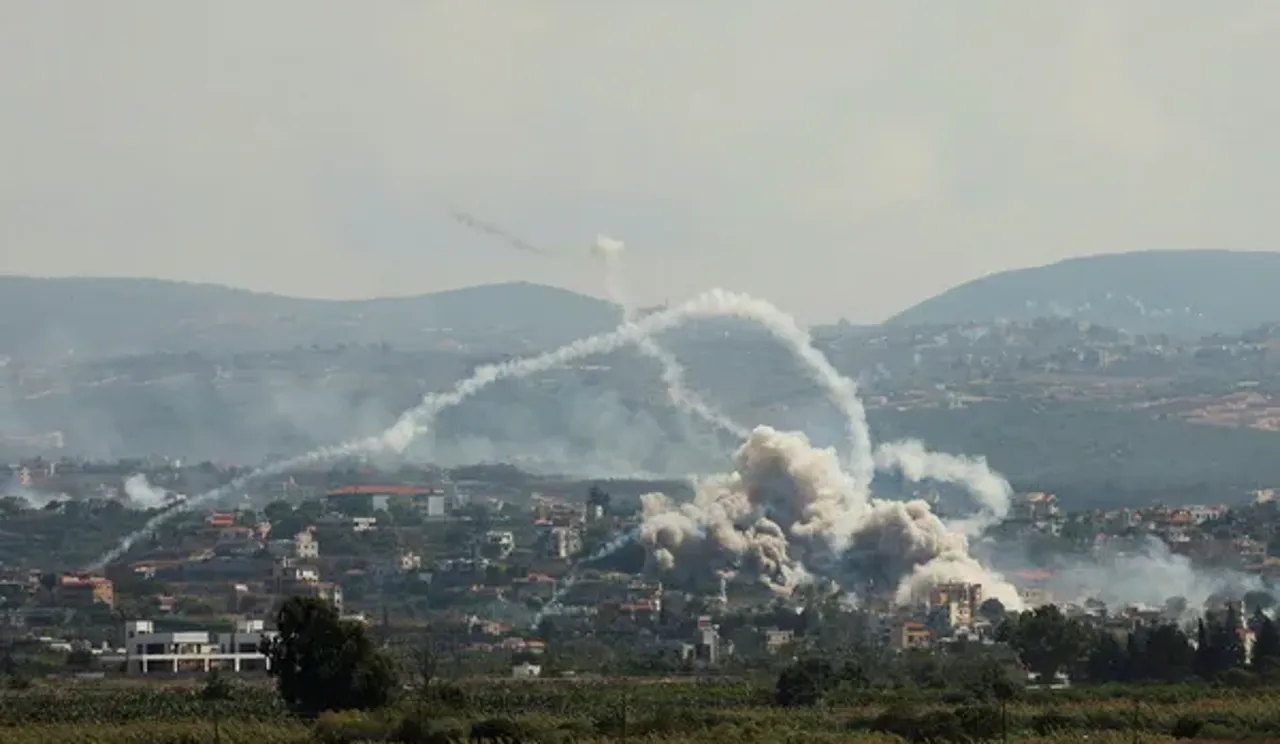
Israeli strike in southern Lebanon (Image: Aziz Taher/Reuters).

Published: 24 September 2024

Last updated: 24 September 2024

Israel’s government declared a "special situation on the home front" on Monday evening, following the most intense day of fighting between Israel and Hezbollah since October.

The declaration significantly expands the IDF's powers to issue instructions to the Israeli public, allowing it to ban gatherings, limit studies, and issue "additional instructions required to save lives".

Hezbollah launched over 210 rockets into Israel on Monday in multiple barrages targeting Haifa and its surrounding suburbs, with many reaching the edge of central Israel and inside the West Bank.

Israel's air force struck over 800 Hezbollah targets in Lebanon, killing at least 492 and wounding more than 1,600, according to Lebanon’s health ministry.

Tens of thousands of southern Lebanese citizens were seen fleeing their homes to find refuge elsewhere in the country after Israel warned them to stay away from known Hezbollah positions.

The IDF released evidence of Hezbollah munitions being placed in homes, as it sought to pre-empt criticism of the wide-ranging strikes. Among the weapons Israel said had been siloed in Lebanese homes before being hit by air force sorties were cruise missiles, rockets with large warheads and drones. In one case, the IDF revealed pictures showing what it said was a long-range rocket mounted on a hydraulic launcher and sitting in the attic of a Lebanese family’s home.

“We are crushing what was built by Hezbollah for 20 years,” Defence Minister Yoav Gallant declared during a visit to the IDF Operations Directorate’s command room, according to his office.

The escalation follows the dramatic and controversial operation that infiltrated and exploded hundreds of Hezbollah pagers and walkie-talkies. Accusations that the targeted pager attack was a war crime emerged this week.
Washington supports Israel's extensive airstrikes against Hezbollah, but is unconvinced that they will achieve their goal. The US Secretary of Defence expressed concern to Gallant that the Israeli move would lead to a state of escalation that would last for weeks or months.

The US is sending additional troops to the Middle East in response to the situation but declined to provide details.

Analysts say Israel’s strategy appears to be “escalate to de-escalate”, hoping that Hezbollah leader Hassan Nasrallah and his Iranian patrons will decide that the price of support for Hamas is becoming too high and will abandon their campaign of rocket attacks on Israel and, ideally, withdraw beyond the Litani River.

The greatest danger is that Nasrallah refuses to be cowed and Israel finds itself in an unwinnable ground war in Lebanon.  

READ MORE

Israel announces 'special situation' across country amid Hezbollah escalation (Haaretz)

After failing to prevent escalation, the U.S. focuses on trying to prevent an Israeli invasion of Lebanon (Haaretz)

Israeli strikes kill 492 in Lebanon: Lebanese Health Ministry (Axios)

Missile in the attic: IDF releases photos of Hezbollah munitions in Lebanese homes (Times of Israel)

US deploying more troops to region as Israel-Hezbollah conflict ramps up (Times of Israel)

RELATED ANALYSIS

Israel keeps moving up the escalation ladder, hoping Nasrallah will jump off (Lazar Berman, Times of Israel)
With massive airstrikes on Hezbollah’s missiles, Netanyahu is still trying to get the terror group to hold its fire after 11 months. If it doesn’t, war seems the only option.

We hit Hezbollah, they hit back. Now Israel must push for a diplomatic way out in Lebanon (Raviv Druker, Haaretz)
Israel cannot repeat the mistake it made by dragging out the Second Lebanon War two decades ago.

Israel has gone on the offensive against Hezbollah but is in no rush for a ground op (Amos Harel, Haaretz)
Without any formal declarations, Israel and Hezbollah have in practice moved to a phase of all-out war on Monday. The IDF is stepping up the military pressure, and Nasrallah must decide whether to intensify his response.

Israel is playing a high-risk game with its new Hezbollah strategy (Nick Paton Walsh, CNN)
Over the past week Israel has clearly decided to massively amplify its attacks on the Iran-backed militant group, claiming, according to some reports, they seek to “escalate to deescalate” – to cow their adversary into a diplomatic solution.

With top aides gone, Nasrallah faces critical decision on precision missiles (Ron Ben-Yishai, Ynet)
Field commanders steering Hezbollah’s war effort, but group yet to deploy precision missiles, maybe holding back hoping to avoid IDF strikes on arsenal amid US pressure to prevent regional war with Iran.

You might also like
  • UK’s dramatic policy change on Israel-Palestine
    Colin Shindler
  • Jerusalemites through the lens
    Sharon Gabay
  • LGBT asylum seekers caught between Palestinian violence and Israeli bureaucracy
    Jarod Rhine-Davis
logomark.67a07ee3
We believe in the free flow of information

Republish our articles for free, online or in print, by using our Creative Commons licence

You might also like

    Protest
    AnalysisIsrael

    Western ‘Palestinianism’ colonises everything – and hurts Palestinians

    Andres Spokoiny 5
    Ofer_Winter_2026
    Israel Votes 2026AnalysisIsrael

    Who is Ofer Winter and could he upset Netanyahu’s election?

    Shahar Burla
    altalena
    Israel Votes 2026OpinionIsrael

    The Altalena should be a warning, not a political weapon

    Shahar Burla 1

Comments

No comments on this article yet. Be the first to add your thoughts.

About the author

TJI Wrap

TJI Wrap

TJI wraps consolidate essential news and analysis from multiple sources into digestable summaries.

More from the author

NewsAustralia

War crimes allegations against Australian IDF soldier

NewsWorld

Wave of attacks on Jewish sites sparks international alarm

AnalysisIsrael

Gaza, Lebanon, Syria, Iran: Israel’s tense security landscape

AnalysisIsrael

Middle East on edge as Iran and Israel inch closer to another war