Aa
  • Read, Watch, Listen
  • TJI Series
  • Community Action
  • Events
  • Zedi
Follow us and continue the conversation
  • LinkedIn
  • Instagram
  • FaceBook
  • X
  • YouTube
Test yourself with the TJI Quiz!

Adjust size of text

Aa

Follow us and continue the conversation

  • LinkedIn
  • Instagram
  • FaceBook
  • X
  • YouTube

Your saved articles

You haven't saved any articles

What are you looking for?

Original reporting, insightful analysis and diverse views, delivered straight to your inbox

  • LinkedIn
  • Instagram
  • FaceBook
  • X
  • YouTube
Your support fuels our mission to inform, entertain and inspire.

The Jewish Independent is bound by the Standards of Practice of the Australian Press Council. If you believe the Standards may have been breached, you may approach The Jewish Independent or make a complaint to the Australian Press Council in writing at www.presscouncil.org.au. The Council may also be contacted on 1800 025 712.

  • Our Story
  • Contact us
  • Our Team
  • Support us
  • Guidelines
  • Pitch your idea
  • Republishing us
  • Community Action
  • Our Awards
  • LinkedIn
  • Instagram
  • FaceBook
  • X
  • YouTube
Aboriginal FlagTorres Strait Islanders Flag

The Jewish Independent acknowledges Aboriginal and Torres Strait Islander peoples as the Traditional Owners and Custodians of Country throughout Australia. We pay our respects to Elders past and present, and strive to honour their rich history of storytelling in our work and mission.

© The Jewish Independent 2026All Rights Reserved
Website design and development by Your Creative, MelbourneTerms & ConditionsPrivacy Policy
HomeRead, Watch, ListenIsrael
AnalysisIsrael

Israel’s media: free but imperfect

Between the Netanyahu government’s anti-democratic moves and the pressures of a country at war, Israel’s independent media is more important than ever.
Deborah Stone
Print this
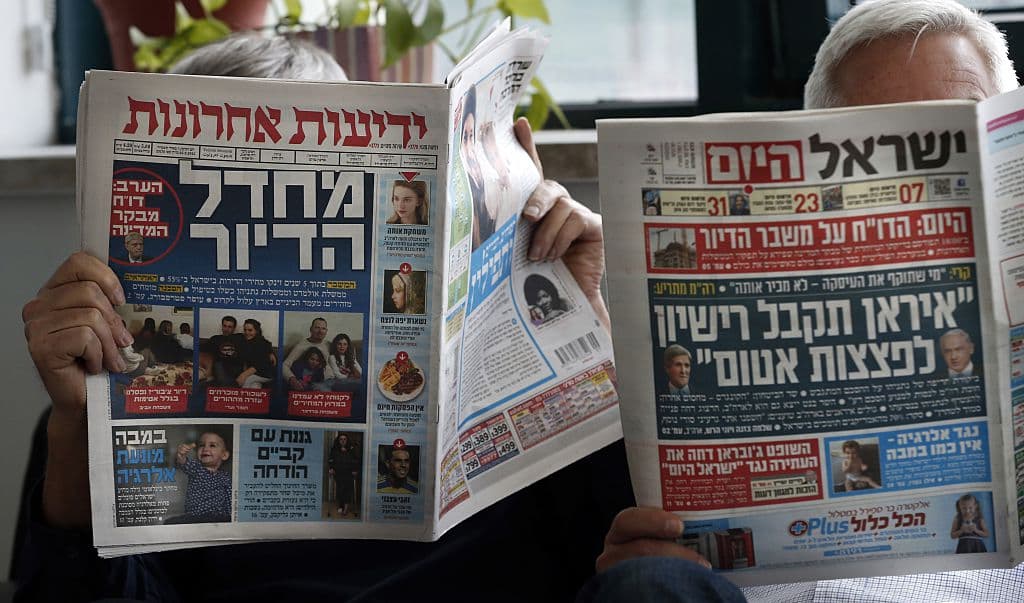
Men reading Hebrew newspapers

Israeli newspapers competitors Yedioth Aharonot and Israel Hayom (THOMAS COEX/AFP via Getty Images)

Published: 9 February 2024

Last updated: 21 March 2024

Between the Netanyahu government’s anti-democratic moves and the pressures of a country at war, Israel’s independent media is more important than ever.

Israel is the only country in the Middle East with a free media.

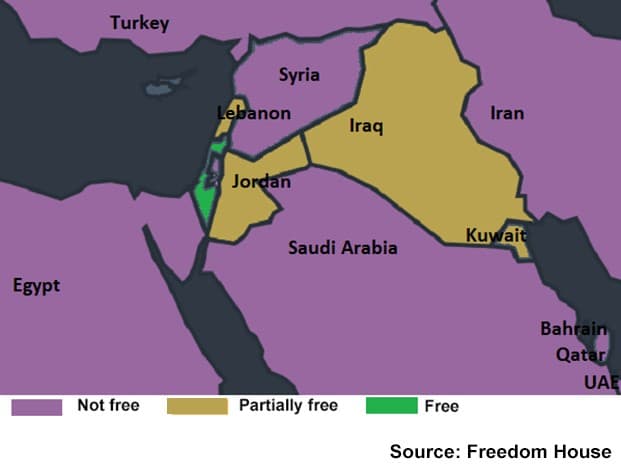
A map produced by the US-based rights monitor Freedom House in 2023 shows Israel as the sole “free” patch, with a mass of “not free” and a few “partially free” countries surrounding it.

Both Gaza – ruled by Hamas – and the West Bank, Israeli occupied territory partially governed by the Palestinian Authority, are categorised as “not free”.

Four Middle Eastern countries are categorised as “partially free”: Lebanon, Jordan, Iraq and Kuwait. The rest – Turkey, Syria, Egypt, Saudi Arabia, Bahrain, Qatar and the UAE – are “not free”.
The Jewish Independent

Media is a key part of the assessment of democratic freedoms, together with electoral freedom, judicial independence, level of corruption and civil rights.

“The Israeli media sector is vibrant and free to criticize government policy,” reports Freedom House.

But it notes several caveats: military censorship, the influence of commercial interests and, increasingly, political interference under Prime Minister Benjamin Netanyahu.

“Despite the existence of robust legal protections for journalists, Netanyahu’s tenure as prime minister negatively affected the public’s trust in the media, which Netanyahu and his allies portrayed as traitors seeking to unseat him.
“As a result, journalists describe being discouraged from reporting on topics that were perceived to be sympathetic to Palestinians, or frame reporting in a way that would not seem “leftist.”

“Netanyahu’s efforts to undermine the independence of Israel’s national broadcaster Kan11 and financially weaken commercial television channels have had a chilling effect on the desire of these media outlets to investigate misconduct or corruption allegations implicating influential politicians,” the monitor reported.

The fundamental health of Israel’s media is evidenced by the extensive number and diversity of its outlets, reflecting a dramatic range of political and ideological frameworks. As Ittay Flescher observes in his assessment of Israeli print and online media outlets, in Israel media platforms frequently function as advocates for particular political positions rather than aiming for independence or objectivity.

Of course, such partisan media is a well-known phenomenon in many democratic countries. It is notoriously true in the UK and increasingly so in Australia, especially in News Limited outlets.

In this context, the great range of television channels, the number of newspapers and websites, and the breadth of news and analysis podcasts about Israel provide a capacity for balance on a societal level.

Choice is an important criterion for media freedom, but it provides no guarantee that the media will do anything more than amplify echo chambers and entrench polarisation. In Israel, as in many liberal democracies, the media is illustrative of increasingly bitter social and political divides.

On the other hand, the past year has brought Israeli media closer to a greater degree of agreement than has been seen in many years.     

For much of 2023, the focus of Israeli society was the Netanyahu government’s controversial anti-democratic reforms. The courts were the first target of these reforms, with attacks on judicial independence sparking blanket media coverage as well as mass protests.

The left-wing and deeply Netanyahu-critical Haaretz was by no means the only outlet to take on Netanyahu over judicial overhaul. The Times of Israel’s centrist editor David Horovitz was particularly outspoken and even the Jerusalem Post, traditionally a supporter of Netanyahu’s Likud party, called for compromise.

The media also found itself fighting on its home ground, defending the essential freedoms that enable it to act as a political and social watchdog.

Minister of Communications Shlomo Karhi directly threatened the public broadcaster Kan11, Israel’s equivalent of the Australian Broadcasting Corporation. Like the ABC, Kan is perceived by right-wing politicians as too left-leaning and an expensive drain on the public purse that bites the hand that feeds it.

“In my view, there is no place in this day and age for a public broadcaster when there is a wide range of channels,” Karhi said.

But leading journalists say the increasing pressure on the private sector suggests the opposite: a commensurately more important role for public broadcasting.

The chairperson of the Union of Israeli Journalists Nurit Canetti wrote in The Jewish Independent that Israeli journalists are increasingly subject to political harassment, online trolling, and pressure from owners to compromise out of commercial interest.

These issues are by no means unique to Israel. Problems of commercial viability and attempted political interference exist in other democratic countries. But in Israel there have been several criminal cases alleging corruption by Netanyahu through his involvement in Israel Hayom and Walla.

None of this had been resolved when the horror of the October 7 massacre changed the country’s focus entirely.

Just as the democracy movement has pivoted from protest to providing basic goods and services to evacuated families, the media has pivoted from acting as a watchdog to performing as a cheer squad for a traumatised country. Even Haaretz, with the exception of the intrepid Amira Hass, has focused its coverage of Gaza on Israeli strategy and casualties, rarely running stories about the humanitarian impacts of Israel’s military campaign.

Israeli journalists are clearly aware that the rest of the world’s media is too quick to assume Israeli atrocities, for example reporting that Israel was responsible for the deaths of 500 Palestinians at Al-Shifra Hospital, when the blast was caused by a malfunctioning rocket misfired by Islamic Jihad. That sense that Israel faces unfair treatment from the world media may pressure Israeli journalists to bend the other way.

But a compliant media, more comfortable for government, is problematic, especially in the face of a war whose prosecution is, at best, controversial and with the judicial crisis and Netanyahu corruption trials continuing in the background.

The problem, wrote Haaretz journalist Ido David Cohen, is not so much military censorship as “endless self-censorship”.

“Journalists and media researchers fear that Israeli broadcasting is returning to bad habits as part of an effort to lift morale and maintain solidarity with soldiers risking their lives in Gaza – and, in doing so, is failing to show the reality in Gaza,” Cohen wrote.

The rest of world’s media is focused on the tragedy of Palestinian civilians in Gaza, to the extent that the Hamas massacre of Israeli civilians that prompted Israel’s assault have been eclipsed. 

Israeli media is clearly unwilling to join the pile-on but nor can it abdicate its role as a guardian of democratic values.

To do so would be to destroy the very principles of freedom and democratic rights that distinguish Israel from the countries around it.

You might also like
  • ABC’s self-vetting like ‘marking own homework’
    Peter Kohn
  • Israeli media dodges hard questions about the war against Iran
    Ben Lynfield
  • Israel moves to shut foreign media outlets claiming ‘security threat’
    Ben Lynfield
logomark.67a07ee3
We believe in the free flow of information

Republish our articles for free, online or in print, by using our Creative Commons licence

You might also like

    Arab Israeli Palestinian election vote
    Israel Votes 2026FeatureIsrael

    Fear of Netanyahu victory may drive big surge in Palestinian voter turnout

    Ben Lynfield
    Netanyahu
    Israel Hamas WarFeatureIsrael

    New evidence Netanyahu was warned about October 7

    Shahar Burla 2
    Woman with land and houses behind her
    NewsAustralia

    Australia to increase sanctions against West Bank settlements

    Deborah Stone 2

Comments

No comments on this article yet. Be the first to add your thoughts.

About the author

Deborah Stone

Deborah Stone

Deborah Stone is Editor-in-Chief of TJI. She has more than 30 years experience as a journalist and editor, including as a reporter and feature writer on The Age and The Sunday Age, as Editor of the Australian Jewish News and as Editor of ArtsHub.

More from the author

NewsIsrael

‘Israel is systemically eliminating Palestinian collective life’:  B’Tselem

Australia

Tame apologises – but with little grace

NewsAustralia

Australia to increase sanctions against West Bank settlements

NewsAustralia

Humanitarian organisations fail on antisemitism: new research