Aa
  • Read, Watch, Listen
  • TJI Series
  • Community Action
  • Events
  • Zedi
Follow us and continue the conversation
  • LinkedIn
  • Instagram
  • FaceBook
  • X
  • YouTube
Test yourself with the TJI Quiz!

Adjust size of text

Aa

Follow us and continue the conversation

  • LinkedIn
  • Instagram
  • FaceBook
  • X
  • YouTube

Your saved articles

You haven't saved any articles

What are you looking for?

Original reporting, insightful analysis and diverse views, delivered straight to your inbox

  • LinkedIn
  • Instagram
  • FaceBook
  • X
  • YouTube
Your support fuels our mission to inform, entertain and inspire.

The Jewish Independent is bound by the Standards of Practice of the Australian Press Council. If you believe the Standards may have been breached, you may approach The Jewish Independent or make a complaint to the Australian Press Council in writing at www.presscouncil.org.au. The Council may also be contacted on 1800 025 712.

  • Our Story
  • Contact us
  • Our Team
  • Support us
  • Guidelines
  • Pitch your idea
  • Republishing us
  • Community Action
  • Our Awards
  • LinkedIn
  • Instagram
  • FaceBook
  • X
  • YouTube
Aboriginal FlagTorres Strait Islanders Flag

The Jewish Independent acknowledges Aboriginal and Torres Strait Islander peoples as the Traditional Owners and Custodians of Country throughout Australia. We pay our respects to Elders past and present, and strive to honour their rich history of storytelling in our work and mission.

© The Jewish Independent 2026All Rights Reserved
Website design and development by Your Creative, MelbourneTerms & ConditionsPrivacy Policy
HomeRead, Watch, ListenIsrael
FeatureIsrael

Israel’s real election is between a Jewish supremacist and an Arab who opposes a Jewish state

Ittay Flescher
Print this

Published: 5 July 2022

Last updated: 5 March 2024

The election advertising focus on extremists from minor parties is a stand-in for the deep debate the majors are avoiding, writes ITTAY FLESCHER  

If you only watch election advertising on social media, you’d be forgiven for thinking the next prime minister of Israel will be either Itamar Ben-Gvir or Ahmad Tibi.

The song sheet for just about every party in the centre-Left bloc is that if you vote for Benjamin Netanyahu on November 1, you will get the ultra-Zionist Itamar Ben-Gvir as a minister. The MK from the extreme Right Otzma Yehudit faction of the Religious Zionist party is known for defending Jewish attacks on Palestinians and for his provocative visits to flashpoint locations including the Temple Mount and Sheikh Jarrah neighbourhood in Jerusalem.

 “Ben-Gvir’s message is simple and violent. He says no to a democratic state, no liberal values, no moderation, no rule of law, only nationalism and racism,” then foreign minister Yair Lapid said in June.

Lapid also articulated the concern across Israel about Ben-Gvir’s influence. “The strongest person today in the Opposition is not Netanyahu, it’s Itamar Ben-Gvir,” he said in a swipe at the former prime minister.

On the other side of the divide, the song sheet for just about every party in the Right-Haredi bloc is that if you vote Lapid, you will get Arab MK Ahmad Tibi in the coalition, leading to the end of the Jewish state as we know it.

Tibi, who has been an MK since 1999, founded the Palestinian party Ta’al. He supports a two-state solution but opposes Israel's character as a Jewish state, and wants the Law of Return, the flag, and the national anthem changed.

He was political adviser to Yasser Arafat though much of the 1990s and has attracted controversy for his praise of Palestinian martyrs as "symbols of the homeland".
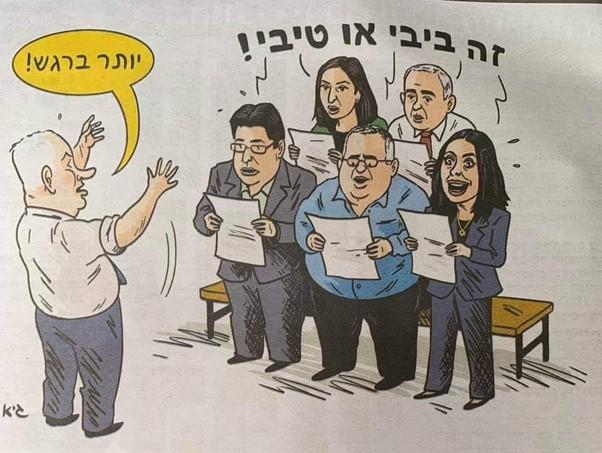
Guy Morad Cartoon from Yediot Achranot showing all the Likud MK’s being led my Netanyahu in a chorus of “Bibi or Tibi” with him instructing them, “This time with passion.”

Neither Tibi nor Ben-Gvir is leader of the slate to which their respective parties belong, but both have a larger social media following and media presence than their nominal leaders.

Given the effectiveness of negative campaigns, the Tibi v Ben-Gvir narrative is only expected to rise in decibels as the campaign goes on.

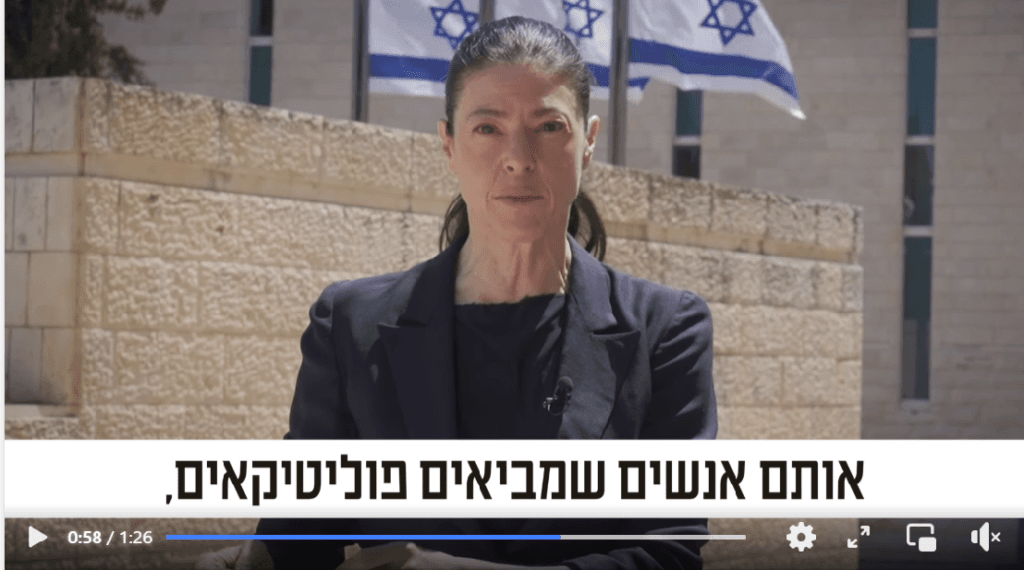
Drawing on the recent Roe v Wade decision in the US, the advertisement shared on social media by Labor Party leader Merav Michaeli is an example of the campaign of fear being run on the Left.

"2022 US Supreme Court takes away women's right over their bodies. 2023 Same here in Israel? We must not let conservative extremists control our high court."

The Jewish Independent

Left advertising features Ben-Gvir promising to overhaul Israel’s highest court: “We will appoint 15 judges with a Jewish-Zionist agenda to the Supreme Court. Together we will put an end to the rule of the Supreme Court over our lives.”

A parallel narrative of anxiety is being run by the Right. In his speech on the day the Knesset was dissolved and Lapid replaced Naftali Bennett as prime minister, Opposition Leader Netanyahu gave a fiery address to the Knesset, emphasising the Left’s relationship with the Arab parties, Ra’am (Islamists who are part of the current Coalition) and the Joint List (a mixed slate of Arab parties who have never joined an Israeli government).

 “These elections are about one thing. Will we again see a failed government under Lapid’s leadership that is dependent on the Muslim Brotherhood, the Joint List, terror supporters, or a stable nationalist government under my leadership, that will return pride, power and hope to the State of Israel? The only coalition Lapid can put together is one dependent on Ra’am and the Joint List.”

Joint List leader Ayman Odeh returned fire, referencing Ben-Gvir: “You have no government without the Kahanist.”

Likud used the speech in a video ad, made for social media, reiterating the line, “The only government Lapid can put together is dependent entirely on Ahmad Tibi and the Joint List.”

As the campaigns continue in this vein, rhetoric displaces important policy debates that should be influencing our votes. Almost everyone will soon forget the reason the Knesset was dissolved on June 30, namely the failure to extend a discriminatory law that enshrines special rights for Jews who live in the West Bank over their Palestinian neighbours. Neither Lapid nor Netanyahu is offering any practical policy solution as to how Israel can live in peace with the Palestinians.

The Tibi v Ben-Gvir conflict has powerful ideological underpinnings.

Tibi represents the idea that Israel should be a “state for all its citizens.” He criticises the status quo, saying,  “Israel calls itself a Jewish and democratic state but in reality, it is a democratic state for Jews and a Jewish state for Arabs. There is a double standard.”

Ben-Gvir represents the desire for Jewish supremacy. At the memorial event for Rabbi Meir Kahane in 2019, he called the notorious terrorist “a holy man, a prophet and a leader for our country,” promising, “We will continue in his path.”

The Jewish Independent

There is little difference in policy between Lapid and Netanyahu with regard to how they would manage Israel’s economy and various security threats.

The Tibi v Ben-Gvir narrative, however, is a battle of ideas about the kind of state Israel seeks to become. Perhaps highlighting the dramatic contrast between these two alternatives is not such a bad thing.

RELATED STORY

This Bedouin City Could Decide Who Is Israel's Next Prime Minister (Haaretz)

Image: Tibi v Ben Gvir (The Jewish Independent)

You might also like
  • Why I’m still voting Labor in Victoria
    Dean Sherr
  • Netanyahu pushed Shin Bet head to spread racist misinformation at election
    Eetta Prince-Gibson
  • The Israelis who flew home to vote
    Gideon Cohen
logomark.67a07ee3
We believe in the free flow of information

Republish our articles for free, online or in print, by using our Creative Commons licence

You might also like

    bulldozer construction settlements west bank
    ExplainerIsrael

    Australia’s latest sanctions raise the stakes, but stay on track

    Deborah Stone
    Displaced Palestinians face harsh conditions amid rain and destruction in Gaza
    Israel Hamas WarNewsIsrael

    Flooding and illness increase urgency of humanitarian relief in Gaza

    Shahar Burla 1
    Joint list
    AnalysisIsrael

    Unlikely bedfellows: How Arab parties could deliver Israel’s next government

    Ben Lynfield 1

About the author

Ittay Flescher

Ittay Flescher

Ittay Flescher is the Jerusalem Correspondent for The Jewish Independent. For over 20 years, he has worked as an educator, journalist, and peacebuilder in Melbourne and Jerusalem. His book, The Holy and the Broken: A Cry for Israeli-Palestinian Peace from a Land that Must Be Shared, was longlisted for the 2025 Walkley Book Awards.

More from the author

FeatureArts & Culture

The eight most Jewish songs of Leonard Cohen

OpinionIsrael

Even on October 7, we are not united

AnalysisArts & Culture

Fauda and the illusion of vengeance

AnalysisIsrael

What ‘Zionism’ means in Israel:  it’s not what you think