Aa
  • Read, Watch, Listen
  • TJI Series
  • Community Action
  • Events
  • Zedi
Follow us and continue the conversation
  • LinkedIn
  • Instagram
  • FaceBook
  • X
  • YouTube
Test yourself with the TJI Quiz!

Adjust size of text

Aa

Follow us and continue the conversation

  • LinkedIn
  • Instagram
  • FaceBook
  • X
  • YouTube

Your saved articles

You haven't saved any articles

What are you looking for?

Original reporting, insightful analysis and diverse views, delivered straight to your inbox

  • LinkedIn
  • Instagram
  • FaceBook
  • X
  • YouTube
Your support fuels our mission to inform, entertain and inspire.

The Jewish Independent is bound by the Standards of Practice of the Australian Press Council. If you believe the Standards may have been breached, you may approach The Jewish Independent or make a complaint to the Australian Press Council in writing at www.presscouncil.org.au. The Council may also be contacted on 1800 025 712.

  • Our Story
  • Contact us
  • Our Team
  • Support us
  • Guidelines
  • Pitch your idea
  • Republishing us
  • Community Action
  • Our Awards
  • LinkedIn
  • Instagram
  • FaceBook
  • X
  • YouTube
Aboriginal FlagTorres Strait Islanders Flag

The Jewish Independent acknowledges Aboriginal and Torres Strait Islander peoples as the Traditional Owners and Custodians of Country throughout Australia. We pay our respects to Elders past and present, and strive to honour their rich history of storytelling in our work and mission.

© The Jewish Independent 2026All Rights Reserved
Website design and development by Your Creative, MelbourneTerms & ConditionsPrivacy Policy
HomeRead, Watch, ListenIsrael
OpinionIsrael

Israel’s tribes are battling over their visions of the future

Colin Shindler
Print this

Published: 26 May 2023

Last updated: 5 March 2024

COLIN SHINDLER argues the current demonstrations in Israel are about far more than judicial overhaul.

The demonstrations every Saturday night against “the judicial overhaul” continue in Israel unabated and remain deeply defiant. Even the hiatus of a rocket barrage from Gaza by Islamic Jihad did not mean an abandonment of protest. Unlike in Türkiye and Hungary, many Israelis are not prepared to roll over and whisper their thoughts in private.

To unsettle Likud MKs even further, Moody's rating agency has lowered its credit rating while Benjamin Netanyahu's long-time supporter in the US, the multi-billionaire Miriam Adelson commented that his attempt to tether an independent judiciary to a post was “a hasty injudicious and irresponsible move”. According to a series of polls, Likud has lost at least 10 seats to Benny Gantz's party — and if an election was held tomorrow Netanyahu would not be able to cobble together a working coalition.

The fissures in Israeli society go deep but now are spreading wider to reflect grievances which go beyond tinkering with the rule of law. The judicial overhaul is, of course, symptomatic of Netanyahu's mindset, but many now talk about the refusal of the Haredim to serve in the IDF amidst millions of shekels showered down on them by government.

The economic inequality between rich and poor is also becoming more apparent in an Israel which is growing increasingly expensive for the ordinary Israeli citizen but even for well-to-do tourists. Even Likud voters now describe the judicial overhaul as a coup and not a reform.

Today's divisions were eloquently described by former president Reuven Rivlin in a speech to the Herzliya Conference in 2015. He argued that Israel now consists of four tribes: the secularists, the national religious, the haredim and the Arabs. With the demise of Ben-Gurion's Israel, he said there are now rival visions of an Israel in the 21st century.

It is this moral cowardice which has annoyed the hundreds of thousands of Israelis from all walks of life who have taken to the streets in protest. In one sense, this is beyond politics.
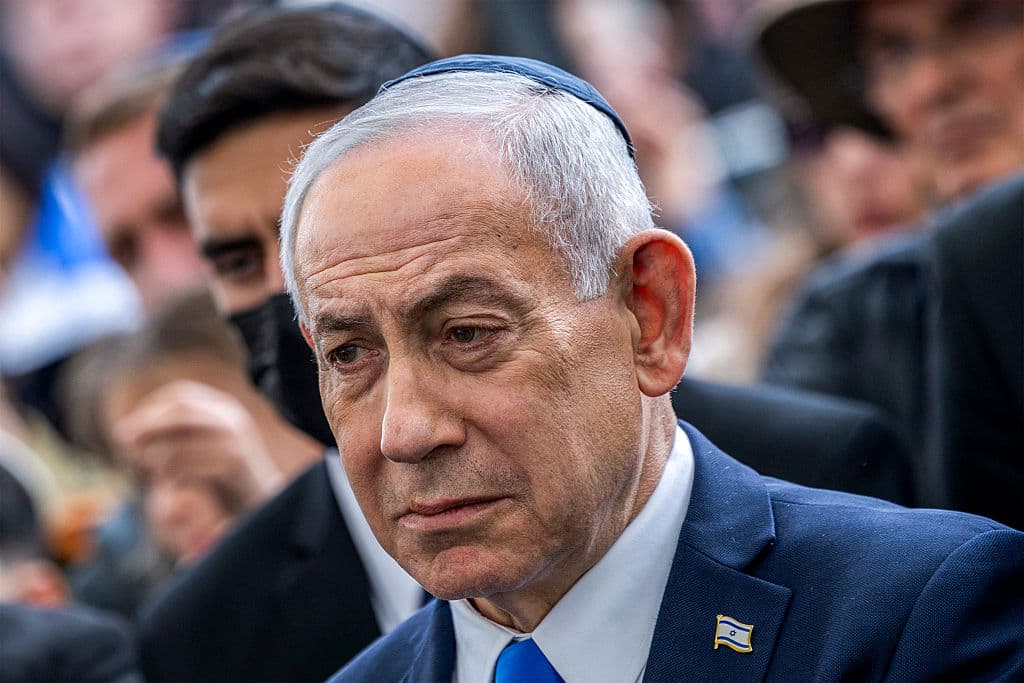
The demonstrations every week reflect the struggle between these tribes now competing for dominance in Israel. Those opposed to Netanyahu's attempt to rewrite the national narrative, such as Ha'aretz columnist Uri Misgav, compared the Prime Minister and his coalition supporters to “burglars breaking into the family home and setting it ablaze”.  Misgav's article was acerbically titled No Compromise and No Dialogue: War.

President Rivlin's speech brought to public attention the meticulous research of the Israeli academic Sammy Smooha, who long before had detailed the cleavages in Israeli society: class, ethnic; Jew/Arab; Left/Right and Religious/Secular. After Rivlin's exposition, an understanding of the growing atomisation of Israeli society finally escaped from the hallowed halls of academia.

There is also a cleavage within Rivlin's four tribes. More money is spent on education by local authorities for the secular and the national religious than for the haredim and the Arabs. The latter have less possibility to enter higher education and a professional career. They have the lowest salaries and the lowest employment rates.

Yet the melting-pot philosophy of 1948 began to falter after the Six Day war in 1967. The Young Guard of the National Religious Party displaced those religious Zionists who had worked with Ben-Gurion and his secular colleagues. They strongly supported the settlement of the West Bank and wanted power and influence in government beyond the traditional concerns of the religious public.

The election of Menahem Begin's Likud in 1977 provided the possibility of a breakthrough to mould a different Israel. As Labour disintegrated, the Likud coalesced and became the natural party of government.

While Begin was able to purge government and the civil service of those who did not share his views, he was less successful in dealing with the judiciary, the media and the universities.

Ben-Gurion and his colleagues had ridiculed and marginalised Begin for decades — and now the Right had achieved power. Netanyahu mirrored Begin's dislike of the ruling pioneering labour elite. In an interview in 1996, Netanyahu complained about his delegitimisation “by the nomenklatura of the old regime”. 

The national religious, unlike the haredim, operated in the conventional world — they worked hard to support their families, became captains of industry and served in the IDF. Under the influence of the religious far Right — which broke away after the Camp David Agreement with Egypt in 1979 — they became more illiberal in their views and more confident in their political advocacy. Naftali Bennett, while becoming the first kipa-wearing prime minister, was regarded as a traitor to the cause because he sat in government with the secular Left and Islamist Arabs.

The national religious are at a crossroads in their evolution. Will they join those who hold positions of power in Israeli society, those who uphold the rule of law and demand democracy, often the secular and the liberal — or will they embrace the "hilltop youth" who gleefully attack Palestinian villagers in the West Bank?

As for the far Right, the spiritual violence of its Yom Yerushalayim (Jerusalem Day) march last week indicated the struggle against tolerance that has become a totem of this tribe's struggle for supremacy. In 1981, Meir Kahane's Kach party received just over 5000 votes in the election but today his disciples are in government.

Even so, it is still remarkable that the highly secular Netanyahu has not only pragmatically allied himself with the Kahanists to maintain the Likud in government but has also allowed their vision of a future Israel to run riot. Making the judiciary subservient to the politicians may only be the first step. The weekly protesters understand that the taming of an independent media and academia may follow.

It is this moral cowardice which has annoyed the hundreds of thousands of Israelis from all walks of life who have taken to the streets in protest. In one sense, this is beyond politics.
Another Israeli academic, Shmuel Sandler, has pointed out that Israel has moved from “an ideological democracy to a tribal-personal political system”. Voters vote more for “leaders” and not for a political philosophy. Any visitor to Israel during an election campaign will see gigantic posters of the all-wise, all-seeing leaders — looking remarkably like each other — and nothing about what they stand for.

The legislature is in effect demoted to a lesser standing and the candidates' electoral list often decided upon by party bosses and voter brokers.

The self-evident problem is that Israeli politics does not exhibit any territorial component. The MKs are not held to account by constituents — there are no constituencies and they only have internal party machinations to consider.

So, will things change? It is highly unlikely. Israeli politicians are extremely comfortable with the current scenario. Ben-Gurion proposed a constituency model decades ago. His suggestion was then rebuffed as the murmurings of an aged leader.

It is not in the interests of the Israeli politicians of 2023 to vote for a new electoral system. It would make them more susceptible to being the servants of the people rather than the governors of the nation. And clearly this is something neither Netanyahu nor his acolytes can abide.

Illustration: Avi Katz

You might also like
  • Israel election explainer: the main parties
    Shahar Burla
  • Sanctioning settlements is a defence of Israel, not an attack
    Elisheva Madar
  • Sanctions must influence, not just perform disapproval
    Adam Slonim
logomark.67a07ee3
We believe in the free flow of information

Republish our articles for free, online or in print, by using our Creative Commons licence

You might also like

    Netanyahu
    Israel Hamas WarFeatureIsrael

    New evidence Netanyahu was warned about October 7

    Shahar Burla 2
    Btselem
    NewsIsrael

    ‘Israel is systemically eliminating Palestinian collective life’:  Israeli human rights report

    Deborah Stone 1
    Woman with land and houses behind her
    NewsAustralia

    Australia to increase sanctions against West Bank settlements

    Deborah Stone 2

About the author

Colin Shindler

Colin Shindler

Colin Shindler is an emeritus professor of Israel Studies at SOAS, University of London. He is the author of several books about Israel: the latest "A Forever War: Israel, Palestine and the Struggles for Statehood" was published in 2026.

More from the author

AnalysisWorld

UK’s dramatic policy change on Israel-Palestine

AnalysisWorld

Diaspora leadership must be candid about its disillusion with Netanyahu

AnalysisWorld

Burnham and Miliband will have trust issues with future Israeli government

AnalysisWorld

If Andy Burnham becomes UK PM, what will that mean for Middle East policy?