Aa
  • Read, Watch, Listen
  • TJI Series
  • Community Action
  • Events
  • Zedi
Follow us and continue the conversation
  • LinkedIn
  • Instagram
  • FaceBook
  • X
  • YouTube
Test yourself with the TJI Quiz!

Adjust size of text

Aa

Follow us and continue the conversation

  • LinkedIn
  • Instagram
  • FaceBook
  • X
  • YouTube

Your saved articles

You haven't saved any articles

What are you looking for?

Original reporting, insightful analysis and diverse views, delivered straight to your inbox

  • LinkedIn
  • Instagram
  • FaceBook
  • X
  • YouTube
Your support fuels our mission to inform, entertain and inspire.

The Jewish Independent is bound by the Standards of Practice of the Australian Press Council. If you believe the Standards may have been breached, you may approach The Jewish Independent or make a complaint to the Australian Press Council in writing at www.presscouncil.org.au. The Council may also be contacted on 1800 025 712.

  • Our Story
  • Contact us
  • Our Team
  • Support us
  • Guidelines
  • Pitch your idea
  • Republishing us
  • Community Action
  • Our Awards
  • LinkedIn
  • Instagram
  • FaceBook
  • X
  • YouTube
Aboriginal FlagTorres Strait Islanders Flag

The Jewish Independent acknowledges Aboriginal and Torres Strait Islander peoples as the Traditional Owners and Custodians of Country throughout Australia. We pay our respects to Elders past and present, and strive to honour their rich history of storytelling in our work and mission.

© The Jewish Independent 2026All Rights Reserved
Website design and development by Your Creative, MelbourneTerms & ConditionsPrivacy Policy
HomeRead, Watch, ListenArts & Culture
ReflectionArts & CultureAustralia

‘After Bondi’: a safe space to speak candidly about trauma and hope

Our panel discussion at the Sydney Writers' Festival was an opportunity to engage directly with the broader community, and perhaps get some acknowledgement
Michael Visontay
Print this
Sydney Writers Week – After Bondi

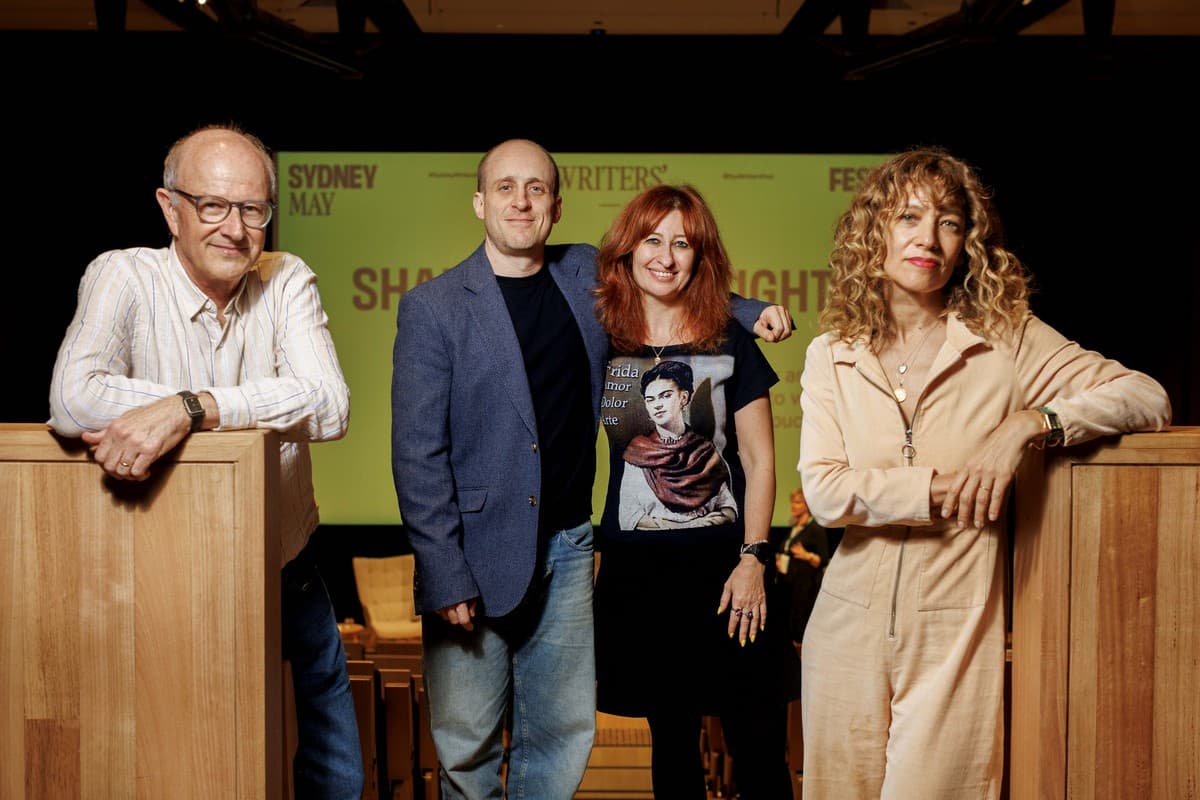
From left, Michael Visontay, Simon Tedeschi, Lee Kofman and Jessica Chapnik Kahn, pictured at Sydney Writers Festival in Sydney on Sunday, May 17, 2026. (Nikki Short/courtesy The Australian)

Published: 21 May 2026

Last updated: 26 May 2026

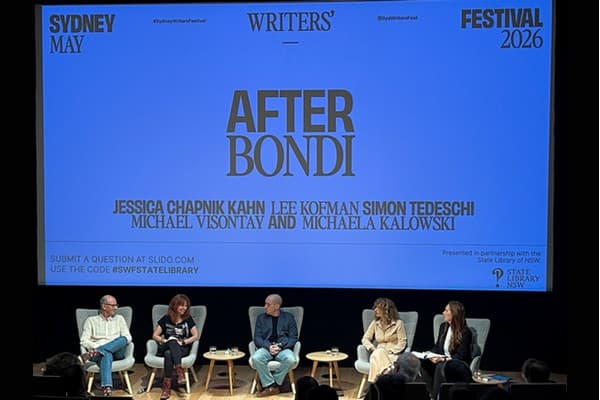
Last Sunday I was on an all-Jewish panel at the Sydney Writers' Festival titled After Bondi. Panel discussions with Jewish writers these days are always loaded with discomfort. But this one had an extra edge. I passed two police officers in the mezzanine of the State Library of NSW as I made my way down to meet the others. At the end of our pre-session briefing, we were told that if there was an interruption, we could pause the session until it was resolved, and that if we still felt unsafe, we could leave the stage.

Up till that point, it had not occurred to me that there might be trouble. Perhaps I was, after everything, still naïve. I know that even in private discussions, talking about Bondi carries an inescapable heaviness. But here we were: five Jewish creatives with an invitation to share a perspective on life before and after Bondi. Fraught or not, these invitations do not come along very often.

Musician and artist Jessica Chapnik Kahn, pianist Simon Tedeschi, author Lee Kofman and I were guided in our conversation by our moderator, Michaela Kalowski. Although the session was titled “After Bondi”, Michaela had made the wise decision to chart a trajectory in our discussion from October 7, 2023, to the present day, to show the audience that Bondi did not occur out of the blue.

This was an opportunity, verging on a responsibility, to speak directly to the broader community; a chance to reflect the accumulation of hostile incidents, large and small, obvious and fleeting, that have contaminated life for Jews and for non-Jews, leaving it almost impossible for people to have discussions – let alone disagreements – over Israel, Palestine, Gaza, Palestine and being Jewish.

Audience transfixed

This day, in the safe space created by the festival, we felt free to speak candidly. Jessica Chapnik Kahn was caught in the shooting at Bondi Beach with her five-year-old daughter. It felt like the whole room leaned forward as she recounted her memory of the day: “There was such a specific sound, those gunshots … and I realised that the people around me were dying and I had to make a choice about how I wanted to die, and how I wanted to guide my daughter to die.”
Covering her daughter’s body with her own, she spoke into her ear: “My darling, go inside your heart, where all the love is, and stay right there. And I felt her soften beneath me. And if you can believe it, in that place of horror, we found a sublime place that was only ours … and we lay there, in that, until the gunshots ended and, much to our surprise, we survived.” The audience was transfixed.

Renowned pianist Simon Tedeschi spoke directly to the distorted logic that has enveloped the political climate. “Australian Jews do not vote in the Knesset (Israeli parliament). Do not hold us responsible for the actions of the Israeli government,” he said, then described how that collective responsibility had infected his working life.

“Like most people, I’m forced by work to be on social media, and being a Jew on social media is very difficult at the moment, especially if you’re a proud Jew.

“I’m not what you would call a jingoistic Jew by any means, but … you hear things said by colleagues who you respected for many years, things that echo nasty periods in history, you begin to realise that what my grandparents repeatedly said is true: the world can change on a dime.”

Tedeschi’s final words included a call for more moderate voices instead of extremism, a plea that prompted heartfelt applause from the room.

The Jewish Independent

Writer Lee Kofman, whose ancestry is Russian, Ukrainian and Israeli, has seen antisemitism up close before and was not as shocked by the response to October 7 as others were. In that febrile climate, she established the now infamous WhatsApp group for Jewish creatives to support each other.

A group of anti-Zionist activists released their names and workplaces to a wide network, an act of doxxing that has since been criminalised by the Albanese government. “People lost jobs, work opportunities,” Kofman said. “One couple I know had to close their business and relocate.”

Words morph into actions

Kofman stressed that words morph into actions. “We kept saying that what happens online, or words, that people post, they’re never just words. Words have a life of their own, and it always leads to violence,” she said in reference to Bondi.

When it was my turn, I dived into a well of conflicting feelings about Bondi – the event, the place, and even the session that we were in. “It’s called After Bondi. But I don’t think we’re “after Bondi” yet,” I suggested. “We’re still in a limbo between Bondi and after Bondi. The event feels like Bondi is still right on top of us, emotionally, culturally and politically. Like the Jewish ritual of Yahrzeit (a year’s time), I will only feel like we’ve moved into 'after Bondi' when we reach that first anniversary."

I reflected on Bondi the place. Having spent so much time there in my younger years – I lived in six separate homes during my twenties and thirties – I see the ghosts of shops and cafes that used to be cultural landmarks. I miss the Gelato Bar deeply; it embodied the Jewish soul of Bondi, and I told the audience about my hankering for a new Jewish bakery on Campbell Parade – something to mark Jewish life, not just death.

An outstretched hand to non-Jews

Jews were the target, which will leave a permanent stain. “We are the chief mourners but we are not the only mourners,” I said. “I want to know how other Australians – Bondi locals, and other non-Jews  – feel about the massacre, because it affects all of us.

“This session has five Jews. I know why the festival asked us. But I would have liked to see a non-Jew on stage with us, to hear how they are dealing with it, what it means to them. Do they still feel violated by what happened, or can they shrug it off?

“Because in the end, even if it causes friction, I want non-Jews to step forward to show that they want to be an active partner in mending the bridge.”

Although I wasn’t sure what I was hoping to gain from the session, I did hope it would act as a small stepping stone towards healing. Afterwards, as speakers and the audience milled together in the foyer, a non-Jewish friend came up to me. “I’m sorry. I just had no idea it was that bad,” she said gravely, in reference to the period since October 7.

It was only one person. But it was acknowledgement.

You might also like
  • Traditional antisemitic myths dominate online antisemitism: new study
    Deborah Stone
  • When security clashes with hospitality
    Jarod Rhine-Davis
  • Legendary magicians who made their Jewish identities disappear
    Nina Siegal
logomark.67a07ee3
We believe in the free flow of information

Republish our articles for free, online or in print, by using our Creative Commons licence

You might also like

    Joni Fleischer
    Generation ChangeInterviewAustralia

    Joni Fleischer: Connecting charities with tech talent

    Gideon Cohen
    Emergency Exit
    FeatureAustralia

    Learning from the Jewish refugee story

    Peter Kohn
    Jewish cemetery
    NewsAustralia

    Melbourne Chevra Kadisha implicitly recognises LGBTQ+ families

    Jarod Rhine-Davis 1

About the author

Michael Visontay

Michael Visontay

Michael Visontay is Commissioning Editor of TJI and was Editor-in-Chief from 2017-22. Michael is a former Assistant Editor of The Sydney Morning Herald and columnist with The Australian Jewish News. He has written six books, including Who Gave You Permission? with Manny Waks, and Welcome to Wanderland: Western Sydney Wanderers and the Pride of the West. His most recent book is Noble Fragments: the Maverick who broke up the world's greatest book (Scribe, 2024).

More from the author

ReflectionWorld

My memory of Gloria Steinem

NewsAustralia

No action to stop Hezbollah ally beaming antisemitic and anti-Israel content into Australia

NewsAustralia

Beinart takes a wrecking ball to Israel

AnalysisAustralia

Prime minister’s absence exposes weakness in Royal Commission hearings