Aa
  • Read, Watch, Listen
  • TJI Series
  • Community Action
  • Events
  • Zedi
Follow us and continue the conversation
  • LinkedIn
  • Instagram
  • FaceBook
  • X
  • YouTube
Test yourself with the TJI Quiz!

Adjust size of text

Aa

Follow us and continue the conversation

  • LinkedIn
  • Instagram
  • FaceBook
  • X
  • YouTube

Your saved articles

You haven't saved any articles

What are you looking for?

Original reporting, insightful analysis and diverse views, delivered straight to your inbox

  • LinkedIn
  • Instagram
  • FaceBook
  • X
  • YouTube
Your support fuels our mission to inform, entertain and inspire.

The Jewish Independent is bound by the Standards of Practice of the Australian Press Council. If you believe the Standards may have been breached, you may approach The Jewish Independent or make a complaint to the Australian Press Council in writing at www.presscouncil.org.au. The Council may also be contacted on 1800 025 712.

  • Our Story
  • Contact us
  • Our Team
  • Support us
  • Guidelines
  • Pitch your idea
  • Republishing us
  • Community Action
  • Our Awards
  • LinkedIn
  • Instagram
  • FaceBook
  • X
  • YouTube
Aboriginal FlagTorres Strait Islanders Flag

The Jewish Independent acknowledges Aboriginal and Torres Strait Islander peoples as the Traditional Owners and Custodians of Country throughout Australia. We pay our respects to Elders past and present, and strive to honour their rich history of storytelling in our work and mission.

© The Jewish Independent 2026All Rights Reserved
Website design and development by Your Creative, MelbourneTerms & ConditionsPrivacy Policy
HomeRead, Watch, ListenAustralia
Israel Hamas WarAnalysisAustralia

Labor MPs joint speeches provide glimmer of hope amid division

As the ALP national conference left its Middle East policy intact, two MPs from opposite sides of the divide stood together to find common ground
Dean Sherr
Print this
Burns Abdo ALP

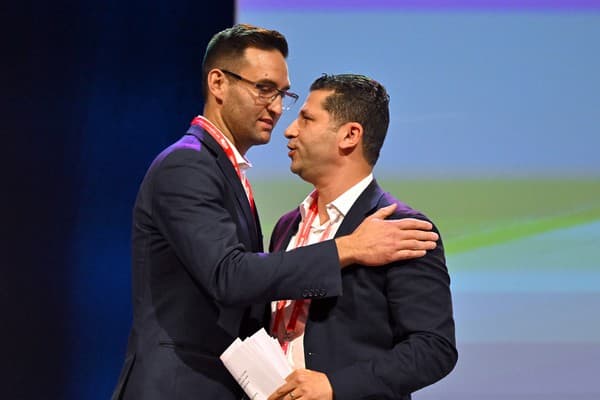
Josh Burns and Basem Abdo at the ALP national conference (AAP/Mick Tsikas)

Published: 30 July 2026

Last updated: 30 July 2026

There were three small steps to climb up to the podium where formalities for Labor’s 50th National Conference were being conducted.

As Jewish MP Josh Burns and Basem Abdo, an MP of Palestinian background, prepared to make their ascent, they paused and shared a gentle embrace.

Burns took the lectern first, and Abdo stood on the side of the stage.

Before speaking, Burns took a deep breath, paused, and let out a sigh. The weight of the moment – and that being carried on their shoulders – was obvious.

Burns began with the night of the Bondi terror attack, when he received a call from his newly elected parliamentary colleague, asking if he could join him at an event to mourn the attack with his community.

The next evening, a large contingent of parliamentarians from both sides of the political aisle gathered at Caulfield Synagogue.

As I looked over at the two of them sitting next to each other in the front row that night, it occurred to me that not many people in the crowd knew the identity of this man sitting next to Burns. Certainly, Abdo was spared the exaggerated boos on acknowledgement that other Labor MPs received from sections of the crowd.

Perhaps if they knew that Abdo was not only the Member for Calwell, but Australia’s first Muslim Australian MP with Palestinian ancestry, sitting in the synagogue next to his Jewish colleague, they would have felt the weight of its significance, as I did.

Standing together after Bondi

My experience of the aftermath of Bondi was to be overwhelmed with calls and messages of kindness and sympathy from my non-Jewish networks. Many moved me to tears – not least the ones that surprised me the most, from people I hadn’t spoken to in years.
But the poignancy of that image of Abdo and Burns sitting in synagogue together was one I kept coming back to.

This was politics – and the Labor movement – at its best. Two young men whose ancestors fled war and persecution on the other side of the world, whose families found themselves on opposite sides of modern history’s most divisive and seemingly intractable conflict, whose families found refuge in Australia, sitting together in its federal parliament.

On that night in Caulfield, both sat quietly, listening to the speeches and prayers, absorbing the pain, the sorrow and the anger.

Seven months later, at Adelaide’s Convention Centre, they climbed to the stage together, to offer separate contributions that conveyed a shared message of common humanity and hope for the future.

Neither glossed over the fact that they had differences of opinion on Labor’s platform, or its policies on the Middle East. Neither pretended their communities – or they themselves – were satisfied with it.

However, they sought to project something more powerful than division – a message of hope and optimism, of choosing to recognise each other’s shared humanity, of allowing that which they have in common to bring them together, rather than that which divides them to drive them apart.

Their decision to do so – months in the making – could have easily been derailed. As they stood on that stage, another parliamentary colleague was speaking to the press right outside, bemoaning his failure to secure support for a resolution that would have derailed this unity and put those differences and divisions front and centre.

Their message was addressed to their fellow Labor delegates, but it was directed across our nation. It came in the face of pushback and criticism from their parties, their communities, and sections of the public – some represented in protests outside the Convention Centre.

Both men faced fierce criticism during the election

Both Burns and Abdo were elected last year despite fierce criticism from their communities and opposition from opponents to their party’s policies on the Middle East – both of which came from both directions.

Closest to home for our community, Burns has faced a torrent of abuse from anti-Israel and antisemitic protesters – as he detailed in his Royal Commission testimony last month. So too has his partner, Georgie Purcell – who is not Jewish – but who chose to bravely speak out about the abuse directed at her, and even their newborn child, over their relationship.

The Royal Commission is telling powerful stories, and we all hope it will move public sentiment and result in cultural and systemic change.

Perhaps the message sent by Burns and Abdo will also have an impact on the tenor of our nation’s debate around the Middle East.

The sad truth is, it is far easier to give voice to division and difference around the Middle East than it is to set aside those differences to find hope and embrace humanity.

This is a lesson for us within our community as well, in how we treat each other, and how we deal with differences of opinion from those who share our ancient ancestry and traditions.

The abuse Burns and other Jewish MPs have faced has come not only from antisemites; accusations of disloyalty to their Jewish identity and the community have also come from within.

Mark Dreyfus told the Royal Commission last week of both, including being called a “Kapo” during last year’s election campaign on live television by a Jewish presenter.

Just days before the conference, Burns was accused by his predecessor of acting as a “Human Shield” for the government, a vitriolic diatribe based on the false and uninformed claim that he was set to move and endorse the party platform.

ALP statement passed without amendment

Ultimately, as I predicted in The Jewish Independent last Thursday, Labor’s Middle East Statement was passed without amendment. Its contents drew justifiable criticism from community leaders for being an incomplete and one-sided picture of its policy on the conflict, but it represented no change to government policy, nor calls for it to make any. This made it the first National Conference in decades not to push Labor’s Israel policy to shift further.

The lessons we take away from the Royal Commission, Labor’s conference and these challenging times are up to all of us – whether we move forward motivated by anger and retribution, or with hope and generosity, committed to building the bridges we need to secure our future.

In politics, just as in the world, when you don’t have the numbers, you have to build coalitions and find common ground with other groups to succeed.

If a Jewish-Australian and a Palestinian-Australian MP can set aside their differences to stand together, not to abandon those differences, but to look for the common hope and humanity they both hold, perhaps we can all find those commonalities in our own worlds – in our workplaces, our industries, our friendship circles, and even in our own families.

Choosing hope over division is rarely the easy choice. But it might just be the one that offers greater comfort and contentment than perpetual division and conflict.

Click to Watch the Speeches

Josh Burns

Basem Abdo  

You might also like
  • ‘Israel is systemically eliminating Palestinian collective life’:  B’Tselem
    Deborah Stone
  • Tame apologises – but with little grace
    Deborah Stone
  • Confronting Richard Flanagan and the myth of the Israel lobby
    Mary Garden
logomark.67a07ee3
We believe in the free flow of information

Republish our articles for free, online or in print, by using our Creative Commons licence

You might also like

    Apple & rotten core Rosh hashanah
    EditorialAustralia

    Facing a new year with the knowledge life can be better

    The Jewish Independent
    Generation Change: Rachel Moshel
    Generation ChangeInterviewArts & Culture

    Rachel Moshel: Creating a space for Jewish art and joy

    Gideon Cohen
    Woman with land and houses behind her
    NewsAustralia

    Australia to increase sanctions against West Bank settlements

    Deborah Stone 2

About the author

Dean Sherr

Dean Sherr

Dean Sherr is a consultant and a former adviser to state and federal Labor MPs, including media adviser to Prime Minister Anthony Albanese. He has also served as a past AUJS National President and ECAJ councillor.

More from the author

AnalysisAustralia

Now is the time for the Royal Commission to deliver, not be politicised

AnalysisAustralia

ALP draft stained by Hamas omission but conference set to maintain status quo

OpinionAustralia

Segal report backlash reveals the heart of the antisemitism debate’s problem

Comments2

  • Avatar of BF

    BF1 August at 12:49 pm

    Unfortunately, this unity is not deemed worthy of media coverage. For example, the 7am Podcast ignored this story and instead lamented that no-one agrees with Ed Husic and that “Albo” has gone soft and is too centrist.

  • Avatar of Pearl Jago

    Pearl Jago30 July at 12:14 pm

    This is a comprehensive view of the state of antisemitism & how much it has increased & how the government have watered down original bills