Published: 18 April 2018
Last updated: 4 March 2024
“Tonight, I call on all of you, and on all young Jews around the world: Come to Israel, Make Aliya. This is your country. This is your birthright. I was proud to represent Israel in Paris alongside other world leaders in the fight against terror. I saw there masses of French people marching and saying ‘Je Suis Charlie’ — and in my heart, I said to myself ‘for us [Jews] there is an additional question — can Jews in other countries march in the street declaring:‘Je Suis Juif’ [I am Jewish]? I tell you as Prime Minister of Israel what every Jew in the State of Israel can say, ‘Je Suis Juif’, and we declare this without fear, without hesitation, and with great pride”.
Benjamin Netanyahu, January 14, 2015, at the annual Taglit-Birthright “Mega Event”’
It was philosopher and thinker Ahad Ha'am (Asher Zvi Hirsch Ginsberg), considered one of Zionism’s least practical thinkers, who already in 1912 envisioned the need to thoroughly examine the relationship between the Jewish state and the Diaspora. He raised the principle regarding the nature of the relationship between the motherland and its Diaspora in the context of the discussion on Eretz Yisrael (The land of Israel) which he imagined as both the historical motherland and the actual nation-state-to-be.
He was the first to acknowledge that even after the establishment of the Jewish state, the majority of Jews would remain in the Diaspora. Therefore, he argued, the Zionist movement ought to devote reflection, attention and resources to the question of the relationship between the political centre that would evolve in Israel and the Jewish communities that would remain in the Diaspora.
Ahad Ha'am argued that the relationship between the political centre and the Diaspora should be based on “spiritual influence”. The purpose of this spiritual (or what today we would call cultural) connection is to forge a positive influence, a connective tissue, between the centre and its Diasporas. This spiritual connection is not metaphysical or religious; it is a deep, complex, cultural and intellectual influence, forged by an array of personal and collective commitments.
He articulated the idea of spiritual influence as a reaction to the “political materialists” of the Zionist movement. For them, the political centre was everything. He compares the materialists to the Sadducees of ancient times: “The political materialists, for whom the existence of the state was everything, had nothing to live for after the political catastrophe; what political catastrophe? and so they fought desperately and did not budge, until they fell dead among the ruins that they loved”.
Ahad Ha’am placed great importance on a balanced relationship between the Diaspora and the homeland, whereas the Zionist materialists tended to ignore the legitimate needs of the Diaspora, and they were certainly not aware of the new Diaspora that was developing in the western democratic world.
In his argument with materialist Zionism, he was, and still is, on the losing side. According to Ahad Ha’am, a negative reasoning for Zionism, such as viewing Israel as a response to anti-Semitism or assimilation similar to Netanyahu’s speech at the Taglit-Birthright event, cannot serve as the connective tissue. It’s not only Netanyahu who talks like this.
Many Israeli representatives tend to describe Israel with the metaphor “insurance policy”. Israel is the Diaspora’s insurance policy against the threats of anti-Semitism, terrorism and assimilation. In other words, it seems like Israel replaced the moral concept of being Or La’goyim (light upon the nations) with the idea that Israel is the safe haven for Jews in distress seeking an existential solution.
As Ahad Ha’am predicted, it will be the way Israel faces moral dilemmas - such as occupation over the Palestinians, the Jewish character of the state, the balance between being Jewish and democratic, and the policies toward asylum seekers – that will determine the role Israel will have in the relationship with the Diaspora. Israel will also have to consider the moral and practical implications of some of its political decisions on the Diaspora and the future of the Jewish people.
Having said that, I believe the possibility of creating an Ahad Ha’am style spiritual influence depends more on the Diaspora. Its leaders should feel confidant to approach Israeli leaders and the Israeli public and raise their concerns about the moral implications of Israel’s policies, particularly in the context of Jewish values.
In February 2017, a week before Netanyahu’s historic visit to Australia, I wrote an article in The Jewish Independent and in the American Jewish magazine The Forward calling on the leaders of Australian Jewry to seek from the Israeli Prime Minister unambiguous answers to questions regarding the future of the Western Wall, freedom of speech in Israel, the right of Palestinians to have their own state and the rise of anti-Semitism in the United States (and the lack of response from Trump).
Only a strong and confident Diaspora leadership, one that can raise important moral questions that gain the respect of the Israeli leadership and public, will be able to initiate a successful discourse of mutual spiritual influence.
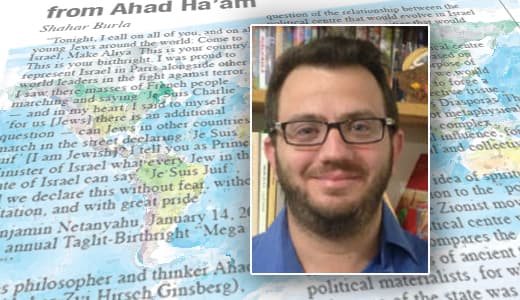
Dr Shahar Burla is a Sydney-based researcher, lecturer and editor at The Jewish Independent. He is the author of “Political Imagination in the Diaspora: The Construction of a Pro-Israeli Narrative” (2013) and co-editor of “Australia and Israel: A Diasporic, Cultural and Political Relationship” (2015).