Mansour Abbas’s bold bid to reshape Israeli politics
The Arab politician’s bold political strategy could transform Ra’am into a legitimate coalition partner and reshape Arab participation in Israeli government
Shahar Burla
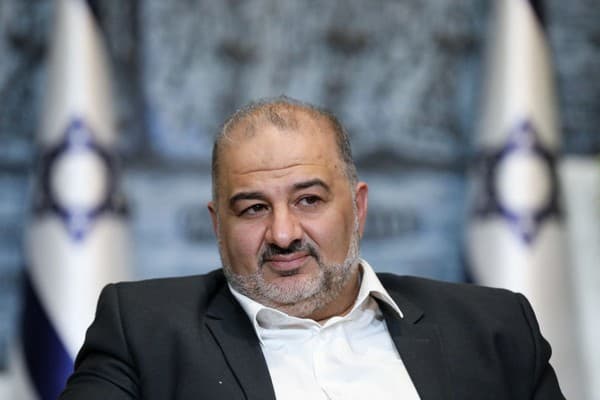
Mansour Abbas ( ABIR SULTAN/POOL/AFP via Getty Images)
Published: 5 August 2026
Last updated: 5 August 2026
As Israel heads towards its October election, Ra’am party leader Mansour Abbas is once again displaying the political courage and strategic skill that have made him one of the country’s most influential politicians.
Reports that Abbas is considering adding Yesh Atid MK Yoav Segalovitz to Ra’am’s electoral slate remain, for now, unconfirmed. Abbas has stressed that no decision will be made before the party’s general conference on August 22, when Ra’am, now operating as an independent political body, will select its Knesset candidates. Yet even the possibility of cooperation with Segalovitz, a Jewish former senior police officer with extensive experience in combatting organised crime in Arab communities, is significant.
Together with Ra’am’s recently finalised separation from the southern branch of the Islamic Movement, the proposal reveals Abbas’s broader strategy. He is attempting to transform Ra’am from an Arab Islamist faction into an independent political party capable of participating fully in Israeli decision-making.
It is a brilliant but courageous gamble. A Jewish candidate with Segalovitz’s security credentials could make Ra’am more difficult to delegitimise, and strengthen its claim to be a legitimate partner in government. It could also ensure that the crisis of violence in Arab communities, too often treated as an internal Arab problem, is finally recognised as a national emergency.
That would give Israel’s Arab citizens something increasingly scarce: hope that political participation can produce practical change.
However, the strategy carries considerable risks. Abbas could alienate parts of Ra’am’s traditional religious base without persuading Jewish opposition leaders to accept the party as a coalition partner. The election may therefore determine whether Abbas’s political project represents the future of Arab participation in Israeli politics, or an experiment that the country’s deepening divisions will not allow to succeed.
How did Abbas become Israel’s Arab kingmaker?
In 2021, Abbas, a dentist from the Galilee, made history. Ra’am became the first independent Arab party to formally join an Israeli governing coalition, helping to end Benjamin Netanyahu’s more than decade-long period in power.
Although the Bennett-Lapid coalition lasted only 18 months, Abbas demonstrated that an Arab party did not have to remain permanently outside the centres of power. Instead of concentrating primarily on the Israeli-Palestinian conflict, he negotiated funding and policy commitments addressing crime, housing, infrastructure and economic inequality within Arab communities.
Abbas now hopes to further develop that model. In a fragmented Knesset where neither the Netanyahu bloc nor the Zionist opposition appears certain to reach the 61 seats required for a majority, Ra’am’s projected seats could again become decisive.
That possibility explains why Netanyahu and his allies are likely to make Ra’am’s legitimacy a major election issue. Their objective will be to convince soft-right opposition voters that a government led by Naftali Bennett, Gadi Eisenkot, or another Netanyahu rival would be dangerously “dependent on the Arabs”.
Netanyahu has also promised to advance steps against the Muslim Brotherhood in Israel. Ra’am has historically been the political arm of the southern branch of the Islamic Movement, which emerged from the Muslim Brotherhood tradition but chose participation in Israeli elections and rejected the northern branch’s separatist approach.
Abbas understands that this connection creates both a legal and political vulnerability. The formal separation from the Islamic Movement is therefore not merely administrative. It is an attempt to remove the most effective weapon used to portray Ra’am as an illegitimate or potentially subversive organisation.
What shaped Abbas’s political pragmatism?
Abbas’s approach is rooted in his upbringing in Maghar, a mixed Galilee town whose population includes Druze, Christians and Muslims. He has described himself as having always been “a minority within a minority”.
His father, Ghazi, served on the local council and was also known as a sulha man, a community mediator who helped reconcile families and resolve disputes. Abbas grew up observing people seek his father’s assistance, an experience that appears to have influenced his preference for negotiation over ideological confrontation.
His alternative was controversial but straightforward: Ra’am would negotiate with any political camp willing to deliver practical benefits to Arab communities
Born in 1974, Abbas studied dentistry at the Hebrew University of Jerusalem but became deeply involved in Islamic and political activism. He helped establish a student organisation representing the Islamic Movement while campaigning on practical issues, such as discrimination and the lack of university accommodation for Arab students.
This focus on achievable improvements became central to his political identity. Abbas did not abandon Palestinian national concerns, but increasingly argued that Arab politicians had an immediate responsibility to address the conditions in which Israel’s Arab citizens lived.
After becoming Ra’am leader in 2018, he grew uncomfortable with the Joint List’s traditional strategy. While its parties were united around Palestinian rights and opposition to the occupation, Abbas believed that remaining outside every potential coalition had left Arab citizens with moral declarations yet limited influence over government budgets or policy.
His alternative was controversial but straightforward: Ra’am would negotiate with any political camp willing to deliver practical benefits to Arab communities. Abbas even held discussions with Netanyahu before eventually joining the Bennett-Lapid coalition.
Why has Ra’am separated from the Islamic Movement?
Ra’am’s new organisational independence may be Abbas’s most important move since entering government in 2021.
The party’s general conference will now select its Knesset candidates and make political decisions without the involvement of the Islamic Movement or its Shura Council, an Islamic advisory body guided by religious principles.
Abbas insists that the separation does not mean abandoning Ra’am’s traditional supporters, many of whom identify with the Islamic Movement. Party activists and movement members will continue to overlap. However, they will formally belong to two independent bodies: one religious and social, the other political.
The distinction matters. It gives Ra’am greater freedom to negotiate alliances, include Jewish candidates and join a future coalition without requiring approval from a religious council. It may also help protect the party against attempts to associate it with the global Muslim Brotherhood or Hamas.
Placing Segalovitz high on Ra’am’s slate would turn the battle against crime into the foundation of a new Jewish-Arab political partnership. It would also challenge the claim that Ra’am represents only narrow Islamist interests
For Abbas, this is the next stage of a long political evolution. The southern branch of the Islamic Movement chose parliamentary participation in the 1990s, arguing that Arab citizens had to work within the Israeli system to advance their rights. Abbas is now taking that principle further: if Ra’am is serious about sharing power, it must operate as an autonomous political organisation.
Yet independence will test his authority. Some members fear that broadening the party could weaken its Islamic identity and distance it from its core constituency, particularly traditional Bedouin communities in the Negev. Abbas must persuade them that political flexibility is not the abandonment of principles but the means of translating those principles into results.
Why would Segalovitz be such a powerful addition?
The choice of Segalovitz is central to the proposal’s potential impact. Before entering politics, Segalovitz was a senior police officer who established Lahav 433, Israel’s national unit for investigating organised crime and corruption. As deputy public security minister in the Bennett-Lapid government, he was given responsibility for coordinating efforts against violence in Arab society.
He developed unusually strong relationships within Arab communities and continued visiting towns affected by serious crime after the government fell. His record gives him credibility on the issue that Abbas has made his political priority.
Arab communities have experienced years of murders, shootings, extortion and organised criminal activity. The crisis has been compounded by deep distrust of the police, illegal weapons and the state’s failure to dismantle criminal organisations with the intensity previously directed at Jewish organised crime.
Abbas has often intervened personally in violent family disputes through traditional reconciliation processes. But he knows community mediation cannot substitute for effective policing, prosecutions, economic investment and sustained government coordination.
Abbas is not merely seeking another term in the Knesset. He is trying to establish Arab political participation as a permanent and legitimate part of Israeli government
Placing Segalovitz high on Ra’am’s slate would turn the battle against crime into the foundation of a new Jewish-Arab political partnership. It would also challenge the claim that Ra’am represents only narrow Islamist interests. A former senior police commander, and potentially a candidate for national security minister, would be difficult to dismiss as a supporter of extremism.
The arrangement remains uncertain, and there is opposition inside Ra’am. Abbas has said any addition will proceed only if it advances the party’s objectives: replacing the current government, joining the next coalition and addressing crime, inequality, racism and home demolitions.
Can Abbas overcome the opposition boycott?
The greatest obstacle is not whether Ra’am can change, but whether Jewish politicians are prepared to recognise that change.
Bennett and Avigdor Liberman have ruled out relying on Ra’am, while Eisenkot has also distanced himself from such cooperation. Their caution reflects the pressure they expect from Netanyahu’s campaign and from voters whose attitudes towards Arab political participation have hardened since the Hamas-led attack of October 7, 2023.
Nevertheless, the electoral arithmetic may eventually force a reconsideration. The anti-Netanyahu parties could struggle to form a majority without Ra’am, particularly if Arab turnout remains low or votes are lost among competing smaller parties.
Abbas’s reported courtship of Segalovitz is designed precisely for this moment. By separating Ra’am from the Islamic Movement, opening its slate to Jewish candidates and placing the fight against organised crime at the centre of its campaign, he is making refusal more difficult to justify.
There is no guarantee the strategy will succeed. Abbas could pay a price among Arab voters while opposition leaders continue to reject him. But the ambition behind the move is unmistakable.
Abbas is not merely seeking another term in the Knesset. He is trying to establish Arab political participation as a permanent and legitimate part of the Israeli government. If he succeeds, Ra’am could again determine who becomes prime minister, and begin changing the boundaries of who is permitted to share power in Israel.
About the author
Dr Shahar Burla is a Sydney-based researcher, lecturer and Contributing Editor of TJI. Shahar holds a Master’s degree in political science from Hebrew University and a PhD in political science from Bar-Ilan University. He is the author of Political Imagination in the Diaspora: The Construction of a Pro-Israeli Narrative (2013) and co-editor of Australia and Israel: A Diasporic, Cultural and Political Relationship (2015).