Aa
  • Read, Watch, Listen
  • TJI Series
  • Community Action
  • Events
  • Zedi
Follow us and continue the conversation
  • LinkedIn
  • Instagram
  • FaceBook
  • X
  • YouTube
Test yourself with the TJI Quiz!

Adjust size of text

Aa

Follow us and continue the conversation

  • LinkedIn
  • Instagram
  • FaceBook
  • X
  • YouTube

Your saved articles

You haven't saved any articles

What are you looking for?

Original reporting, insightful analysis and diverse views, delivered straight to your inbox

  • LinkedIn
  • Instagram
  • FaceBook
  • X
  • YouTube
Your support fuels our mission to inform, entertain and inspire.

The Jewish Independent is bound by the Standards of Practice of the Australian Press Council. If you believe the Standards may have been breached, you may approach The Jewish Independent or make a complaint to the Australian Press Council in writing at www.presscouncil.org.au. The Council may also be contacted on 1800 025 712.

  • Our Story
  • Contact us
  • Our Team
  • Support us
  • Guidelines
  • Pitch your idea
  • Republishing us
  • Community Action
  • Our Awards
  • LinkedIn
  • Instagram
  • FaceBook
  • X
  • YouTube
Aboriginal FlagTorres Strait Islanders Flag

The Jewish Independent acknowledges Aboriginal and Torres Strait Islander peoples as the Traditional Owners and Custodians of Country throughout Australia. We pay our respects to Elders past and present, and strive to honour their rich history of storytelling in our work and mission.

© The Jewish Independent 2026All Rights Reserved
Website design and development by Your Creative, MelbourneTerms & ConditionsPrivacy Policy
HomeRead, Watch, ListenIsrael
AnalysisIsrael

Netanyahu renames war, taking a shot in the battle of blame

The Gaza war is now officially 'The War of Revival', a name change that attempts to paper over deep unresolved divisions about October 7 and the conduct of the war.
Eetta Prince-Gibson
Print this
Benjamin Netanyahu papers over cracks with an announcement labelled "War of Revival"

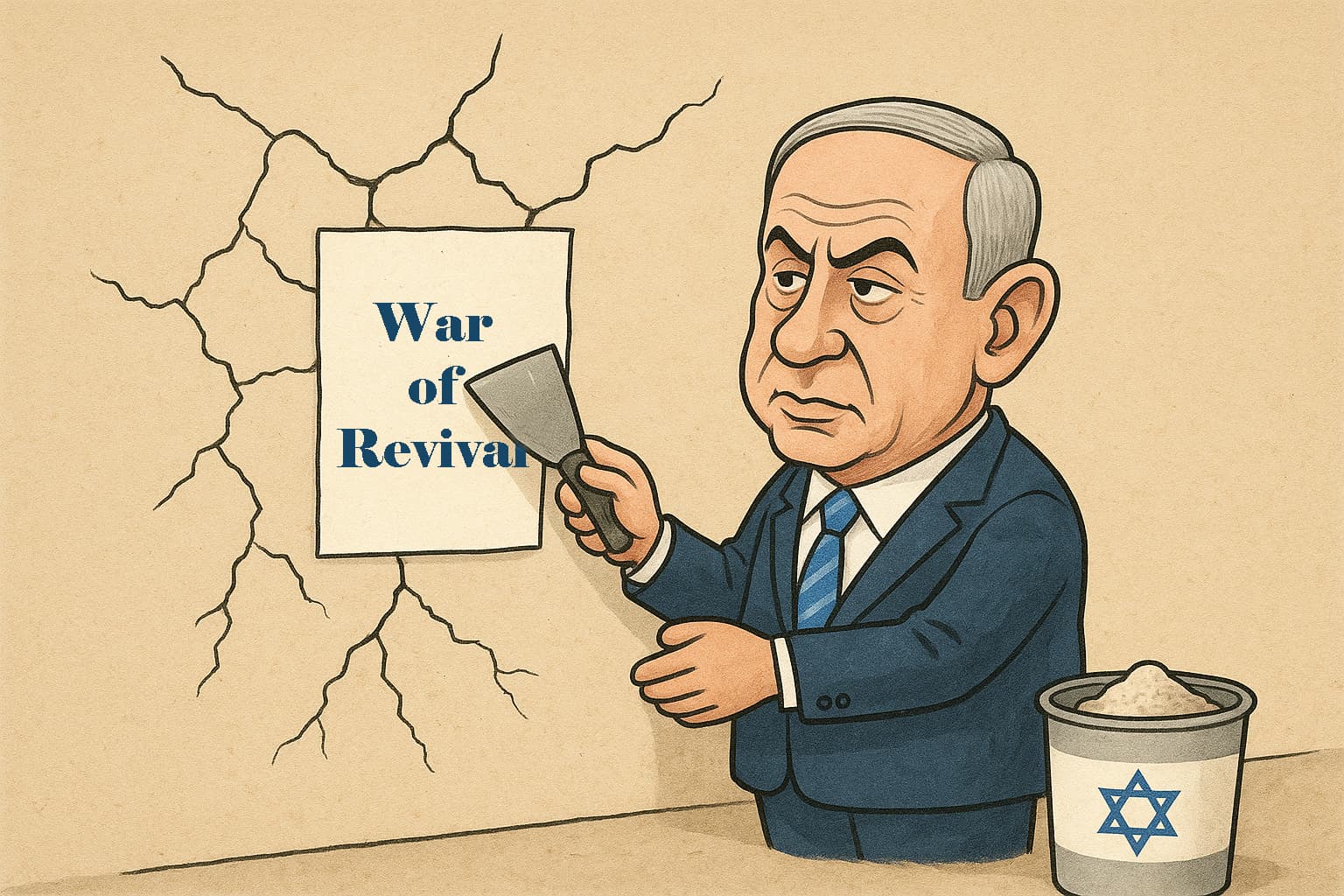
Benjamin Netanyahu has announced a new name for the Gaza War (AI/ Chat GPT)

Published: 23 October 2025

Last updated: 23 October 2025

What’s in a name? Unlike Juliet in her famous balcony soliloquy in Shakespeare’s Romeo and Juliet, Israeli Prime Minister Benjamin Netanyahu does not believe that a war by any other name would be the same.

Earlier this week, the government backed a proposal brought by Netanyahu to rename the war that began with the murderous assault from Gaza on October 7, 2023.  From now on, the longest war in Israel’s history will be officially called, “The War of Revival”.

The term will be used in all public ceremonies and, crucially, the education system.

Netanyahu explained the decision by stating, “We rose from the terrible disaster of October 7. This is the war of our revival—a direct continuation of the War of Independence.”

Actually, the war already had a name.  Computers at the Israel Defense Forces print out random catchy names as soon as the government declares that Israel is at war, and they came up with “Iron Swords” for this one.  But the public rarely accepts these names, and this war is popularly referred to as “The War of October 7” or “The Gaza War”. At The Jewish Independent we often referred it as The Israel-Hamas War, making it clear that Israel’s opponent is Hamas, not all Palestinians.

This was, and remains, the October 7 war, the October 7 government, and the October 7 disaster

Opposition leader Yair Lapid

Netanyahu has never liked the name, “Iron Swords” – and he likes the popular names even less. The naming-shaming in the popular branding has made it difficult for him to distance himself from the worst disaster the Jewish world has known since the Holocaust.  They bring up the associations of the death, the horror, the trauma, and the government’s failure - and his responsibility for them. 
The associations attached to “The War of Revival,” on the other hand, are more upbeat and bring a hint of religious, even messianic, fervor.  The word for redemption is derived from the Hebrew verb lakum, meaning "to rise" or "to stand up”; alternate translations include “redemption”, “rebirth”, and even “resurrection”. 

Politics and pragmatics

The revival, Netanyahu apparently hopes, would also be his own, since Israel is scheduled to go to general elections in 2026.  A recent poll by Channel 12 news revealed that 63% of a representative sample of Israelis think that Netanyahu should resign; 27% think he should not and 10% percent say that they do not know.

Even within his own government, Netanyahu knows that support for him is conditional, and that he must constantly please and placate both the ultra-Orthodox and the far-right religious Zionist parties. National Projects Minister Orit Strock of the Religious Zionism party voted against the proposal to change the war’s name, saying, “We have to wait and see if we achieve all of its [the war’s] goals or if new dangers enter the picture in Gaza, for example forces from Turkey, Qatar and the like, or if we hand over [responsibility for] dismantling the tunnels to people I wouldn’t trust to fix the plumbing in my house,” she said.

The new moniker for Israel’s longest war is also intended to imply that the war is over, when it is far from clear that it is. The word, “t’kumah,” refers less to a process and more to a completed event, and is thus an attempt to brand the future.  His critics have claimed that Netanyahu has sought to prolong the war for his own political and personal benefit yet the name implies that the war has already been successfully brought to its victorious conclusion – ignoring the recent skirmishes in the Gaza, missiles sent over Israel, and the loss of two more soldiers this week.  Branding himself as bringing the war to an end puts Netanyahu in a stronger position as the election campaign heats up.

We will not allow an election slogan or the arrogant propaganda of this cold-hearted government to desecrate his tombstone

Yizhar Shai, father of Yaron Shai who died on October 7

Perhaps, then, Netanyahu was not aware of the irony that ended the cabinet meeting in which the new name was approved. Netanyahu declared that Israel was already getting ready to award citations to soldiers who fought in the war, which is usually done after war’s end.  “The decorations of the current campaign will bear the official name of the War of Revival,” he said.  And then he rushed out of the meeting because Hamas operatives had launched an attack on Israeli forces in the Gaza Strip.

Battle of blame

As expected, the opposition parties criticised the renaming as an attempt by to evade responsibility for failing to prevent October 7.

Opposition leader Yair Lapid declared, “The government can call the October 7 war whatever it wants – it won’t help. This was not a ‘war of revival.’ If anything, it was the ‘war of blame,’ named after all those who tried to escape responsibility and failed. This was, and remains, the October 7 war, the October 7 government, and the October 7 disaster. All attempts to erase what happened will fail, because the real story was written in blood.”

Families of the hostages, the causalities of October 7, and the soldiers who have fallen in  battle are also largely opposed to the change. Liad Baram, the father of Neta Baram, who fell on October 7 while defending the Nahal Oz outpost, told the media that the name change “is nothing less than spitting in the faces of the bereaved families.  Until a commission of inquiry is established…we cannot speak of Revival. 

Others cynically suggested that the war be called the War of “Hafkarah,” Hebrew for neglect or abandonment (which also rhymes with the new Hebrew name).

The war of the names-of-the-war also reflects deeper divisions in Israeli society.  During the pullout from Gaza in 2005, supporters of then prime minister Ariel Sharon used the formal and neutral name hitnatkut (disengagement), while those opposed called it the gerush, (expulsion or eviction), an emotionally-laden term that recalls the expulsion from Spain in 1492 BCE as well as the expulsions during the Holocaust. 

It is also likely to open up a new and very painful conflict, focusing on the inscriptions on the tombstones of the soldiers who died in combat in the war.  Yizhar Shai, father of Yaron, who died in battle on October 7, told the press that the government, “should not dare to even think about touching the sacred grave of our son, the hero.  We will not allow you to even come close.  We will not allow an election slogan or the arrogant propaganda of this cold-hearted government to desecrate his tombstone.”

You might also like
  • New evidence Netanyahu was warned about October 7
    Shahar Burla
  • The Altalena should be a warning, not a political weapon
    Shahar Burla
  • Who is Ofer Winter and could he upset Netanyahu’s election?
    Shahar Burla
logomark.67a07ee3
We believe in the free flow of information

Republish our articles for free, online or in print, by using our Creative Commons licence

You might also like

    Btselem
    NewsIsrael

    ‘Israel is systemically eliminating Palestinian collective life’:  B’Tselem

    Deborah Stone
    Protest
    AnalysisIsrael

    Western ‘Palestinianism’ colonises everything – and hurts Palestinians

    Andres Spokoiny 5
    Woman with land and houses behind her
    NewsAustralia

    Australia to increase sanctions against West Bank settlements

    Deborah Stone 2

About the author

Eetta Prince-Gibson

Eetta Prince-Gibson, who lives in Jerusalem, was previously Editor-in-Chief of The Jerusalem Report, is the Israel Editor for Moment Magazine and a regular contributor to Haaretz, The Forward, PRI, and other Israeli and international publications.

More from the author

AnalysisIsrael

Segalovitz decision to join Arab party is a paradigm change for Israel

AnalysisIsrael

Netanyahu pre-election juggling act

AnalysisIsrael

Women disadvantaged by new powers for Israel’s religious courts

AnalysisArts & Culture

The Sea: deserving award-winning film or one-sided disgrace?

Comments

No comments on this article yet. Be the first to add your thoughts.