Aa
  • Read, Watch, Listen
  • TJI Series
  • Community Action
  • Events
  • Zedi
Follow us and continue the conversation
  • LinkedIn
  • Instagram
  • FaceBook
  • X
  • YouTube
Test yourself with the TJI Quiz!

Adjust size of text

Aa

Follow us and continue the conversation

  • LinkedIn
  • Instagram
  • FaceBook
  • X
  • YouTube

Your saved articles

You haven't saved any articles

What are you looking for?

Original reporting, insightful analysis and diverse views, delivered straight to your inbox

  • LinkedIn
  • Instagram
  • FaceBook
  • X
  • YouTube
Your support fuels our mission to inform, entertain and inspire.

The Jewish Independent is bound by the Standards of Practice of the Australian Press Council. If you believe the Standards may have been breached, you may approach The Jewish Independent or make a complaint to the Australian Press Council in writing at www.presscouncil.org.au. The Council may also be contacted on 1800 025 712.

  • Our Story
  • Contact us
  • Our Team
  • Support us
  • Guidelines
  • Pitch your idea
  • Republishing us
  • Community Action
  • Our Awards
  • LinkedIn
  • Instagram
  • FaceBook
  • X
  • YouTube
Aboriginal FlagTorres Strait Islanders Flag

The Jewish Independent acknowledges Aboriginal and Torres Strait Islander peoples as the Traditional Owners and Custodians of Country throughout Australia. We pay our respects to Elders past and present, and strive to honour their rich history of storytelling in our work and mission.

© The Jewish Independent 2026All Rights Reserved
Website design and development by Your Creative, MelbourneTerms & ConditionsPrivacy Policy
HomeRead, Watch, ListenIsrael
ExplainerIsrael

New construction project could spell death of two-state solution

The Israeli government has approved the controversial E1 settlement project, a decisive step in Smotrich's "de facto sovereignty plan".
TJI Wrap
Print this
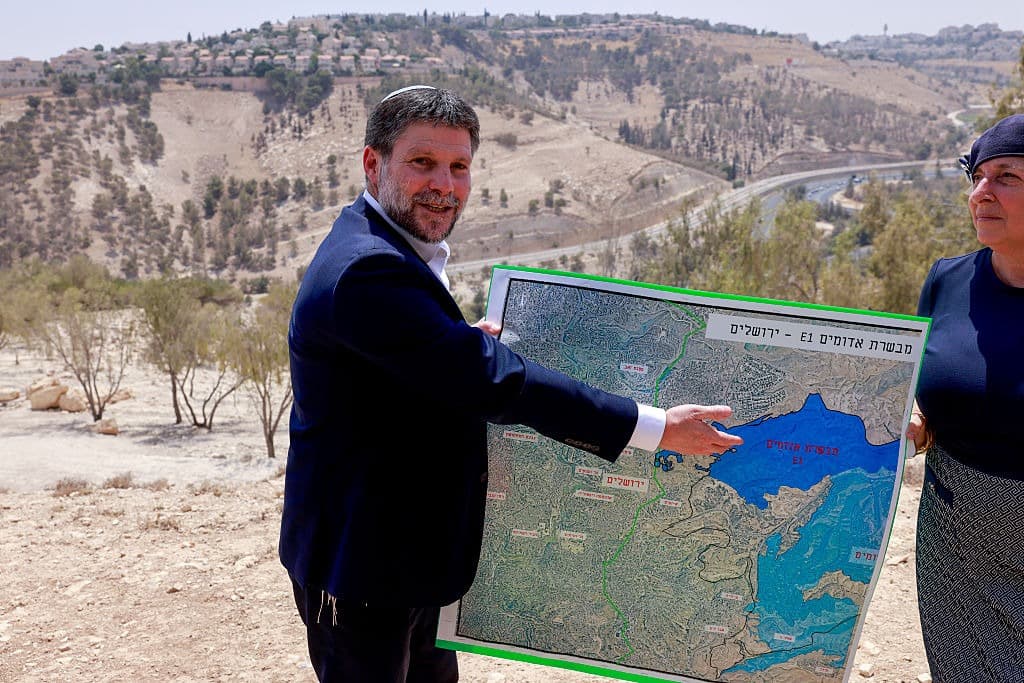
Man with a large map in front of a barren landscape

Finance Minister Bezalel Smotrich displays a map of the E1 settlement zone (MENAHEM KAHANA/AFP via Getty Images)

Published: 21 August 2025

Last updated: 21 August 2025

On Wednesday, Israel formally approved the long-delayed and deeply controversial construction plan for the E1 area of the West Bank, a move that critics say will effectively sever the northern and southern parts of the territory and fatally undermine prospects for a two-state solution. The decision, celebrated by members of the country’s far-right coalition, provoked swift and widespread condemnation from the international community.

The approval of more than 3,000 housing units in the E1 zone follows decades of postponement under pressure from successive American and European governments. Far-right Finance Minister Bezalel Smotrich hailed the decision as a historic victory for the settlement movement and the consolidation of Israeli sovereignty in the West Bank. “The Palestinian state is being erased – not with slogans, but with actions,” he declared.

Smotrich insisted the project represents a decisive step in what he has called the government’s “de facto sovereignty plan,” aimed at permanently integrating the West Bank into Israel’s jurisdiction. “This buries the idea of a Palestinian state and continues the many steps we are taking on the ground,” he said. Smotrich, who also serves as a minister within the broader Defence Ministry, added that Prime Minister Benjamin Netanyahu “backs me up in everything concerning Judea and Samaria [the biblical term for the West Bank]. He is letting me create the revolution.”

What is the E1 zone?

The E1 area, roughly 12 square kilometres of mostly undeveloped land, is located between the settlement city of Ma’ale Adumim, home to some 40,000 residents, and the Palestinian neighbourhood of Shuafat in East Jerusalem. While officially part of Ma’ale Adumim municipality, the land has remained open desert for decades.
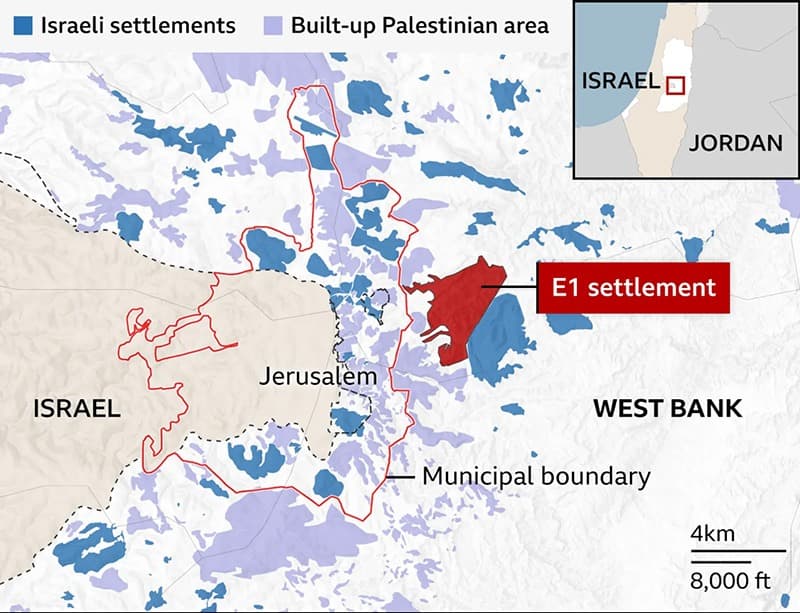
A map of the E1 settlement plan (Peace Now)

Plans to build in the zone date back to 1995 under the late Prime Minister Yitzhak Rabin. Yet every attempt to move forward has run into international resistance, most notably from the US. The George W. Bush administration in 2005 warned that construction in the area would “contravene American policy.” In 2021, Israel’s High Planning Committee once again discussed the project, but postponed approval after U.S. and European objections.

The project’s significance lies in geography: if completed, E1 would create a continuous block of Jewish settlements linking Ma’ale Adumim to Jerusalem. This would physically cut off the northern West Bank from the south, obstructing Palestinian movement between key cities such as Ramallah, East Jerusalem and Bethlehem. Palestinian and international critics argue the move would make the establishment of a contiguous, viable Palestinian state virtually impossible.

Last year, Israel sought to mitigate criticism by approving a new highway intended for Palestinian use, allowing residents to bypass the E1 zone. However, critics argued that the road simply entrenches segregation, reserving prime routes for settlers while diverting Palestinians around them.

Human rights organisations say the E1 project exemplifies the broader policy of deepening Israeli control while constraining Palestinian development. Peace Now, an Israeli NGO that monitors settlement activity, warned: “The Netanyahu government is exploiting every minute to deepen the annexation of the West Bank and prevent the possibility of a two-state solution. It is clear to everyone today that the only solution to the conflict, and the only way to defeat Hamas, is through the establishment of a Palestinian state alongside Israel. The government of Israel is condemning us to continued bloodshed, instead of working to end it.”

International reactions

The decision prompted immediate and sharp responses from world capitals. The European Union reiterated its position that any Israeli annexation of occupied land is illegal under international law. “The EU rejects any territorial change that is not part of a political agreement between the involved parties. Annexation of territory is illegal under international law,” said European Commission spokesperson Anitta Hipper.

Nabil Abu Rudeinah, spokesperson for Palestinian President Mahmoud Abbas, denounced the plan as a victory for “the terror of the settlers” over international law. He urged the United States to intervene and pressure Israel to halt settlement expansion.

Britain’s Foreign Minister, David Lammy, issued a strongly worded statement: “The UK strongly opposes the Israeli government’s E1 settlement plans, which would divide a future Palestinian state in two and mark a flagrant breach of international law.” Germany also “strongly objected” to the plan, urging Israel to “stop settlement construction” in Palestinian territory. Norway’s Foreign Minister, Espen Barth Eide, condemned Smotrich’s leadership, saying it demonstrated Israel’s intent “to appropriate land owned by Palestinians in order to prevent a two-state solution.”

Human rights groups and UN officials echoed these concerns, warning the move would further entrench conflict and destabilise the region.

Smotrich’s power shift

While opponents warn that E1 may kill the two-state solution, some analysts argue that outcome is already a reality. Writing in Haaretz, commentator Becca Strober argued that Israel’s policies of the last decade have effectively nullified the Oslo Accords framework.

She noted that Smotrich’s appointment as a second minister in the Defence Ministry gave him unprecedented civilian authority over West Bank affairs. This shift transferred much of the governing power from the military to civilian ministries, a profound structural change. “Those critical of this most recent E1 plan as the assassination of the two-state solution have been asleep at the wheel, not only for the last year, but for well over a decade,” Strober wrote.

Under Smotrich’s direction, Israel has expanded demolitions of Palestinian homes in Area B and C, authorised new outposts, and assumed control over land registry for the first time since 1948. This legal mechanism allows the registration of land under Israeli ownership, effectively removing Palestinian property rights.

In addition, the government has allocated the equivalent of nearly $US1.9 billion to new West Bank infrastructure this year alone, primarily benefiting settlers. Critics argue these measures collectively entrench annexation, regardless of whether formal legislation is passed.

Sovereignty versus normalisation

The E1 decision coincided with remarks by Likud MK Boaz Bismuth, a close ally of Netanyahu and newly appointed chair of the Knesset Foreign Affairs and Defense Committee. Touring the northern West Bank alongside settler leaders, Bismuth said applying Israeli sovereignty to the territory is “more urgent” than pursuing normalisation agreements with Arab states. “Normalisation is important, but applying sovereignty is no less important – even more urgent,” Bismuth said. He described sovereignty as essential for ending the current conflict “in victory.”

A Tel Aviv resident, Bismuth emphasised his personal identification with the region, declaring: “I feel much more at home in Samaria than anywhere else in the world.” His use of the biblical name for the northern West Bank highlighted the ideological framing shared by many in Netanyahu’s coalition.

In a video circulated by Yossi Dagan, head of the Samaria Regional Council, Bismuth argued that sovereignty over the West Bank would constitute “a decisive victory” over Israel’s enemies.

The road ahead

The approval of the E1 plan marks a decisive moment in Israel’s settlement policy. While its implementation may still face procedural delays and international opposition, the political momentum within the current government appears firmly in favour of deepening Israeli control.

For Palestinians, the move symbolises not only the erosion of hopes for an independent state but also the steady encroachment on daily life through land seizures, road networks and building restrictions. For the international community, it raises pressing questions about the viability of a two-state solution, long seen as the only viable path to peace.

As Israel presses ahead, the rift between rhetoric and reality grows sharper. While global leaders reiterate support for two states, developments on the ground – from E1 to wider governance changes under Smotrich – suggest that annexation, whether de facto or formal, is advancing at pace.

The E1 project may therefore be less a turning point than a confirmation of a trajectory decades in the making.

READ MORE

Israel's Smotrich to approve E1 settlement plan that 'buries idea of Palestinian state' (Paywall, Al-Monitor)

Smotrich's West Bank plan isn't killing the two-state solution. Israel buried it long ago (Becca Strober, Haaretz)

Member of Netanyahu’s party says West Bank ‘sovereignty’ trumps Saudi normalization (Times of Israel)

Settlers establish new mobile homes in Palestinian neighborhood in Hebron (Times of Israel)

Why Israel—and Trump—should support Palestinian statehood (Ami Ayalon , Gilead Sher and Orni Petruschka, Time)

You might also like
  • ‘Israel is systemically eliminating Palestinian collective life’:  B’Tselem
    Deborah Stone
  • Tame apologises – but with little grace
    Deborah Stone
  • Confronting Richard Flanagan and the myth of the Israel lobby
    Mary Garden
logomark.67a07ee3
We believe in the free flow of information

Republish our articles for free, online or in print, by using our Creative Commons licence

You might also like

    ISRAEL-LGBTQ-PRIDE-PARADE-PALESTINIAN-CONFLICT-HOSTAGES
    NewsIsrael

    LGBT asylum seekers caught between Palestinian violence and Israeli bureaucracy

    Jarod Rhine-Davis
    Arab Israeli Palestinian election vote
    Israel Votes 2026FeatureIsrael

    Fear of Netanyahu victory may drive big surge in Palestinian voter turnout

    Ben Lynfield
    Woman with land and houses behind her
    NewsAustralia

    Australia to increase sanctions against West Bank settlements

    Deborah Stone 2

About the author

TJI Wrap

TJI Wrap

TJI wraps consolidate essential news and analysis from multiple sources into digestable summaries.

More from the author

NewsAustralia

War crimes allegations against Australian IDF soldier

NewsWorld

Wave of attacks on Jewish sites sparks international alarm

AnalysisIsrael

Gaza, Lebanon, Syria, Iran: Israel’s tense security landscape

AnalysisIsrael

Middle East on edge as Iran and Israel inch closer to another war

Comments1

  • Avatar of Ian Light

    Ian Light24 August at 10:09 pm

    Autonomy in water food shelter health is the most Israel can offer Palestinians in the Judea and Samaria /West Bank Area and all parts of Gaza by allowing 600 Trucks a day full of clean water food and medicine while continuing powerful and overwhelmingly Israeli Military Defence against the Hamas anti-Jewish Fascists .

    In Education Fascistic NeoNazi stereotypes and conspiracy libels about the Jewish People have to be illegal
    and liable to prosecution.
    The young children of Gaza their mothers and maternal grand parents have maternal great grand parents ought be allowed into Palestine Cities in Judea and Samaria Jordan and Lebanon .
    In Gaza only Combat Actives ought be present but treated according to the Geneva Conventions after surrender.