Aa
  • Read, Watch, Listen
  • TJI Series
  • Community Action
  • Events
  • Zedi
Follow us and continue the conversation
  • LinkedIn
  • Instagram
  • FaceBook
  • X
  • YouTube
Test yourself with the TJI Quiz!

Adjust size of text

Aa

Follow us and continue the conversation

  • LinkedIn
  • Instagram
  • FaceBook
  • X
  • YouTube

Your saved articles

You haven't saved any articles

What are you looking for?

Original reporting, insightful analysis and diverse views, delivered straight to your inbox

  • LinkedIn
  • Instagram
  • FaceBook
  • X
  • YouTube
Your support fuels our mission to inform, entertain and inspire.

The Jewish Independent is bound by the Standards of Practice of the Australian Press Council. If you believe the Standards may have been breached, you may approach The Jewish Independent or make a complaint to the Australian Press Council in writing at www.presscouncil.org.au. The Council may also be contacted on 1800 025 712.

  • Our Story
  • Contact us
  • Our Team
  • Support us
  • Guidelines
  • Pitch your idea
  • Republishing us
  • Community Action
  • Our Awards
  • LinkedIn
  • Instagram
  • FaceBook
  • X
  • YouTube
Aboriginal FlagTorres Strait Islanders Flag

The Jewish Independent acknowledges Aboriginal and Torres Strait Islander peoples as the Traditional Owners and Custodians of Country throughout Australia. We pay our respects to Elders past and present, and strive to honour their rich history of storytelling in our work and mission.

© The Jewish Independent 2026All Rights Reserved
Website design and development by Your Creative, MelbourneTerms & ConditionsPrivacy Policy
HomeRead, Watch, ListenAustralia
OpinionAustralia

On hatred, hope, and the Australian Labor Party

The Australian Labor Party is facing a moral crisis. Two contrasting recent events reveal the crossroads where antisemitism meets progressive politics.
Adam Slonim
Print this
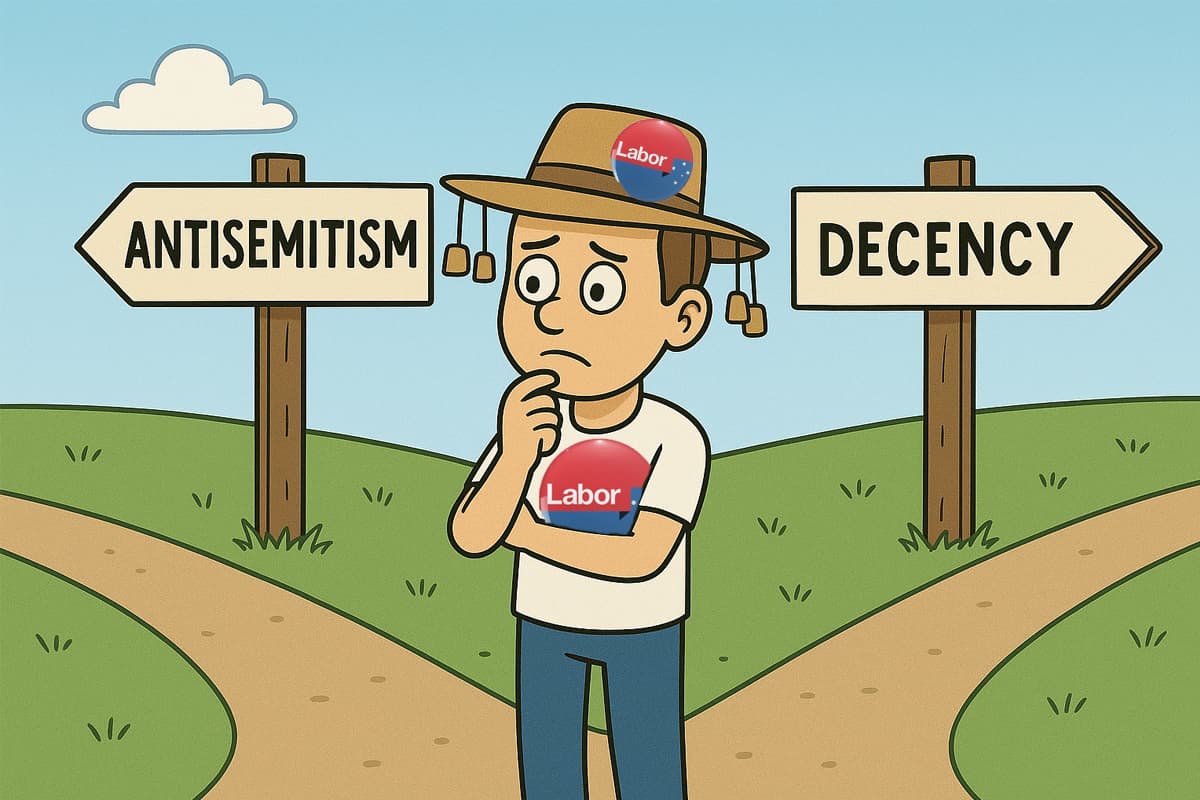
man in Akubra with Labor burt button at a crossroads with two signposts pointing in opposite directions, one reading Antisemitism and the other reading Decency

The ALP is at a crossroads (Image: ChatGPT/TJI)

Published: 10 December 2025

Last updated: 10 December 2025

There are moments in political life when events seem to part like a curtain, revealing not just the machinery of party dynamics but something older, almost biblical in contour.

Australia witnessed two such moments in recent weeks—one in Queensland, one in New South Wales—offering portraits so stark, so opposed in spirit, that they feel torn from different moral universes. Together, they form a parable about the state of the Australian Labor Party, the Jewish community, and the long shadow cast by the world’s oldest hatred.

The first moment came from Queensland Labor, whose branch members advanced a motion demanding the investigation and potential prosecution of Australian citizens who have served in the Israel Defence Forces. It was a motion of such remarkable selectivity—such clarifying ideological precision—that it could only be described as hateful in intent and discriminatory in effect.

There was no parallel call to investigate Australians who had joined ISIS as it beheaded and burned its way across the Middle East. No special motion for the Russians who aided in the execution-style murders of fleeing civilians in Bucha, or the Sudanese Australians who took up arms in the genocidal wars splitting their homeland like bone. No. Only one group, one nationality, one ethnicity, one battered sliver of people whose history is an unbroken millennia-long experiment in survival.

The motion singled out Jewish Australians.

Queensland Labor did what centuries of Jew-haters have done: it found a way to isolate Jews as a category apart, a class deserving suspicion and legal scrutiny. It dressed the motion in the hollow language of international law, but the targeting was unmistakable.

If this were the only story, the tale would be short and bitter: the party of equality and solidarity has become one more stage for the world’s oldest hate. The instincts of the mob have conquered the instincts of the movement.

But the second moment arrived from a different direction entirely. It came from the NSW chapter of Australian Young Labor.

The stakes reach beyond party politics into something much larger: the struggle for the moral soul of progressive movements in the West

Here, in a forceful act, NSW Young Labor passed a motion acknowledging the rising antisemitism that has driven young Jewish progressives away from the movement where they once campaigned for universal healthcare, workers’ protections, climate justice. Spaces where they had felt at home.

The motion invited them back. It did not gaslight them. It did not demand they prove their moral purity by denouncing Israel in the ritualistic manner required by today’s activist gatekeepers. It did not insist that their fears were exaggerated, or that their pain was incidental to the grand “struggle.” Instead, it recognised—plainly, truthfully—that Jewish members have been marginalised, silenced, sometimes shouted down, and frequently abused.

And then it said something that has become astonishingly rare: come home.

This gesture—minor on paper, but monumental in spirit—was an act of moral resistance. A refusal to surrender the movement to those who distort anti-racism by smuggling in the oldest racism of all. A refusal to accept that Jewish progressives must check their safety and identity at the door in exchange for political belonging.

The juxtaposition of the two motions echoes the story of Abraham bargaining with God over the fate of Sodom, pleading that a city so corrupted by hate might yet be spared if only ten righteous people remained within its gates.

Queensland’s motion feels like the verdict on a city with no righteous left—no decency or empathy to stay the hand, no wisdom to temper zeal, no historical memory powerful enough to interrupt hatred dressed up as policy. Queensland Labor looked at the Jewish community—its members, its history, its vulnerabilities—and found in it not neighbours or fellow citizens or contributors to Australia’s prosperity, but a suspect class. A problem to be investigated.

NSW Young Labor, by contrast, proved that empathy is still possible in public life. That decency, once voiced, can echo louder than mobs. That a political movement can correct itself, even in small ways, through acts of moral clarity.

Queensland Labor’s motion landed with such a dull, ugly thud because it was not an aberration: it was the logical extension of a worldview in which Jews are uniquely antagonistic, uniquely political, uniquely problematic.

And that is why the NSW Young Labor motion matters. It punctures the narrative that the ALP is lost. It says: There are still good people who see through the miasma of singular hatred. The citadel of hope still burns.

Which Labor Party will prevail?

The party that looks at the Australian Jewish community, sees citizens exercising their identity and tradition, sees diaspora Jews fulfilling a voluntary obligation felt by millions worldwide—and responds with suspicion?

Or the party that says: We see you. You are part of us. Your fear is legitimate. Your dignity is non-negotiable. You belong here.

The stakes reach beyond party politics into something much larger: the struggle for the moral soul of progressive movements in the West. Jewish Australians once marched proudly within Labor’s ranks not because it was perfect, but because it recognised the fragile miracle of pluralism. It understood that minorities are protected not by slogans but by the culture of a movement—its instincts, its reflexes, its ability to resist scapegoating.

Today, that instinct is under threat. Not just from illiterate activists or social media’s rage economy, but from a deeper failure of imagination: the failure to recognise that anti-Zionism has become the socially acceptable dialect of antisemitism. The failure to see that Jewish safety is a barometer of a society's moral health.

Queensland Labor has failed that test. Completely. Cynically. Historically.

NSW Young Labor has passed—modestly, tentatively, but meaningfully.

If Queensland’s brand of moral extremism wins, then the story ends like Sodom—consumed by its own hatred. A movement that once prided itself on defending the vulnerable will have become one more force for their persecution.

But if the NSW spirit prevails—if the ten decent people grow to a hundred, then a thousand—then perhaps the party can recover its moral instinct, its universalism, its capacity to see Jews not as symbols in someone else’s ideological battle but as full citizens with the same dignity and complexity as any other people.

There is still time. There is still hope. But hope, in Jewish history, is never passive. Hope requires vigilance. It requires courage. It requires the refusal to let old hatred masquerade as new politics.

And it requires something else—something timeless.

It requires people.

Adam Slonim is a Life Member of the ALP.

You might also like
  • Why Menachem Vorchheimer keeps taking people to court 
    Max Gross
  • The secret to successful Holocaust education
    Lauren Chalk & David Slucki
  • ‘For 80 years we lived in a kind of fairyland. It’s over’
    Vic Alhadeff
logomark.67a07ee3
We believe in the free flow of information

Republish our articles for free, online or in print, by using our Creative Commons licence

You might also like

    Jillian Segal
    AnalysisAustralia

    Pros and cons in Antisemitism Envoy’s new proposals

    Michael Visontay
    Josh Frydenberg
    FeatureAustralia

    Josh Frydenberg weighs political return as he releases his new memoir

    Gideon Cohen
    At the Edge of the Desert
    FeatureArts & Culture

    How this artist went from hiding to embracing her Mizrahi heritage

    Elana Benjamin

About the author

Adam Slonim

Adam Slonim

(He/Him)

Adam Slonim is Director of the Middle East Policy Forum, a founder of Labor Friends of Israel, and is writing a book on the Gaza War, “The Gaslighting of Israel”.

More from the author

OpinionAustralia

Memo Usman Khawaja: Jesus was Jewish

DebateAustralia

Sanctions must influence, not just perform disapproval

OpinionAustralia

The case for leaving graffiti up for a while

DebateAustralia

The one minority whose self-definition of prejudice is rejected