Aa
  • Read, Watch, Listen
  • TJI Series
  • Community Action
  • Events
  • Zedi
Follow us and continue the conversation
  • LinkedIn
  • Instagram
  • FaceBook
  • X
  • YouTube
Test yourself with the TJI Quiz!

Adjust size of text

Aa

Follow us and continue the conversation

  • LinkedIn
  • Instagram
  • FaceBook
  • X
  • YouTube

Your saved articles

You haven't saved any articles

What are you looking for?

Original reporting, insightful analysis and diverse views, delivered straight to your inbox

  • LinkedIn
  • Instagram
  • FaceBook
  • X
  • YouTube
Your support fuels our mission to inform, entertain and inspire.

The Jewish Independent is bound by the Standards of Practice of the Australian Press Council. If you believe the Standards may have been breached, you may approach The Jewish Independent or make a complaint to the Australian Press Council in writing at www.presscouncil.org.au. The Council may also be contacted on 1800 025 712.

  • Our Story
  • Contact us
  • Our Team
  • Support us
  • Guidelines
  • Pitch your idea
  • Republishing us
  • Community Action
  • Our Awards
  • LinkedIn
  • Instagram
  • FaceBook
  • X
  • YouTube
Aboriginal FlagTorres Strait Islanders Flag

The Jewish Independent acknowledges Aboriginal and Torres Strait Islander peoples as the Traditional Owners and Custodians of Country throughout Australia. We pay our respects to Elders past and present, and strive to honour their rich history of storytelling in our work and mission.

© The Jewish Independent 2026All Rights Reserved
Website design and development by Your Creative, MelbourneTerms & ConditionsPrivacy Policy
HomeRead, Watch, Listen

Petrol, property, poverty… the economy matters in this Israeli election

Oscar Kaspi-Crutchett
Print this

Published: 23 August 2022

Last updated: 5 March 2024

Stagnant wages, the pandemic and Ukraine have turned the cost of living into an election issue. Netanyahu has gone on the offensive and the ball is now in Lapid's court.

Earlier this year, the Governor of the Bank of Israel, Amir Yaron, gave the following description of the Israeli economy: “[It] is in a strong position in a number of respects. Growth is high, the labour market is tight, the government deficit is low, tax revenues are rising, and businesses continue to report an improvement.”

Yaron’s optimism seems difficult to square with Israel’s increasing cost of living and the pressures this has imposed, but his statements are not unfounded. Israel’s annual inflation figures may be at a 14-year high of 5.2%, but this is an enviable figure in comparison with Australia, the UK, US and OECD average.

The Bank of Israel is also right to be encouraged by the quarterly economic-growth figures released this week which showed an annual growth rate of 6.8%. This is an impressive turnaround since the year’s first quarter, when Israeli GDP dropped by 2.7%. It also exceeds Israel’s growth rate before the pandemic.

However, as is often the case in economics, the headline numbers do not tell the full story. Israel’s consumer price index, which determines the inflation rate, does not account for changes in housing prices, which have been a central source of stress. These changes are instead recorded by the Central Bureau of Statistics, which announced in July that house prices increased by 16% in the previous year. This is the highest annual increase in housing costs in a decade.

In his bid to win over the swinging voters who could give him the 61 seats he needs to form government, Netanyahu has made the early choice to use the economy as an election pitch.
Electricity, fuel and basic food costs have also jumped, by about 8%.

At the same time, a worker’s earning power has taken a hit;  monthly salaries have flatlined since 2020 and the tech-sector, key to Israeli exports, has been bruised recently, laying-off thousands of workers. The minimum wage, which was increased this year after being frozen for several years, has not adequately improved to meet the rocketing cost of living.

For Israelis, this has occurred alongside several structural problems which have haunted the economy since before the pandemic: widening inequality, high poverty, rising municipal taxes and deteriorating public services.

In recent years, Israeli lawmakers, and perhaps Israeli voters with them, have been distracted from these economic issues by political crisis, war, and Covid.  Now that widespread rises in the cost of essential goods and housing have hit, it is not going to be possible to ignore the economy any longer.

At the November election, long-held assumptions about Israeli voters and their loyalties will be tested. Conventional wisdom says that Israel has a politics of identity, not a politics of interest - elections are waged on security matters or culture wars.

Israeli voters are often characterised as having their loyalties set in stone, determined by a byzantine network of ethnic, sectarian, religious and regional factors, or unshakable loyalties to certain party leaders. This creates political identities which are assumed to be classless and cultural, totally removed from the economy and its oscillations.

Research from the Israeli Democracy Institute suggests that these assumptions might not survive the coming election. This month, more Israeli voters named the party’s economic platform as the main factor influencing their vote than defence, security and religious issues combined. Less than a quarter stated that that the identity of the party leader was their main concern.

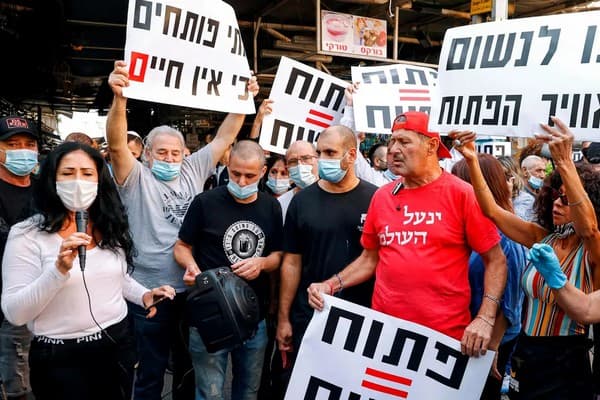
Tel Aviv stall owners protest against Covid lockdown restrictions in November 2020

Especially notable was the unity in political priorities that the inflation crisis has created between Israel’s Jewish and Arab populations. Both ranked their concerns in the same way, with plans to address cost of living at the top, and identity issues, along with climate change, at the bottom.

The writing has been on the wall for some time. In April 2019, when the economy was strong and prices were low, voters identified economic policy as their main concern. Despite this, the subsequent elections were fought on political grounds with a scant focus on economic policy.

In 2022, 80% of Israelis are reporting that their incomes have either stayed the same or decreased in the last year, and 85% believe cost of living exceeds that of comparable nations. Low-wage earners and Israeli Arabs have experienced the greatest hardship, with a third of both groups reporting a fall in income in the last year.

This suggests that politicians who can adapt to the shifting landscape of priorities will be rewarded at the election. Those who cannot connect with voters about economic pressures risk defeat. In recent years, politicians have been able to avoid hard economic debates because of the preference of all sides to discuss other things.

Now that Benjamin Netanyahu has released a 17-minute long “emergency plan” to tackle cost of living, the other parties have no option but to engage. The former prime minister has read the room. Putting the blame for Israel’s higher prices at Yair Lapid’s doorstep, he has pledged to cut prices and lower taxes, arguing that unstable government and runaway inflation go hand-in-hand.

Netanyahu is re-animating the Bibi of days gone by, the Bibi who depended on perceived economic credentials to win elections, rather than cults of personality. His “emergency plan” proposes to subsidise housing for young couples, freeze municipal tax rates, liberalise trade and cut income taxes, as well as offering free pre-school for children under three and lowering utility prices.

A raft of strong policies will be required from Lapid to deliver immediate economic relief while addressing the structural problems that propelled Israel to its current state.

In his bid to win over the swinging voters who could give him the 61 seats he needs to form government, Netanyahu has made the early choice to use the economy as an election pitch. Although he will, no doubt, play the Palestinian security card as the election date draws closer, he has clearly heard the Israeli voters’ desire for economic action.

If there is no strong response from the centre, Netanyahu will take ownership of the policy debate that has been, for the past two years, the public’s primary concern. His “emergency plan” is no stroke of genius but it’s better than anything we’ve heard so far from the government.

The rallying cry of “anyone but Bibi” will continue to motivate the centre-left’s reliable base, as will appeals to secular identity, social equality and “saving democracy”. However, mobilising a broader audience will depend on whether they can speak to the economic issues felt across the country.

Netanyahu already has a head start. The Bank of Israel’s outlook, optimistic as it may be, should not lull the government into complacency. Difficult economic news will continue to be released from now until November in the bank’s monthly reports. The opposition, organised around a cost-of-living campaign, will weaponise these figures.

The election is months away, but time is drawing near for Lapid and the centre-left to engage in the cost-of living-debate. Netanyahu has made the first move. A raft of strong and ambitious policies will be required from Lapid; policies that deliver immediate economic relief while addressing the structural problems that propelled Israel to its current state.

Photo: Woman in a Tel Aviv shopping mall

You might also like
  • Tame apologises – but with little grace
    Deborah Stone
  • Confronting Richard Flanagan and the myth of the Israel lobby
    Mary Garden
  • UK’s dramatic policy change on Israel-Palestine
    Colin Shindler
logomark.67a07ee3
We believe in the free flow of information

Republish our articles for free, online or in print, by using our Creative Commons licence

You might also like

    Australia’s Prime Minister Albanese Speaks After Bondi Shootings
    News

    What PM, Premier, Police say about Bondi antisemitic attack

    The Jewish Independent 1
    Jewish-diversity copy
    Feature

    The three questions that will define the Jewish future

    Shahar Burla 1
    Funeral for top military commander of Hamas’ armed wing in Gaza
    Israel Hamas WarAnalysisIsrael

    Gaza ceasefire falters as Israel and Hamas prepare for next war

    Shahar Burla 1

About the author

Oscar Kaspi-Crutchett

Oscar Kaspi-Crutchett

Oscar Kaspi-Crutchett formerly worked in the Commonwealth Parliament and now works as a senior researcher and organiser in the Victorian union movement.

More from the author

AnalysisAustralia

The conditions enabling neo-Nazis to proliferate in Australia

FeatureAustralia

How Australian trade unions are backing Palestinian activism

FeatureAustralia

School strikes for Palestine mark a generational watershed. Jewish leaders don’t get it

OpinionIsrael

Israeli Labor needs to say what it stands for – not against