Aa
  • Read, Watch, Listen
  • TJI Series
  • Community Action
  • Events
  • Zedi
Follow us and continue the conversation
  • LinkedIn
  • Instagram
  • FaceBook
  • X
  • YouTube
Test yourself with the TJI Quiz!

Adjust size of text

Aa

Follow us and continue the conversation

  • LinkedIn
  • Instagram
  • FaceBook
  • X
  • YouTube

Your saved articles

You haven't saved any articles

What are you looking for?

Original reporting, insightful analysis and diverse views, delivered straight to your inbox

  • LinkedIn
  • Instagram
  • FaceBook
  • X
  • YouTube
Your support fuels our mission to inform, entertain and inspire.

The Jewish Independent is bound by the Standards of Practice of the Australian Press Council. If you believe the Standards may have been breached, you may approach The Jewish Independent or make a complaint to the Australian Press Council in writing at www.presscouncil.org.au. The Council may also be contacted on 1800 025 712.

  • Our Story
  • Contact us
  • Our Team
  • Support us
  • Guidelines
  • Pitch your idea
  • Republishing us
  • Community Action
  • Our Awards
  • LinkedIn
  • Instagram
  • FaceBook
  • X
  • YouTube
Aboriginal FlagTorres Strait Islanders Flag

The Jewish Independent acknowledges Aboriginal and Torres Strait Islander peoples as the Traditional Owners and Custodians of Country throughout Australia. We pay our respects to Elders past and present, and strive to honour their rich history of storytelling in our work and mission.

© The Jewish Independent 2026All Rights Reserved
Website design and development by Your Creative, MelbourneTerms & ConditionsPrivacy Policy
HomeRead, Watch, ListenArts & Culture
FeatureArts & Culture

Modern revival for Portugal’s ancient Jewish community

Portugal's dark history of antisemitism has been lightened by a law allowing descendants of expelled Sephardic Jews to claim citizenship.
Deborah Cassrels
Print this
Portugal mural main

Mural in the old Jewish quarter of Lisbon (Deborah Cassrels)

Published: 27 January 2026

Last updated: 24 February 2026

Porto, Portugal's vibrant northern city, is famed for port wine, historic monuments and colourful UNESCO architecture stretching along the Douro River. 

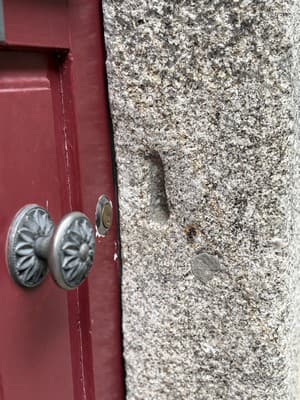
It also lays claim to a dark Jewish legacy which draws daily tour groups through the old Jewish quarters to discover old Hebrew inscriptions etched into the stone and the scars of mezzuzahs ripped off once-Jewish homes.

A long history

Ricardo Bessa Siva, a guide in the Jewish quarters, says the earliest archaeological evidence of Jews in Portugal dates to the 4th century. By the 8th century, under Moorish rule, the Jewish community was flourishing in a cultural Golden Age.

But after the Catholic conquest, which was completed by 1249, life became much harder. Jews paid discriminatory high taxes and were blamed for the Black Death.   

When Spain expelled its Jews in 1492, most sought refuge in Portugal but the sanctuary was shortlived: four years later Portugal's King Manuel 1 ordered Jews to leave unless they converted to Catholicism. Muslims were expelled with no alternative. 

Suspicions remained that Jews who converted were practising their faith and in 1536 the Portuguese inquisition began, targeting New Christians suspected of being crypto-Jews.  

Memorial for 4000 Jews killed in 1506 massacre in Lisbon
This sign marks the last vestige of the Alfama Jewish quarter

Return to Portugal

Jews were largely absent from Portugal for hundreds of years but the community has experienced a remarkable revival.

A decade ago there were several hundred Jews living in Portugal: it is now home to about 3000. Most live in Lisbon, with 1100 in Porto and a smattering elsewhere. Belmonte, in central Portugal, is unique as a small crypto-community that publicly reidentified with Judaism today and opened a synagogue in 1996.  

A Portuguese law in 2015 allowed descendants of Sephardic Jews who had been expelled during the Portuguese Inquisition to claim citizenship, and there was an influx of Jews, mostly from Israel, Turkey and Brazil. 

But last year the government moved to tighten the law, claiming its reparative objective has been fulfilled and that some applicants’ documentation was unverified.  

Modern Jewish life is evident in the splendid Sephardic Kadoorie Mekor Haim Synagogue, the largest synagogue on the Iberian Peninsula, established by World War I hero, Captain Artur de Barros Basto, a Portuguese Jewish convert of crypto heritage who founded Porto’s modern Jewish community and helped hundreds of Jews escape the Holocaust to neutral Portugal.   

The Kadoorie Mekor Haim Synagogue in Porto

The Jewish community also honours the World War II hero, Aristides de Sousa Mendes, referred to as the Portuguese Schindler who defied orders from his government and issued thousands of visas to Jewish refugees fleeing the Nazis.

Vestiges of the past

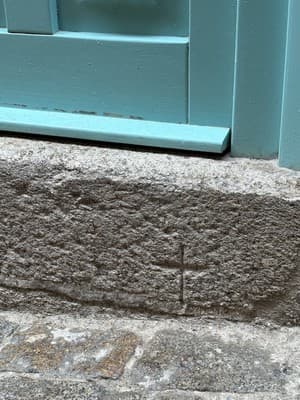
Remnants of Porto’s past Jewish community are evident in the city's ancient Jewish quarters filled with narrow streets and boarded-up houses, prepared for new construction. Evidence of forced conversions can be seen in crosses etched into stone beside front doors which also bear the scars of mezzuzahs removed in the Judiaria Nova do Olival.

Vestiges are evident in the culture too. Jews invented the alheira - a horseshoe-shaped sausage which is a Portuguese national dish. They replaced the traditional pork sausage with a mixture of bread, poultry and garlic and hung them prominently, creating the hooked shape and implying they were eating pork and therefore not Jewish.   

Indentations where mezzuzahs were removed
Crosses carved in stone at homes of forcibly converted Jews

The Judiaria Nova do Olival, established in 1386, is the most significant remaining Jewish historical quarter. “The fact they had their own laws, school and mikvah shows how important they were during this time. But the fact that it was a ghetto and they had a curfew at night meant it was strictly controlled. The Jews were literally considered property of the king of Portugal,’’ says Bessa Silva

Only the synagogue stairs - known as Escada de Vitória or Victory Stairs - remain of a medieval synagogue which has been replaced by a baroque church, Igreja de Nossa Senhora da Vitória.

Outside there is a recent memorial honouring the Jews forced to choose between forced conversion or death’.  

Nearby, terraced emerald lawns cover the site of the old Jewish cemetery. But who would know?  “After the Jews converted to Catholicism it became obsolete,’’ says Bessa Silva. “Nowadays there’s no sign marking what the place was centuries ago.’’    

Lisbon’s dark legacy

The capital Lisbon, has lost much of its Jewish life too. Between 1147 and 1497, there were four Jewish quarters and three synagogues. The Judiarias, which have vanished due to the conversion to churches and confiscation of houses, suffered a final blow when Lisbon’s massive 1755 earthquake wiped them out.  

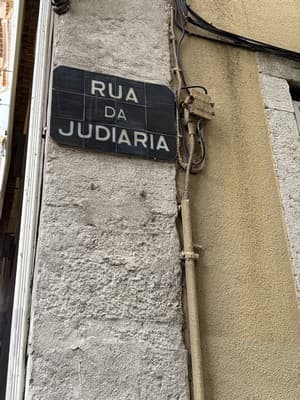
The 12th century Rua da Judiaria, in the Alfama district is the last surviving Jewish site of the era, its maze of narrow, winding steep streets, steps and courtyards was home to a thriving Jewish community before the 15th century expulsion.  

But here too, there are signs of revival. At the quarter’s entrance, a Star of David leads to the Jewish Cultural Center, opened in 2019, and founded by Luciano Waldman. The centre’s front door features a painted menorah and the word Israel in Hebrew letters.  

“Its inspiration comes from the traditional doors of Jewish homes in North Africa. Today, that door has become an emotional symbol of the Jewish presence on the street,’’ Waldman says.  

The Jewish Independent
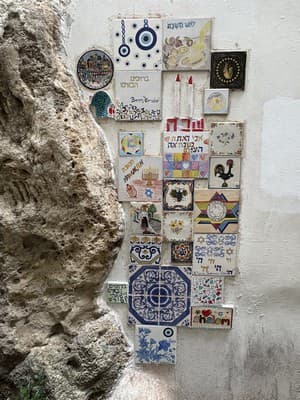
Plaque of Hebrew tiles

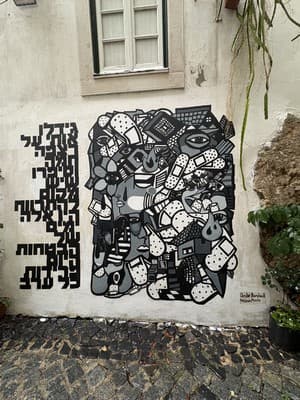
Nearby, a wall of Hebrew-themed tiles represents Jewish rituals and festivals and I’m surprised to see a large mural by Israeli-American street artists Dede Bandaid and Nitzan Mintz, who created the controversial Kidnapped poster campaign after the Hamas attacks. Their mural, with Hebrew text, combines the expulsion of the Jews from Portugal and the events of October 7.

Downtown, a memorial plaque with a Star of David, outside the Igreja of São Domingo in busy Rossio Square, the former site of the Inquisition Tribunal, recalls one of the most tragic pages in the history of Portugal’s Jews, in which more than 2000 forcibly converted Jews were executed.  

Outside the old city, the Shaare Tikva Synagogue (Gates of Hope), built in 1904 serves a community of about 700 and takes guided tours.   

Tours have significantly increased, says Waldman, who has run them for the past four years. But like most countries, the community has not been immune to antisemitic attacks since October 7, and graffiti is seen around the city. “We have faced … death threats, threatening phone calls, graffiti, and verbal and physical hostility,” he adds. 

You might also like
  • Antisemitism, homophobia and a radical response to both
    Dennis Altman
  • Confronting Richard Flanagan and the myth of the Israel lobby
    Mary Garden
  • Court decision fails to understand when ‘Fuk Israel’ becomes antisemitic
    Jeremie Bracka
logomark.67a07ee3
We believe in the free flow of information

Republish our articles for free, online or in print, by using our Creative Commons licence

You might also like

    Jewish word map
    FeatureArts & Culture

    Was the barmi a shemozzle? How Australians use Jewish words 

    Caroline Hendy & Emma Breslow 1
    Eden Bahar
    InterviewArts & Culture

    ‘L’chaim for the next 1,500’: Israeli drummer celebrates Cirque Du Soleil milestone

    Gideon Cohen
    haredi street guitar
    Photo EssayArts & Culture

    Jerusalemites through the lens

    Sharon Gabay

About the author

Deborah Cassrels

Deborah Cassrels

Deborah Cassrels was The Australian's first Bali-based correspondent, and worked in Indonesia for a decade from 2009. She has written extensively on politics, terrorism, refugees, crime and social justice. She was a Walkley Award finalist in 2016 for her work on terrorism in Indonesia. Her memoir about that period, Gods and Demons, was published in 2020.

More from the author

FeatureWorld

The riches to rags story of Indonesia’s Iraqi Jews

InterviewArts & Culture

Israel-Hamas poster war tears the social fabric of New York

InterviewArts & Culture

Compelling fly-on-the-wall portrait of a hostage family

Comments2

  • Avatar of Deborah Stone

    Deborah Stone28 January at 12:43 pm

    Thanks for picking that up. It’s been corrected.

  • Avatar of Lillian Violet

    Lillian Violet27 January at 11:59 am

    Hello, didn’t see a feedback form so I’ll post this here. The first sentence says Porto is in spain while the rest of the article is about Portugal (where Porto is) correctly. I think a small mistake snuck in there.