Aa
  • Read, Watch, Listen
  • TJI Series
  • Community Action
  • Events
  • Zedi
Follow us and continue the conversation
  • LinkedIn
  • Instagram
  • FaceBook
  • X
  • YouTube
Test yourself with the TJI Quiz!

Adjust size of text

Aa

Follow us and continue the conversation

  • LinkedIn
  • Instagram
  • FaceBook
  • X
  • YouTube

Your saved articles

You haven't saved any articles

What are you looking for?

Original reporting, insightful analysis and diverse views, delivered straight to your inbox

  • LinkedIn
  • Instagram
  • FaceBook
  • X
  • YouTube
Your support fuels our mission to inform, entertain and inspire.

The Jewish Independent is bound by the Standards of Practice of the Australian Press Council. If you believe the Standards may have been breached, you may approach The Jewish Independent or make a complaint to the Australian Press Council in writing at www.presscouncil.org.au. The Council may also be contacted on 1800 025 712.

  • Our Story
  • Contact us
  • Our Team
  • Support us
  • Guidelines
  • Pitch your idea
  • Republishing us
  • Community Action
  • Our Awards
  • LinkedIn
  • Instagram
  • FaceBook
  • X
  • YouTube
Aboriginal FlagTorres Strait Islanders Flag

The Jewish Independent acknowledges Aboriginal and Torres Strait Islander peoples as the Traditional Owners and Custodians of Country throughout Australia. We pay our respects to Elders past and present, and strive to honour their rich history of storytelling in our work and mission.

© The Jewish Independent 2026All Rights Reserved
Website design and development by Your Creative, MelbourneTerms & ConditionsPrivacy Policy
HomeRead, Watch, ListenAustralia
Royal CommissionAnalysisAustralia

Anti-Zionist Jewish voices pose a risk at Royal Commission

The Jewish Council of Australia and similar groups deny links between antisemitism and anti-Zionist activism. Their views distort the evidence of both research and lived experience.
Andrew Wirth
Print this
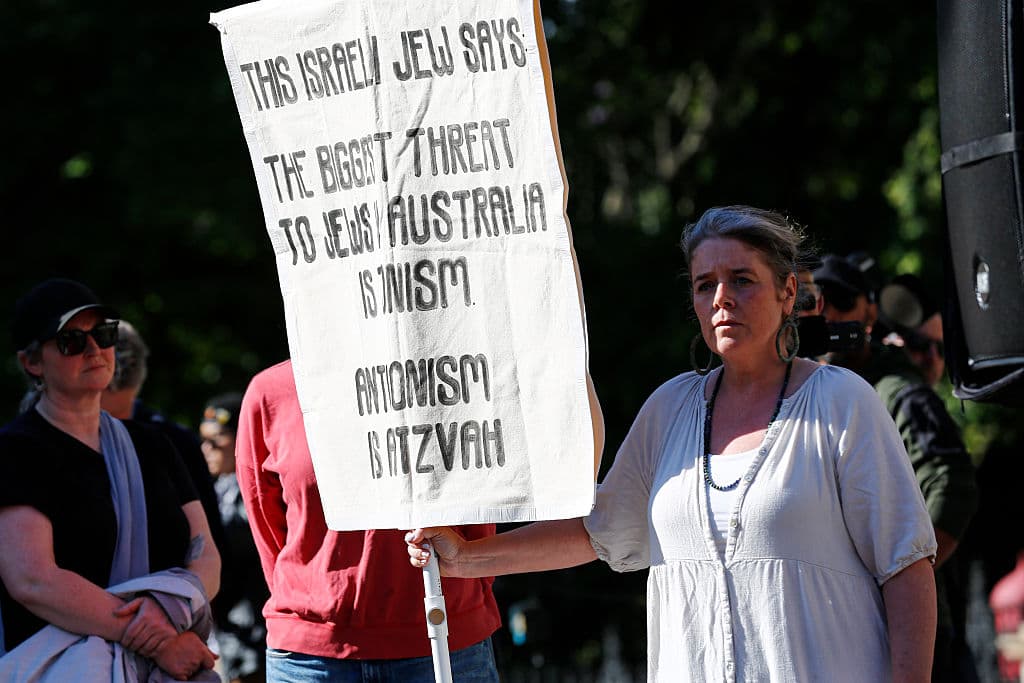
A protester holds a placard expressing her opinion during

A Jewish anti-Zionist protester in Melbourne following the release of the Segal report on antisemitism in 2025 (Ye Myo Khant/SOPA Images/LightRocket via Getty Images)

Published: 19 January 2026

Last updated: 6 May 2026

In the aftermath of Bondi, and following an agonising public conversation, the Albanese Government has agreed to a Royal Commission into antisemitism and social cohesion.

It is critical that our community gets this process right given the stakes are so high. Submissions from Jewish communal organisations should reflect deeply and widely-held community concerns, should be careful analytically and explicitly address risk.

The Jewish Council of Australia (JCA) has expressed the intention to engage with the Commission, as is their right. However, public positions taken so far by the JCA and other anti-Zionist Jewish groups raise concerns about the nature and impact of their likely submissions.

Denying links to violence

Jewish and Palestinian anti-Zionist commentators have asserted that there is no possible relationship between the language of protest and the attack. "Zero evidence”, according to one commentator.

Such statements ignore the substantial literature linking speech and violence. The Dangerous Speech Project describes how speech “can increase the risk that its audience will condone or commit violence against members of another group”.  Extreme views propagated via  social media can lower the threshold for violence in primed individuals or “lone wolves”. A major review of 55 studies confirmed that exposure to hate leads to a climate of hostility, psychological harm and risk of violence.
In Australia, ASIO Director-General Mike Burgess, noted that inflammatory rhetoric and political grievances have “raised the temperature (and) made acts of violence more likely”. The Online Hate Prevention Institute has identified “racist anti-Zionism” as a contributing factor to violence, both before and after Bondi.

This is not an issue of direct causation or “collective blame”.  However, preparedness to acknowledge this well-described phenomenon is essential to constructively engage with its policy implications.

Minimising harms to the Jewish community

The dramatic rise in incidents negatively impacting Australian Jews since October 7 2023 has been well documented, with a measurable effect on their feelings of safety. A survey conducted weeks after the start of the Gaza war reported that one in five Jews surveyed had experienced insults or harassment, and a similar number was less open in showing their identity in public. Similar findings have been reported in the UK, Europe and the US.

Mike Burgess, commenting on anti-Israel activists observed: “Directly or indirectly, their actions can marginalise, stigmatise and frighten sections of the community.”

Against this background of reported adverse Jewish experiences, Jewish anti-Zionist commentary often focuses on issues with definitions, methodology and measurement. There are accusations of “weaponising” antisemitism and conflating antisemitism with criticism of Israel. Concerns about the impact of vilifying anti-Zionist speech on communal experience are often met with observations such as “not all Jews are Zionists”. This is not in keeping with the “community-centric” approach to racism advocated by The AHRC Framework.

In accounting for experiences of antisemitism, anti-Zionists also focus heavily on the racism of the far right, rather than engaging with the broader political spectrum and the contribution of anti-Zionist activism to an atmosphere of hostility.

Rejecting specific responses to antisemitism

Jewish anti-Zionists resist specific policies to respond to antisemitism, casting their lot with generalised anti-racism frameworks.

They reject the Special Envoy’s report on antisemitism, in part for reasons of free speech.

In public statements the JCA has argued that calls to curb the most hostile forms of anti-Zionist speech risk making Jews less safe, by exposing them to blame for increased state repression. It is worth asking whether reframing such calls as political manoeuvres rather than expressions of communal fear does not itself heighten that risk — by casting concern for safety as bad faith.

While society-wide approaches to racism are essential, Indigenous Australians, migrants, women, LGBTQ+ communities, Muslims and Jews all have different histories of oppression and face different challenges.

The need for targeted measures for antisemitism is not about moral priority but relates to its specific dynamic. Jews are often not recognised as a vulnerable minority, because they are coded “white” and linked with power, money, conspiracy and influence. A UN report highlighted the lack of awareness of antisemitism’s modern manifestations.

When antisemitism is subsumed under generalised frameworks of disadvantage, it often disappears from view, notes human rights law academic Kenneth Marcus.

The Special Envoy’s plan, while open to criticism, is consonant with Global Guidelines which have been endorsed by over 40 states and regional groups, and consistent with UN recommendations that addressing antisemitism requires specific strategies in addition to general anti-racism measures.

Distorting perceptions of Jewish community representation

The JCA presents itself as an expert voice that provides a counterbalance to allegedly unrepresentative communal leadership bodies such as the ECAJ.

While Jewish peak bodies are not directly elected by the whole of community, they include a wide range of community organisations across the country and are closely aligned the community’s concerns regarding safety and connection with Israel. Around 90% of Australian Jews have close connection with, and concern for Israel, and around three quarters self-identify as Zionist.

The JCA has a small, high-profile leadership and a claimed membership of 1300 supporters (many anonymous).Their views are unlikely to reflect more than a small minority of the community. This doesn’t delegitimise their participation or views but should have bearing on the weight given these views at the Royal Commission.

Rights and risks

Anti-Zionist Jewish positions are often cited by the larger anti-Zionist advocacy community whose agenda they share, and given prominence by segments of the media and civil society.

A practical concern is that this may have a “spoiler effect” on achieving the goals of the broader Jewish community at the Royal Commission.

The recent referendum on an Indigenous Voice to Parliament, though set in a different political context, is illustrative. Tanya Muscat and Katharina Wolf from Curtin University described how “No” proponents “… were selectively framed by media to present a picture of broad Indigenous opposition, thereby neutralising support for the Yes campaign…(this)  illustrates the need for communication strategies that are not only inclusive, but genuinely representative and responsive to the diversity within Indigenous communities.”

At a deeper level, there is also an asymmetric risk inherent in what is essentially a free speech versus safety debate. The risks of getting it wrong are not evenly distributed: on one hand, the cost is a degree of restraint in the language and forms of protest; and on the other hand, serious and lasting harm to an Australian minority community already reporting fear and withdrawal from civic spaces.

Jewish anti-Zionists are, of course, entitled to protest, to criticise Israel, and to argue passionately for Palestinian rights - and to make submissions to the Royal Commission.

But those submissions risk lacking substance if they fail to engage with widespread community experience, with the substantial literature on hate speech and harm, and with the specific characteristics of antisemitism that warrant targeted strategies.

Public debate during the Royal Commission demands intellectual seriousness, caution, sensitivity to asymmetric risk and humility in a complex environment, when the stakes are high and the potential for harm is real.

You might also like
  • Sanctioning settlements is a defence of Israel, not an attack
    Elisheva Madar
  • Sanctions must influence, not just perform disapproval
    Adam Slonim
  • Confronting Richard Flanagan and the myth of the Israel lobby
    Mary Garden
logomark.67a07ee3
We believe in the free flow of information

Republish our articles for free, online or in print, by using our Creative Commons licence

You might also like

    jiff26-cancelled.jpg
    ReflectionArts & Culture

    On despair: A reflection after watching ‘Cancelled’

    Deborah Stone
    Generation change Template
    Generation ChangeInterviewAustralia

    Ash Densham: Building community through Humanistic Judaism

    Gideon Cohen
    Apple & rotten core Rosh hashanah
    EditorialAustralia

    Facing a new year with the knowledge life can be better

    The Jewish Independent

About the author

Andrew Wirth

Andrew Wirth

Andrew Wirth is a medical specialist, a member of the Melbourne Jewish community and an active participant in an egalitarian orthodox shul. He is deeply concerned about the future of Israel/Palestine and contributes to the Times of Israel blogs.

More from the author

ReflectionWorld

At home where we are: Salzberg, The Sound of Music and the value of ‘here’

AnalysisAustralia

From the opera house to Bondi: a direct path

ReflectionArts & Culture

Between tribalism and compassion 

Comments18

  • Avatar of Judy

    Judy29 January at 09:52 am

    (begin part 2)

    (3) Jeremie Bracka appears to assert that JCA[???] is a “spoiler,” and there are “risks posed by spoilers in a truth-telling process.” To me, this devalues and denigrates those with opposing “truths” and different “lived experiences.”
    (4) Have we forgotten the story about two Jews talking and having three opinions? Can we not understand, accept, and embrace that Jews, like all people everywhere, have different lived experiences? Can we stop quibbling about which singular Jewish organisation has the one-right-truth?

    (5) I completely concur with Shakira Hussein’s comments.

    Peace, Judy

    References:

    [CRO23] https://thejewishindependent.com.au/surveying-australian-jews-on-israel

    [CRO25] https://jewishindependent.yourcreativeagency.com.au/wp-content/uploads/2026/01/TJI_Crossroads-Report-25_Complete_DIGITAL.pdf

  • Avatar of Judy

    Judy29 January at 09:52 am

    (1) Would that Simon Krite and others internalise what JCA is … and is not:

    “We provide an independent expert Jewish voice supporting human rights and opposing antisemitism and racism. We support Palestinian freedom and justice and are united in our opposition to Israel’s continued policies aimed at the destruction of Palestinian life.” … “Pro-Israel Jewish organisations, that do not recognise the diversity of views among Australian Jews, do not speak for us.”

    Nowhere do I see any words that assert “[JCA] presents itself as a representative Jewish voice”; nowhere do I see any “[dismissal of] the lived safety concerns of Australian Jews.”

    (2) Would that Simon Krite and others cited their sources for the data they use, such as: “Around 95% of Australian Jews have a strong connection to Israel … ” Data in Crossroads23 [CRO23] and 25 [CRO25] do not support this. The highest number several Google searches showed me was 88%-90% (no citations).

    (end part 1)

  • Avatar of Jeremie Bracka

    Jeremie Bracka26 January at 06:01 pm

    This is an insightful and well-researched piece by Andrew that does important work in clarifying the risks posed by spoilers in a truth-telling process. Whatever one’s moral or political convictions, the article is not weighing the righteousness of particular views. It is focused on a more precise and necessary concern: how easily the lived experience of a community can be misrepresented in a post-Bondi context, and why that matters for the integrity of the Commission’s work.

    It’s unfortunate that some of the commentary here has missed that central point. The article is not seeking to defend, define, or attack anti-Zionists, Zionism, or the JCA. Rather, it highlights a shared concern about the risks of speaking for a community in ways that misrepresent lived experience and ultimately undermine what truth-telling is meant to achieve.

  • Avatar of Larry Stillman

    Larry Stillman26 January at 03:44 am

    One point. And that is how to approach antisemitism. It is not either or. There is a specific emergency for our community, and very specific needs but others are also copping it. Neglecting other hatred will cause great resentment
    Shakira Hussein a Muslim commentator has said this in Crikey.
    “…, attempts to address antisemitism in isolation rather than in conjunction with other forms of racism will be not only ineffective, but harmful. In particular, current representations of antisemitism and Islamophobia as locked into a type of zero-sum game, in which discussion of one form of hatred is seen as coming at the expense of attempts to counter the other, are placing both Jews and Muslims at increased risk of harm.”

  • Avatar of Simon Krite

    Simon Krite25 January at 11:05 am

    The issue is not free speech or the right to make a submission. It is legitimacy.

    The Jewish Council of Australia presents itself as a representative Jewish voice while consistently dismissing the lived safety concerns of Australian Jews. Its public positions minimise the link between anti-Zionist agitation and real-world harm, reject targeted antisemitism frameworks endorsed by the UN and democratic allies, and recast Jewish fear as political manipulation.

    These positions align with the narratives of the anti-Zionist activist ecosystem, including APAN-linked campaigns, and are repeatedly used to undermine mainstream Jewish advocacy. That is vulgar ideological laundering through Jewish identity.

    Around 95% of Australian Jews have a strong connection to Israel and a clear majority report increased fear, harassment and withdrawal from public life. The JCA’s narrow leadership and limited constituency do not reflect that reality.

    A Royal Commission into antisemitism exists to understand and reduce harm to a vulnerable minority, not to amplify groups that deny its dynamics while claiming moral authority over the community. Minority views may be heard, but they must be weighed proportionately, transparently, and without confusing activism for representation.

  • Avatar of Judy

    Judy24 January at 06:29 pm

    (begin Part 2)

    (4) If supposed “inflammatory rhetoric and political grievances have ‘raised the temperature (and) made acts of violence more likely’,” one need look no further than Opposition Leader Ley’s commentary about PM Albanese’s approach for “inflammation” and “political grievances.” Does this mean Ley advocates a civil war?

    (5) The statistics cited in the article come from a non-statistically valid sample that is “weighted,” as the survey’s report notes clearly. Thus, exact numbers should not be reported without caveats.

    (6) If ECAJ is as representative as it asserts, then it should not fear comments from the JCA or any group, Jewish or not, being submitted to the Royal Commission.

    (7) Which leads to another question for the author: Why are JCA contributions different from all other contributions? What is it about JCA that causes the author fear?

    (8) I am *NOT* an apologist for the JCA.

    Peace,
    Judy

  • Avatar of Judy

    Judy24 January at 06:28 pm

    I found several incomplete / leading and mis-leading statements in this article that, together, provide zero support for the thesis asserted by the article’s title. To me, the author showed no connection between “Anti-Zionist Jewish voices” and any sort of “risk at Royal Commission.”

    (1) As noted before, the author does not define “Zionism” (and, by implication, does not define “anti-Zionism”). This undercuts the author’s ability to prove the article’s thesis.

    (2) Lowenstein’s quote is taken hugely out of context, as “James” noted, and in no way “supports” the argument it is used to support. Many other citations have similar issues.

    (3) The author lumps JCA into a group with “other anti-Zionist Jewish groups.” The JCA website makes no mention of being either a Zionist or anti-Zionist organisation; its “raison d’etre” describes “supporting human rights and opposing antisemitism and racism”. The author’s assertion that JCA is among the “anti-Zionists” is the author’s alone.

    (end Part 1)

  • Avatar of Geoffrey Wexler

    Geoffrey Wexler24 January at 08:18 am

    Despite variations and outliers, there’s a nexus between feeling pro-jew and pro-Israel, and feeling anti-jew and anti-Israel.

    Public speech powerfully influences public feeling and public action. Think Hitler and Germany, or think Hamas and Gaza. What did these people say, and what did they bring to their people?

    In consideration of such stark, tragic history, I say, acceptable influencers must always possess authentic credibility and good authority before presenting attitudes to their community. Without such a rule, outliers and extremists can hijack public feelings, thoughts and actions, and destruct their society.

    These discussions are not about war or a foreign leader.

    We only want a just and safe Australia.

  • Avatar of Shaike Snir

    Shaike Snir24 January at 12:58 am

    Thanks Andrew.
    Important article.
    YISHAR KOACH

  • Avatar of Andrew Wirth

    Andrew Wirth23 January at 07:28 am

    The comments are welcome but don’t actually address the key contention of the piece. Namely, that the public positions of Jewish anti-Zionists fail to engage the serious literature on speech and violence; that they fail to engage with, or minimise, well documented Jewish experience of harm; that they fail to recognise the features of antisemitism that may warrant specific strategies; and that high-profile advocacy of minority community positions can distort or cloud public debate, as occurred in the lead up to the referendum on the Voice to Parliament.

    Regarding the nature of Antizionism- this requires an essay in its own right, but I’ll proffer the following working definition: Opposition to Jewish political self-determination (explicit or implied) in any part of historic Palestine. I would explicitly exclude from the definition even the most vigorous critics of Israel’s government or conduct of the war, who don’t oppose Jewish self-determination.

    I don’t see where criticism of policy and opposition to Jewish self-determination were conflated.

    Israel’s conduct of the war is a critically important issue but not the subject of the essay which addresses the quality of public advocacy of Australian Jewish anti-Zionists.

  • Avatar of Alan Slade

    Alan Slade23 January at 04:25 am

    Surely the terminology “anti-Zionist” depends on the definition of Zionism. If the classical definition, based on Theodor Herzl’s dream of a homeland for Jewish people in the biblical area of Israel is accepted, those Jewish people calling themselves anti-Zionists are really anti-Netanyahu government. They cannot want to be alligned with Hamas, Iran and others wanting to obliterate the modern state of Israel.

  • Avatar of Ian Grinblat

    Ian Grinblat23 January at 03:45 am

    In response to Robert Richter KC, may I ask some questions. 1. Why it is so important that the major Jewish organisations condemn the ‘Netanyahu regime’? 2. Do you think that such condemnation would reduce levels of antisemitism in Australia? 3. As no person living outside Israel may vote in Israeli elections, why is it necessary for us to distance ourselves publicly? I don’t believe that the majority or even a significant minority of Australian Jews is happy to see the widespread destruction and loss of life in Gaza, but it began as a response to a brutal breaking of the ceasefire in 7 October 2023 and was prolonged by the refusal of Hamas to return the hostages. 4. Given that some of the surviving hostages reported that they were held in private homes, and given that the construction of the extensive underground infrastructure required the removal of spoil through schools and hospitals, is it really a stretch to accuse all Gazans of being complicit?

  • Avatar of Robert Richter KC

    Robert Richter KC22 January at 12:19 pm

    The present article conflates all shades of criticism of Israeli government into a single entity: “anti-Zionists”; it deliberately elides from the range of views within the JCA. If you cared to look at the declaration of principles to which signatories of its charter subscribed, you would find one unifying principle: Human regard for Jewish and Palestinian lives. I challenge you to find instances of the principal Jewish organisations in Australia publicly condemning the conduct of the Netanyahu regime in its response of manifest excess in collectively seeking to punish ALL Gazans. The President of Israel has declared that all Gazans are complicit in the Hamas Atrocities of October 23. That was an invitation for collective vengeance – not legitimate self defence -which resulted in grave War Crimes against a defenceless population of women, children, aged and helpless humans. Are you prepared to print an analysis which exceeds 200 words? So much for your “Jewish Independent” pretence.

  • Avatar of Ian Grinblat

    Ian Grinblat22 January at 06:46 am

    ‘the violent, racist actions of the current Israeli government and its role in the rise in antisemitism since October 7. ” Miriam, antisemitism is never acceptable and is a totally inappropriate response to the actions of any Israeli government. That said, your characterisation of the current Israeli government as violent and racist. War is unavoidably violent and a war between the Jewish State and Islamic para-state cannot avoid the semblance of racism but you do know that it was launched as a response to a heinous attack, and it was unnecessarily prolonged by the refusal of Hamas to return the hostages. Please allow your own people no less charity than you allow others.

  • Avatar of Judy

    Judy22 January at 06:45 am

    All this talk / writing about “Zionism” and “anti-Zionism” … and nowhere is either term defined. I know enough about the history of “Zionism” to know there was, is, and will be several concurrent, clearly disjoint, operative definitions of the term.

    Would the author please provide a clear, operative definition of each term so I can read and understand the article the way the author wants it read and understood?

    Thank you sincerely, Peace, Judy

  • Avatar of James

    James22 January at 06:31 am

    The quote from the antizionist “commentator” as somewhat misrepresented. Lowenstein’s full quote was “The truth of the matter is that there is literally no connection that we are aware of between the murderers, these two men, father and son, and the pro-Palestine movement. Zero,”

  • Avatar of Wesley Parish

    Wesley Parish22 January at 06:12 am

    I think a Venn diagram is probably needed to display the complexity of the issue – it’s not a case of “all non-Jewish Zionists are philosemites” and “all anti-Zionists are antisemites”. I’m sure that a good many of the world’s most fervent non-Jewish Zionists are equally rabid antisemites; I know many Jewish Zionists have made antisemitic statements.

  • Avatar of Miriam Feldheim

    Miriam Feldheim21 January at 08:24 pm

    All this focus on anti-Zionism detracts attention and discussion from the violent, racist actions of the current Israeli government and its role in the rise in antisemitism since October 7. As for the weaponisation of antisemitism, what do you call it when the prime minister of Israel blames the Bondi terrorist attack on the Australian government’s recognition of a Palestinian state?