Aa
  • Read, Watch, Listen
  • TJI Series
  • Community Action
  • Events
  • Zedi
Follow us and continue the conversation
  • LinkedIn
  • Instagram
  • FaceBook
  • X
  • YouTube
Test yourself with the TJI Quiz!

Adjust size of text

Aa

Follow us and continue the conversation

  • LinkedIn
  • Instagram
  • FaceBook
  • X
  • YouTube

Your saved articles

You haven't saved any articles

What are you looking for?

Original reporting, insightful analysis and diverse views, delivered straight to your inbox

  • LinkedIn
  • Instagram
  • FaceBook
  • X
  • YouTube
Your support fuels our mission to inform, entertain and inspire.

The Jewish Independent is bound by the Standards of Practice of the Australian Press Council. If you believe the Standards may have been breached, you may approach The Jewish Independent or make a complaint to the Australian Press Council in writing at www.presscouncil.org.au. The Council may also be contacted on 1800 025 712.

  • Our Story
  • Contact us
  • Our Team
  • Support us
  • Guidelines
  • Pitch your idea
  • Republishing us
  • Community Action
  • Our Awards
  • LinkedIn
  • Instagram
  • FaceBook
  • X
  • YouTube
Aboriginal FlagTorres Strait Islanders Flag

The Jewish Independent acknowledges Aboriginal and Torres Strait Islander peoples as the Traditional Owners and Custodians of Country throughout Australia. We pay our respects to Elders past and present, and strive to honour their rich history of storytelling in our work and mission.

© The Jewish Independent 2026All Rights Reserved
Website design and development by Your Creative, MelbourneTerms & ConditionsPrivacy Policy
HomeRead, Watch, ListenAustralia
OpinionAustralia

The ‘Believe Women’ icon who doesn’t believe Jewish women

Grace Tame's dismissal of evidence of sexual violence during the October 7 Hamas attacks undermines her credibility as the ABC's new podcast host
Mary Garden
Print this
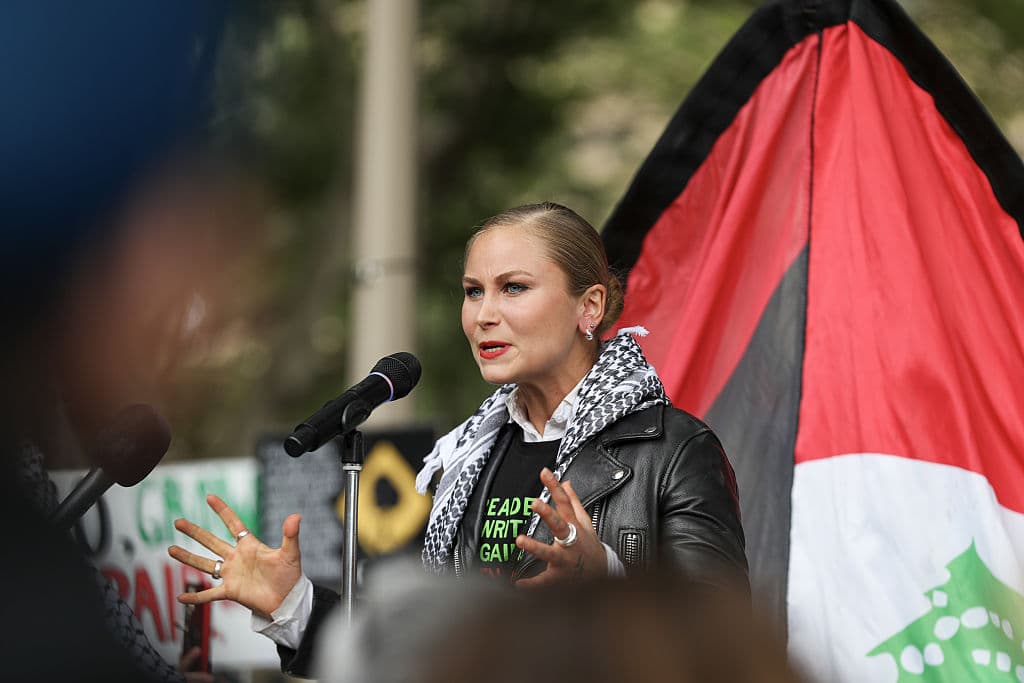
Grace Tame Palestinian protest

Grace Tame speaks to the crowd during a pro-Palestinian rally in Sydney in August 2025 (Roni Bintang/Anadolu via Getty Images)

Published: 10 June 2026

Last updated: 11 June 2026

The ABC’s decision to give Grace Tame a new platform as a podcast host has revived questions about her dismissal of evidence of sexual violence during the October 7 Hamas attacks – and whether some victims are deemed less worthy of belief than others.

Tame, the former Australian of the Year whose advocacy transformed the national conversation about child sexual abuse, will front a series exploring the experiences of autistic women and gender-diverse Australians.

Only months ago, appearing on ABC Radio Sydney with Hamish Macdonald, Tame suggested that reports Israeli women were raped and sexually assaulted during the October 7 Hamas attacks had been “debunked” and were merely “propaganda”.

When Macdonald pointed out that the United Nations Special Representative on Sexual Violence in Conflict had found reasonable grounds to believe sexual violence had occurred during the attacks, Tame rejected that conclusion, saying she would not “sink to the level of entertaining propaganda”.

I am a survivor of rape as an adult and of childhood sexual abuse. Like many victims, I know that the trauma of sexual violence is often compounded by disbelief. Victims are questioned, doubted, dismissed or accused of exaggeration. It is one reason why so many women remain silent.

Allegations of sexual violence should be judged on evidence, not ideology

For many of us who have experienced sexual violence, Tame became a powerful voice. We listened to her. We admired her courage and were grateful for her leadership. She spoke publicly about the abuse she endured and challenged a legal system that prevented victims from identifying themselves. In doing so, she helped change laws and attitudes and encouraged Australians to take allegations of sexual violence seriously.
That is why her remarks carried such weight.

By the time Tame made those remarks to Hamish Macdonald on ABC Radio Sydney, evidence of sexual violence during the October 7 attacks had already been documented by witnesses, investigators and international bodies.

A major report released by the Dinah Project, a group of Israeli legal scholars, former prosecutors, judges and gender experts established after October 7, has drawn together testimony from survivors, former hostages, eyewitnesses and first responders.

Its conclusions are difficult to ignore.

The report argues that sexual violence during the October 7 attacks was widespread and systematic and formed part of a deliberate strategy of terror. Witnesses described rapes and gang rapes at multiple locations. Former hostages reported sexual abuse, sexual humiliation, forced nudity and threats of forced marriage while in captivity. First responders documented evidence of sexual violence and mutilation among victims found at attack sites.

A second major report, Silenced No More, recently released by the Civil Commission on October 7 Crimes by Hamas Against Women and Children, reached similar conclusions. Drawing on hundreds of interviews, testimonies and thousands of photographs and videos, it alleges that Hamas used rape, sexual torture and sexual humiliation systematically during the attacks and in captivity. The report includes testimony from female and male victims and former hostages, adding to a body of evidence that can no longer be dismissed as rumour or propaganda.

Many of the victims can never speak for themselves because they were killed on October 7.

These findings are increasingly difficult to reconcile with claims that the crimes were somehow “debunked”.

Reasonable people may disagree about the broader conflict. They may disagree about Israel’s conduct in Gaza. What should not be controversial is acknowledging evidence of sexual violence.

Yet somehow these crimes by Hamas have become politically contested. The reports of sexual violence committed on October 7 have often been treated differently from similar allegations in other conflicts.

For decades women have fought to have rape recognised as a weapon of war rather than an unfortunate by-product of conflict.

The world was forced to confront sexual violence during the wars in Bosnia and Rwanda. Survivors struggled not only against the trauma of the crimes themselves but against widespread scepticism. Their testimony was doubted. Their experiences minimised. Their suffering questioned.

Out of those conflicts emerged a hard-won understanding that sexual violence can be used deliberately as a weapon of terror and domination.

What message does it send when a public figure who dismissed evidence of wartime sexual violence is rewarded with a prominent new platform?

It also established a simple principle: allegations of sexual violence should be judged on evidence, not ideology.

It should apply whether the victims are Israeli, Palestinian, Ukrainian, Sudanese, Congolese or Australian, regardless of race, religion, nationality or politics.

As evidence from October 7 has accumulated, a troubling pattern has emerged. Instead of engaging with the evidence, some activists have chosen to question whether the crimes occurred at all.

For many people, the dismissal of the sexual violence committed on October 7 as propaganda was deeply disturbing. I was shocked and infuriated. For Jewish people, and especially for those who survived October 7 or whose loved ones were murdered or taken hostage, it compounded an already profound trauma.

No one expects public figures to be experts on every issue. People make mistakes. They misread evidence. They say things they later regret.

But Grace Tame has never acknowledged that her remarks were wrong. 

Nor has she recognised the pain those comments caused many victims of sexual violence and members of the Jewish community.

Indeed, as recently as this week, Tame praised on Instagram an article by David Milner, editor of The Shot, titled Australia is Manufacturing Explosives for Israel’s Atrocities. In the article, Milner accuses Israel of genocide and describes the United States and Israel as a “death machine”. The endorsement suggests Tame’s views on the broader conflict remain firmly entrenched.

The ABC is entitled to commission whomever it chooses. Grace Tame is entitled to express her views. Free speech protects both.

But what message does it send when a public figure who dismissed evidence of wartime sexual violence is rewarded with a prominent new platform?

The real test of our commitment to survivors is not whether we believe the stories that align with our politics. It is whether we are prepared to acknowledge evidence when it challenges our beliefs.

Believe women.

Believe Jewish women.

You might also like
  • ‘Israel is systemically eliminating Palestinian collective life’:  B’Tselem
    Deborah Stone
  • Tame apologises – but with little grace
    Deborah Stone
  • Confronting Richard Flanagan and the myth of the Israel lobby
    Mary Garden
logomark.67a07ee3
We believe in the free flow of information

Republish our articles for free, online or in print, by using our Creative Commons licence

You might also like

    Commissioner Virginia Bell
    Royal CommissionAnalysisAustralia

    Now is the time for the Royal Commission to deliver, not be politicised

    Dean Sherr 2
    Generation Change: Rachel Moshel
    Generation ChangeInterviewArts & Culture

    Rachel Moshel: Creating a space for Jewish art and joy

    Gideon Cohen
    Woman with land and houses behind her
    NewsAustralia

    Australia to increase sanctions against West Bank settlements

    Deborah Stone 2

About the author

Mary Garden

Mary Garden

Mary Garden is an award-winning author and journalist whose work has appeared in Australian and international publications, including The Guardian, The Australian and the Australian Financial Review. She has a PhD in Journalism.

More from the author

OpinionAustralia

Confronting Richard Flanagan and the myth of the Israel lobby

OpinionIsrael

‘What about Hamas?’ The protesters’ blind spot that can’t be ignored

Comments2

  • Avatar of Mary Garden

    Mary Garden12 June at 04:58 am

    I agree Joe Lenzo. Did you read Deborah Stones’s excellent article 29 May, “Sexual violence exposed on both sides of Israel-Palestine conflict”
    A new report provides extensive evidence of Hamas sexual terror, while research reveals cases of Israeli prison guards using sexual violence on Palestinian detainees

  • Avatar of joe lenzo

    joe lenzo11 June at 11:00 pm

    IT GOES BOTH WAYS:

    The United Nations has found credible evidence and reasonable grounds to believe that some Palestinian detainees have been subjected to sexual violence, sexualized torture, and other forms of sexual abuse in Israeli detention facilities. The UN has called for independent investigations and accountability, and it does not support claims that such allegations can be dismissed outright as fabricated or impossible.

    Similarly, regarding the October 7 attacks, the UN found reasonable grounds to believe that sexual violence was committed against Israeli victims. In both contexts, the UN’s position is that allegations of conflict-related sexual violence should be investigated based on evidence rather than accepted or rejected solely because of the identity of the alleged perpetrators or victims.