Aa
  • Read, Watch, Listen
  • TJI Series
  • Community Action
  • Events
  • Zedi
Follow us and continue the conversation
  • LinkedIn
  • Instagram
  • FaceBook
  • X
  • YouTube
Test yourself with the TJI Quiz!

Adjust size of text

Aa

Follow us and continue the conversation

  • LinkedIn
  • Instagram
  • FaceBook
  • X
  • YouTube

Your saved articles

You haven't saved any articles

What are you looking for?

Original reporting, insightful analysis and diverse views, delivered straight to your inbox

  • LinkedIn
  • Instagram
  • FaceBook
  • X
  • YouTube
Your support fuels our mission to inform, entertain and inspire.

The Jewish Independent is bound by the Standards of Practice of the Australian Press Council. If you believe the Standards may have been breached, you may approach The Jewish Independent or make a complaint to the Australian Press Council in writing at www.presscouncil.org.au. The Council may also be contacted on 1800 025 712.

  • Our Story
  • Contact us
  • Our Team
  • Support us
  • Guidelines
  • Pitch your idea
  • Republishing us
  • Community Action
  • Our Awards
  • LinkedIn
  • Instagram
  • FaceBook
  • X
  • YouTube
Aboriginal FlagTorres Strait Islanders Flag

The Jewish Independent acknowledges Aboriginal and Torres Strait Islander peoples as the Traditional Owners and Custodians of Country throughout Australia. We pay our respects to Elders past and present, and strive to honour their rich history of storytelling in our work and mission.

© The Jewish Independent 2026All Rights Reserved
Website design and development by Your Creative, MelbourneTerms & ConditionsPrivacy Policy
HomeRead, Watch, ListenIsrael
Israel

The long march from revenge to empathy

Ahead of Rami and Bassam’s landmark Australian tour this month, ITTAY FLESCHER discusses the politics of bereavement in the Israel-Palestine conflict. 
Ittay Flescher
Print this

Published: 9 May 2023

Last updated: 16 November 2026

“There is no such thing as a bereaved Palestinian family.” That’s what one of the angry young men who joined a protest outside the Rene Cassin School in Jerusalem said in an interview to Israeli news site N12 in March 2022.

He was one of about a dozen boys led by far-Right Knesset member Itamar Ben-Gvir protesting a presentation to students by the Parents Circle - Bereaved Families Forum.

These presentations, which have been happening in schools across the country for more than a decade, are an opportunity for students to hear from Palestinian and Israeli families who lost loved ones in the conflict and have rejected the path of revenge and violence.

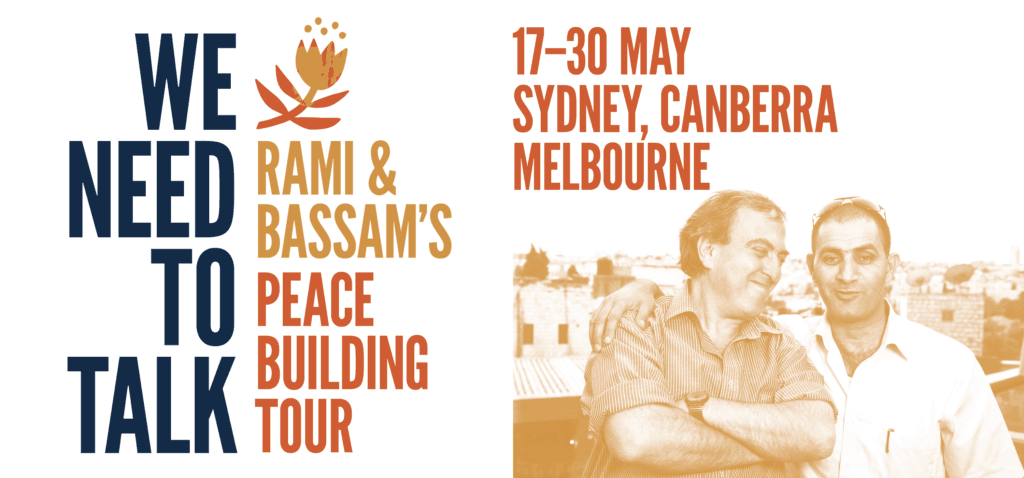
The speakers include parents like Rami Elhanan and Bassam Aramin, self-proclaimed brothers who each lost a young daughter to the conflict. They are visiting Australia this month for events in Sydney, Melbourne and Canberra, in a tour organised by The Jewish Independent. 

To the Israeli far-Right, there is no equivalence between Palestinian and Israeli grief. The young man at the Rene Cassin School protest suggested all Palestinians killed must be terrorists. No doubt he had been raised to believe that the IDF has never taken the life of any innocent person.

Palestinian Bassam’s story of the death of his 10-year-old daughter Abir, like Israeli Rami’s story of the death of his 14-year-old daughter Smadar, challenge such assumptions.

They are among a small but growing group of parents able to act as moral beacons despite their grief.

They often transition from wanting vengeance to advocating for peace, understanding that nothing else will prevent future tragedies.

Yusra Abdel Aziz Mahfouz from the West Bank city of Nablus, who lost her son, Alaa, to a stray bullet in 2000, described her emotional journey to 15,000 people at the 2023 Joint Memorial Service for Palestinians and Israelis on Yom Hazikaron.
“In the first days after the tragedy, I had a strong desire for revenge, that is, to do something to heal myself, but I didn’t know what to do,” she said.

Through meetings with bereaved Palestinian and Israeli families, Mahfouz said she came to understand that “their pain is similar to mine, and the will to take revenge changed to the understanding that it is better to seek peace, not to continue violence.”

The Parents Circle message of empathy and shared grief is rarely heard in either the Israeli or Palestinian mainstream media. The dominant voices are those calling for revenge, an approach that is dressed in more palatable words that range from “resistance” and “defend our honour” to “the right to self-defence, and a “proportionate response to terror”.

On the Israeli side, life in Sderot and the cities that surround it has been traumatic for many years. Before the last election, Ben-Gvir, who is now the Minister for National Security, demanded that for every rocket fired towards Israel, there should be 50 rockets fired back onto Hamas Gaza, killing 50 terrorists.

Meanwhile on the Palestinian side, Hamas chief Ismail Haniyeh responded to Israeli police violence against Muslim youth who had barricaded themselves in the Al-Aqsa mosque, saying “Our Palestinian people and the Palestinian resistance groups will not sit idly by” in the face of Israel’s “savage aggression”. By the end of Pesach, over 50 rockets had been fired into Israel from Lebanon and Gaza in response.

Mark Twain once said that “History never repeats itself, but it does often rhyme.” The idea that an extreme use of force will compel either Israelis or Palestinians to leave en masse or give up their dreams for a national homeland where life can be lived in security and freedom is one that has dominated relations between the two peoples for over a century.

The Parents Circle, whose message of non-violence sadly has little mainstream support in either society, is trying to change this reality.

I recently heard Rami and Bassam speak to a pre-army seminar during a “Judea and Samaria” week in Jerusalem. For over an hour, a group of some 30 Israelis who will soon be drafted to the IDF listened to them and respectfully asked probing questions.

Watching the encounter, I saw how they patiently explained in several different ways that the security and freedom which both Israelis and Palestinians so desperately desire will be immensely more resilient if it comes through an agreement than through the barrel of a gun.

While I’m not sure many were convinced to take the path of non-violence by the end of the presentation, the fact that it happened at all is significant in changing the narrative that has defined the relationship between the two nations who dwell in this twice promised land.

Their presentation reminded me of something that former Meretz MK Mossi Raz does on social media whenever an Israeli or Palestinian is killed. He always posts their name, photo and expresses sorrow to their loved ones, followed by the line, “We will continue to do all we can to ensure this is the last victim”.

Despite resistance on both sides, the Parents Circle has an unwavering commitment to promoting reconciliation and justice such that no more Israeli and Palestinian will ever need to suffer the pain of bereavement again.

Tickets to "We Need to Talk: Rami and Bassam's Peacebuilding Tour" are on sale now.

The Jewish Independent

Photo: Israeli woman participates in olive planting in memory of victims of the conflict, Tu BeShvat January 2022 (Courtesy of Parents Circle Bereaved Families Forum)

You might also like
  • My vision for Palestinian cancer patients
    David Adler
  • A Gazan doctor’s journey of hope
    Deea Okasha
  • Planned non-Zionist Jewish school part of a growing US trend
    Shira Li Bartov
logomark.67a07ee3
We believe in the free flow of information

Republish our articles for free, online or in print, by using our Creative Commons licence

You might also like

    Arab Israeli Palestinian election vote
    Israel Votes 2026AnalysisIsrael

    Netanyahu pushed Shin Bet head to spread racist misinformation at election

    Eetta Prince-Gibson
    Planes Flying Over Barcelona
    Israel Votes 2026InterviewAustralia

    The Israelis who flew home to vote

    Gideon Cohen
    Arab league
    Israel Votes 2026FeatureIsrael

    Dear Israel, we don’t care who your next prime minister is

    Michal Yaari 1

About the author

Ittay Flescher

Ittay Flescher

Ittay Flescher is the Jerusalem Correspondent for The Jewish Independent. For over 20 years, he has worked as an educator, journalist, and peacebuilder in Melbourne and Jerusalem. His book, The Holy and the Broken: A Cry for Israeli-Palestinian Peace from a Land that Must Be Shared, was longlisted for the 2025 Walkley Book Awards.

More from the author

FeatureArts & Culture

The eight most Jewish songs of Leonard Cohen

OpinionIsrael

Even on October 7, we are not united

AnalysisArts & Culture

Fauda and the illusion of vengeance

AnalysisIsrael

What ‘Zionism’ means in Israel:  it’s not what you think