Aa
  • Read, Watch, Listen
  • TJI Series
  • Community Action
  • Events
  • Zedi
Follow us and continue the conversation
  • LinkedIn
  • Instagram
  • FaceBook
  • X
  • YouTube
Test yourself with the TJI Quiz!

Adjust size of text

Aa

Follow us and continue the conversation

  • LinkedIn
  • Instagram
  • FaceBook
  • X
  • YouTube

Your saved articles

You haven't saved any articles

What are you looking for?

Original reporting, insightful analysis and diverse views, delivered straight to your inbox

  • LinkedIn
  • Instagram
  • FaceBook
  • X
  • YouTube
Your support fuels our mission to inform, entertain and inspire.

The Jewish Independent is bound by the Standards of Practice of the Australian Press Council. If you believe the Standards may have been breached, you may approach The Jewish Independent or make a complaint to the Australian Press Council in writing at www.presscouncil.org.au. The Council may also be contacted on 1800 025 712.

  • Our Story
  • Contact us
  • Our Team
  • Support us
  • Guidelines
  • Pitch your idea
  • Republishing us
  • Community Action
  • Our Awards
  • LinkedIn
  • Instagram
  • FaceBook
  • X
  • YouTube
Aboriginal FlagTorres Strait Islanders Flag

The Jewish Independent acknowledges Aboriginal and Torres Strait Islander peoples as the Traditional Owners and Custodians of Country throughout Australia. We pay our respects to Elders past and present, and strive to honour their rich history of storytelling in our work and mission.

© The Jewish Independent 2026All Rights Reserved
Website design and development by Your Creative, MelbourneTerms & ConditionsPrivacy Policy
HomeRead, Watch, ListenArts & Culture
FeatureArts & Culture

Yentl poses fresh questions in the age of gender fluidity

Isaac Bashevis Singer’s iconic story is finding new audiences in a dark and sexy production that might shock both Isaac Bashevis Singer and Barbra Streisand.
Deborah Stone
Print this
Woman wearing tefillen

Amy Hack as Yentl in the Malthouse production (Jeff Busby)

Published: 11 March 2022

Last updated: 19 September 2024

YENTL, THE YESHIVA BOY, has come a long way since she first appeared in an Isaac Bashevis Singer story in 1962.

To the great Yiddish writer, the girl who disguised herself as a yeshiva boy in order to pursue Talmudic studies, was a tragic figure caught between two realities: a woman’s body and a man’s world.

Twenty years later, in the hands of Barbra Streisand, Yentl was transformed into a sentimental feminist hero, adored by cinema audiences and dismissed by Singer.

The production created in Melbourne is for a world that has changed in ways Singer – and probably even Streisand – could never have imagined.

This Yentl comes to us in an age of transgender and non-binary identities when it is increasingly understood that one can be born in a body which doesn’t match one’s gender identity. It makes exchanges like this one between Yentl and her father peculiarly resonant.

“Yentl, you have the soul of a man.”
“So why was I born a woman?”
“Even Heaven makes mistakes.”

This Yentl is produced by Kadimah Yiddish Theatre and created by Australians Gary Abrahams, Elise Hearst, Galit Klas and Evelyn Krape . It premiered in 2022 at Arts Centre Melbourne, won four major performing arts awards and was revived last year. Now it is coming to the Sydney Opera House.

Yentl traces the story of the eponymous young woman as she joins the yeshiva disguised as a boy named Anshel and becomes drawn into a hopeless love triangle with her study partner Avigdor and his fiancée Hadass.
Singer wrote Yentl in Yiddish but even in translation the story has the flavour of the shtetl. It has been suggested that the character of Yentl was based on Singer’s elder sister Esther Kreitman, a largely ignored Yiddish writer, whose first novel includes a woman who studies in secret.

Singer is interested in the spiralling deception which sucks the characters into a whirlpool of sin, heartbreak and loss. The writer carries no candle for the injustice of Yentl’s predicament. Feminism in its modern form was still in utero; Betty Friedan’s seminal The Feminine Mystique was published a year after Yentl appeared.

The story ends tragically with Yentl disappearing. The implication is that she is forever an outsider, a Cain-like figure condemned to wander, while the rhythms of shtetl life resume behind her.

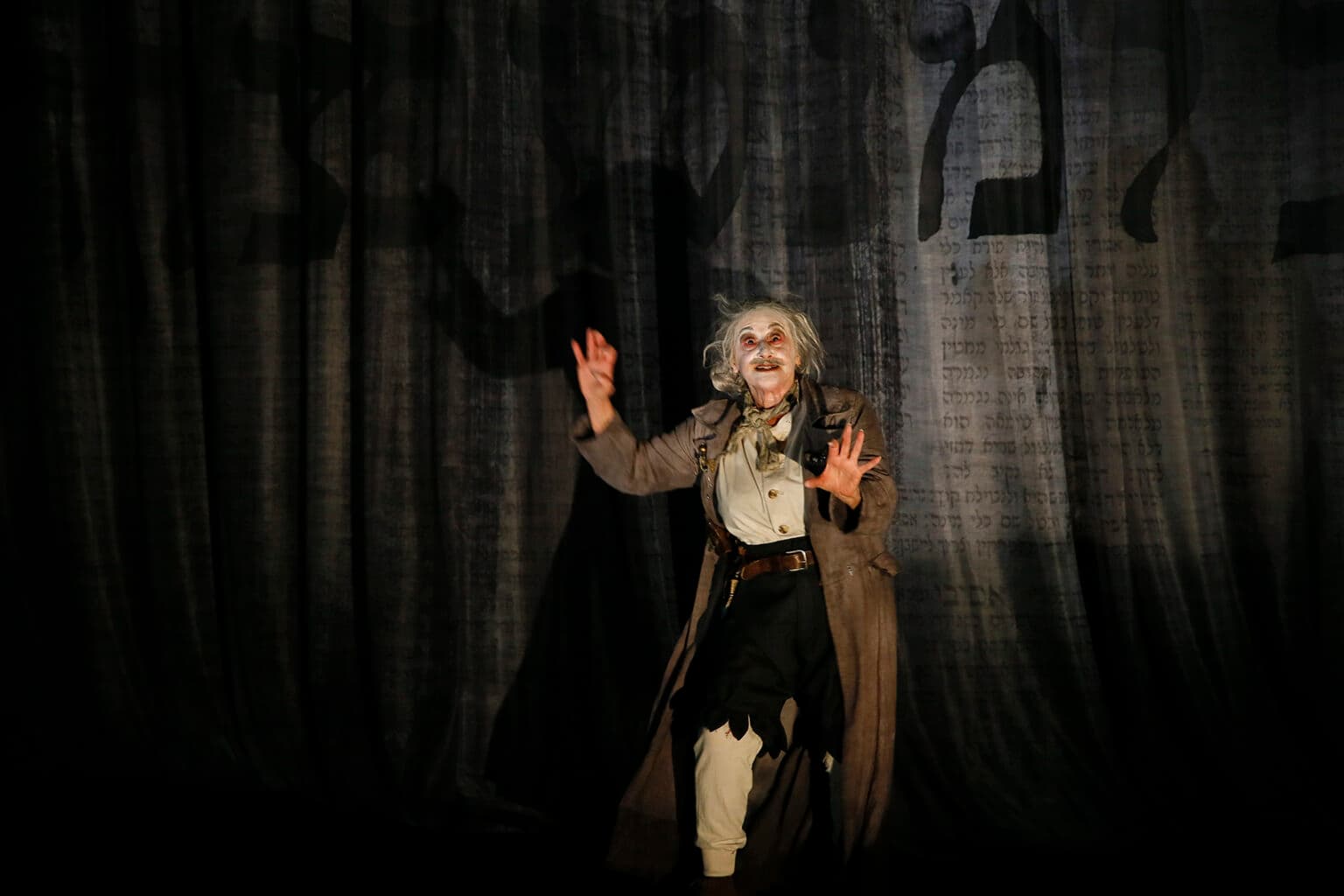
Evelyn Krape in Yentl (Mark Gambino)

Singer was scathing about the musical film, particularly its optimistic ending, which puts Yentl on a ship bound for the new world, singing “What's wrong with wanting more? If you can fly, then soar/
With all there is/ why settle for just a piece of sky?” 

In a short “interview with himself” for the New York Times, he scoffed: “What would Yentl have done in America? Worked in a sweatshop 12 hours a day where there is no time for learning? Would she try to marry a salesman in New York, move to the Bronx or to Brooklyn and rent an apartment with an ice box and a dumbwaiter?”

To Singer the essence of Yentl is “her sacrifice, her great passion for spiritual achievement”. Female sacrifice was, after all, a very comfortable idea to men of Singer’s generation.

But characters sometimes develop lives of their own. Streisand’s musical gave Yentl a new life as a self-determining woman, albeit dressed in Hollywood schmaltz.

To these contradictory characters, contemporary creatives need to add questions that neither Singer nor Streisand would have thought to ask: Is there a queer subtext in Avigdor’s attraction to Anshel or Yentl’s attraction to Hadass? Does Yentl want to be a free woman or a trans man? Is her sense of living in the wrong body the pain of gender dysphoria or a reflection of the limits of her society?

Co-creator and director Gary Abrahams said he wanted to create a production which could raise all these questions but leave the answers open.  

Is it a trans story? A queer story? A feminist story? It’s not our job to decide. People will bring their own lenses to the show.

“Is it a trans story? A queer story? A feminist story? Where we have ultimately landed is that there are multiple prisms and lenses through which to view this show and it’s not our job to decide. People will bring their own lenses to the show.

“Theatre is a place where you pose questions, and you look at those questions from every possible viewpoint, but I don’t think its our job to answer them or to have an agenda. We need to stay with the ambiguity,” he says.

This Yentl is not a rendition of the charming and light-hearted film, but a darker and sexier production, populated with the demons, dybbuks and ghosts of Singer’s kabbalah-infused imagination. Audiences may be confronted by the vivid dreams and sexual imagery.

Abrahams says the creators wanted to find theatrical language to deal with spiritual aspects of the story.  “Bashevis Singer was a learned scholar, and his work is imbued with the images, symbols of motifs of kabbalistic mythology. We wanted to be able to conjure the mood of the shtetl, but we didn’t want it to feel like a museum piece,” he says.

Selective use of Yiddish – with surtitles – is interwoven in the production evoking the cultural context but also allowing the director to play with its theatrical possibilities. “It’s such an onomatopoeic language, such a musical expressive language, that even if you don’t speak Yiddish it can be really powerful,” says Abrahams.

Most of the cast are Jewish but few knew any Yiddish so getting the language – and much of the cultural context – right was a challenge.

But the production has been a remarkable success, catapulting Kadimah from a community theatre group to an award-winning mainstage producer and drawing everyone from ageing Yiddishists to LGBTQI+ people to regular cultural consumers.

Yentl will run from October 17 to November 10 at the Playhouse. Tickets here.

You might also like
  • When the state faltered, civil society and Diaspora Jewry stepped up
    Shahar Burla
  • The case for leaving graffiti up for a while
    Adam Slonim
  • ‘To bring joy where there is no joy’: the show goes on for a lost composer
    Zeddy Lawrence
logomark.67a07ee3
We believe in the free flow of information

Republish our articles for free, online or in print, by using our Creative Commons licence

You might also like

    jiff26-cancelled.jpg
    ReflectionArts & Culture

    On despair: A reflection after watching ‘Cancelled’

    Deborah Stone
    Jewish word map
    FeatureArts & Culture

    Was the barmi a shemozzle? How Australians use Jewish words 

    Caroline Hendy & Emma Breslow 1
    haredi street guitar
    Photo EssayArts & Culture

    Jerusalemites through the lens

    Sharon Gabay

About the author

Deborah Stone

Deborah Stone

Deborah Stone is Editor-in-Chief of TJI. She has more than 30 years experience as a journalist and editor, including as a reporter and feature writer on The Age and The Sunday Age, as Editor of the Australian Jewish News and as Editor of ArtsHub.

More from the author

ReflectionArts & Culture

On despair: A reflection after watching ‘Cancelled’

NewsAustralia

Proposed digital care law to offer protection against online antisemitism

NewsIsrael

‘Israel is systemically eliminating Palestinian collective life’:  Israeli human rights report

Australia

Tame apologises – but with little grace