Aa
  • Read, Watch, Listen
  • TJI Series
  • Community Action
  • Events
  • Zedi
Follow us and continue the conversation
  • LinkedIn
  • Instagram
  • FaceBook
  • X
  • YouTube
Test yourself with the TJI Quiz!

Adjust size of text

Aa

Follow us and continue the conversation

  • LinkedIn
  • Instagram
  • FaceBook
  • X
  • YouTube

Your saved articles

You haven't saved any articles

What are you looking for?

Original reporting, insightful analysis and diverse views, delivered straight to your inbox

  • LinkedIn
  • Instagram
  • FaceBook
  • X
  • YouTube
Your support fuels our mission to inform, entertain and inspire.

The Jewish Independent is bound by the Standards of Practice of the Australian Press Council. If you believe the Standards may have been breached, you may approach The Jewish Independent or make a complaint to the Australian Press Council in writing at www.presscouncil.org.au. The Council may also be contacted on 1800 025 712.

  • Our Story
  • Contact us
  • Our Team
  • Support us
  • Guidelines
  • Pitch your idea
  • Republishing us
  • Community Action
  • Our Awards
  • LinkedIn
  • Instagram
  • FaceBook
  • X
  • YouTube
Aboriginal FlagTorres Strait Islanders Flag

The Jewish Independent acknowledges Aboriginal and Torres Strait Islander peoples as the Traditional Owners and Custodians of Country throughout Australia. We pay our respects to Elders past and present, and strive to honour their rich history of storytelling in our work and mission.

© The Jewish Independent 2026All Rights Reserved
Website design and development by Your Creative, MelbourneTerms & ConditionsPrivacy Policy
HomeRead, Watch, ListenIsrael
PeacebuildingFeatureIsrael

‘Empathy is a muscle’

Passionate attachment to our own narratives has stalled hope for Israelis and Palestinians, argues Anton Goodman from Rabbis for Human Rights.
Deborah Stone
Print this
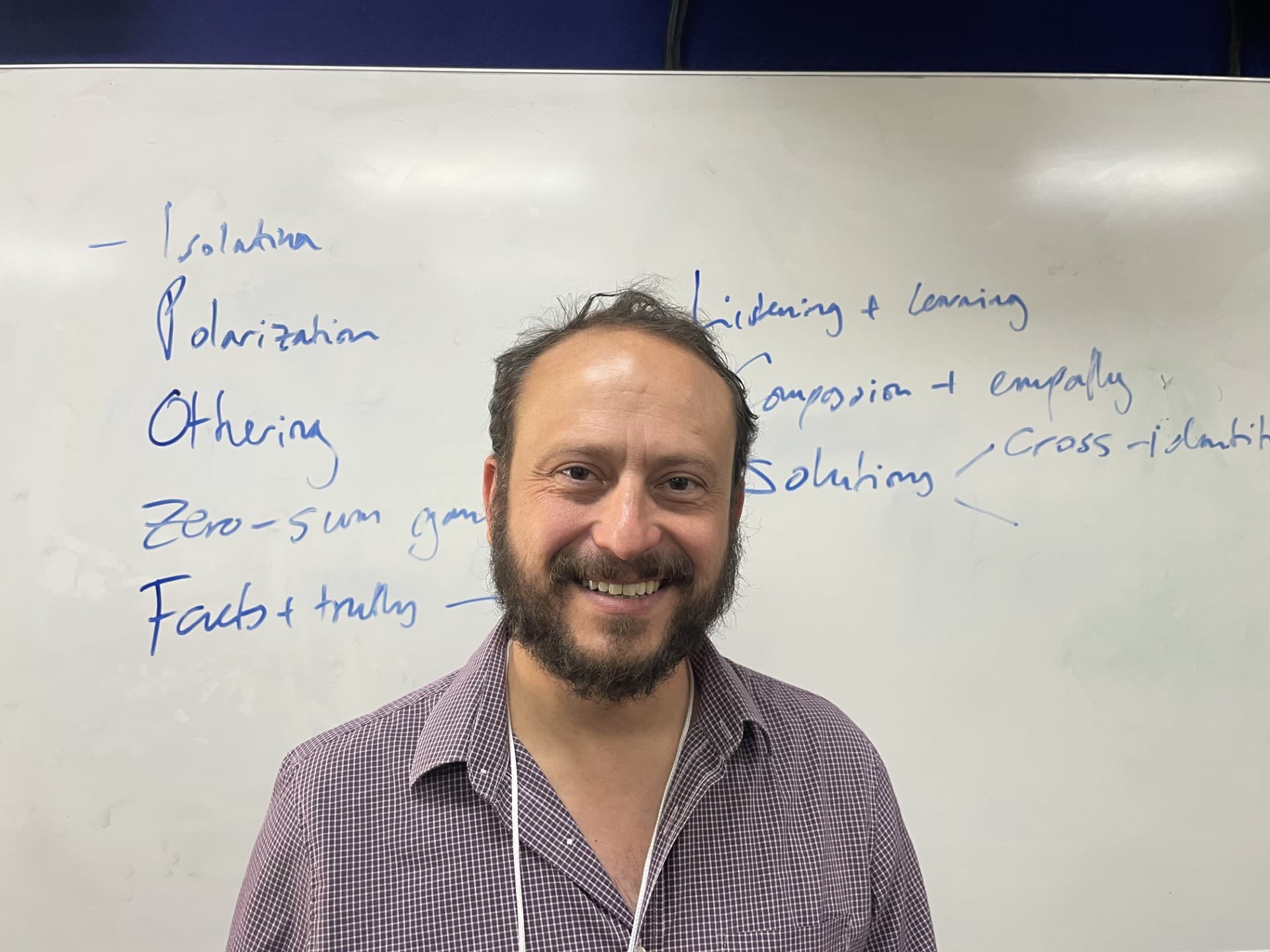
Man in front of a whiteboard with writing.

Anton Goodman from Rabbis for Human Rights at Limmud Oz

Published: 13 June 2024

Last updated: 9 May 2025

The most difficult words I heard at Limmud Oz in Sydney last weekend came from a man who is committed to improving the lives of both Israelis and Palestinians.

“Israel cares more about its narrative than the lives of its children,” Anton Goodman, Partnerships Director at Rabbis for Human Rights, told a session on non-binary conflict resolution.

Goodman’s statement comes in the context of the failure of successive Israeli governments to engage in any process to end the occupation and enable a Palestinian state.

The English-born Israeli talks regularly with young Israelis on the cusp of army service. There has been no peace process in their lifetimes. “They are all experts in explaining why there is no solution,” he said.

Goodman himself has four children, the oldest 17. “I have nightmares about my children in the army. It is irresponsible not be setting the wheels in motion for a more secure future for all of us, even if that means taking difficult decisions around it.”

Goodman says attachment to our own narratives mean we are too inclined to insist upon our own understanding of the “truth” or “facts” of the conflict, rather than listen to other narratives.

“I’m sure you hear it here all the time too. You hear people saying ‘If only they’d listen. If only they knew the facts. Then they’d understand.’ No, they wouldn’t,” he said.

Arguments about whether the Palestinian Health Ministry has inflated the number of deaths in Gaza, or whether details in reports of the Hamas massacre on October 7 are accurate completely miss the point, says Goodman.

Instead, he urges people to listen with compassion to the experiences of the other side. “Compassion and empathy are not values. They are muscles. The more you use them, the more you have the ability to use them.”


"We’ve got a generation in Israel that’s never seen anything except a Netanyahu government and a generation in Gaza that’s never left the Gaza Strip."

Anton Goodman, Rabbis for Human Rights

But he said most Israelis do not want to hear about the Palestinian experience. “Israeli society, for the most part, has a willful ignorance to Palestinian life and occupation. They turn away from anything that you show them around it.”

“This is not a problem of peace, it is a problem of human rights and a problem of lack of hope. We've said for many years, this is an issue with the siege of Gaza, and it is a siege in the sense that people can't go in and out, and all the products going in and out are decided by the Israelis.

“We’ve got a generation in Israel that’s never seen anything except a Netanyahu government and a generation in Gaza that’s never left the Gaza Strip. The only administration they've seen is Hamas, which is Islamic jihadi fundamentalism. That's their schools. That's their media. That's their society. That's their world. That's what they understand. When you create that kind of isolation of people, that is the context that you live in.”

Goodman said discussions have to begin not with maps about how the land could be divided, but with on the ground initiatives to improve people lives. “Maybe we put the maps back on the table but to say: Who doesn't have access to water? Which community is getting rocketed every week? Where don’t they have access to their farming lands? How can we come in and change this? How can we go in piece by piece and get the message out to people that we care about you?”

Speaking about the deep divisions in the international community over Israel-Palestine, Goodman said in each country, the conflict was viewed through the lenses of their own divisions – through race relations in the US, apartheid in South Africa, and the Holocaust in Germany.

“It has become a tipping point for polarisation. Societies are being pulled apart by our conflict.

“We are in for a number of very hard years as Israelis and Palestinians and for you [Diaspora Jews] too. If you think you've got over the delegitimisation of Israel as a state, you haven't . And the longer that Israel holds on to its fortress mentality, the worse it's going to get.”

He said while there was bad faith and politicisation behind South Africa’s accusing Israel of genocide at the International Court of Justice, it was not without foundation.

“They had a wealth of material, of quotes from Israeli politicians, of songs, of all kinds of things calling for genocide. They were in a very strong position with materials that they had that we created in Israel.”

Goodman has seen such extremism in his own circles too. He quotes one man at his synagogue who advocated killing all Palestinians.

“So, I said, ‘Really? women, children, old people?’ He said, ‘Yes’. So, I said, ‘Okay, you’re in charge of the children.’ He said, ‘No worries’.”

You might also like
  • ‘Israel is systemically eliminating Palestinian collective life’:  B’Tselem
    Deborah Stone
  • Tame apologises – but with little grace
    Deborah Stone
  • Confronting Richard Flanagan and the myth of the Israel lobby
    Mary Garden
logomark.67a07ee3
We believe in the free flow of information

Republish our articles for free, online or in print, by using our Creative Commons licence

You might also like

    Erdogan Turkey
    AnalysisIsrael

    Turkey emerges as military threat to Israel

    Dror Doron
    Segalovitz Abbas
    Israel Votes 2026AnalysisIsrael

    Segalovitz decision to join Arab party is a paradigm change for Israel

    Eetta Prince-Gibson
    Arab Israeli Palestinian election vote
    Israel Votes 2026FeatureIsrael

    Fear of Netanyahu victory may drive big surge in Palestinian voter turnout

    Ben Lynfield

About the author

Deborah Stone

Deborah Stone

Deborah Stone is Editor-in-Chief of TJI. She has more than 30 years experience as a journalist and editor, including as a reporter and feature writer on The Age and The Sunday Age, as Editor of the Australian Jewish News and as Editor of ArtsHub.

More from the author

NewsIsrael

‘Israel is systemically eliminating Palestinian collective life’:  B’Tselem

Australia

Tame apologises – but with little grace

NewsAustralia

Australia to increase sanctions against West Bank settlements

NewsAustralia

Humanitarian organisations fail on antisemitism: new research

Comments1

  • Avatar of Ruth Armitage

    Ruth Armitage16 June at 11:58 pm

    How encouraging it is to hear a voice of reason.