Aa
  • Read, Watch, Listen
  • TJI Series
  • Community Action
  • Events
  • Zedi
Follow us and continue the conversation
  • LinkedIn
  • Instagram
  • FaceBook
  • X
  • YouTube
Test yourself with the TJI Quiz!

Adjust size of text

Aa

Follow us and continue the conversation

  • LinkedIn
  • Instagram
  • FaceBook
  • X
  • YouTube

Your saved articles

You haven't saved any articles

What are you looking for?

Original reporting, insightful analysis and diverse views, delivered straight to your inbox

  • LinkedIn
  • Instagram
  • FaceBook
  • X
  • YouTube
Your support fuels our mission to inform, entertain and inspire.

The Jewish Independent is bound by the Standards of Practice of the Australian Press Council. If you believe the Standards may have been breached, you may approach The Jewish Independent or make a complaint to the Australian Press Council in writing at www.presscouncil.org.au. The Council may also be contacted on 1800 025 712.

  • Our Story
  • Contact us
  • Our Team
  • Support us
  • Guidelines
  • Pitch your idea
  • Republishing us
  • Community Action
  • Our Awards
  • LinkedIn
  • Instagram
  • FaceBook
  • X
  • YouTube
Aboriginal FlagTorres Strait Islanders Flag

The Jewish Independent acknowledges Aboriginal and Torres Strait Islander peoples as the Traditional Owners and Custodians of Country throughout Australia. We pay our respects to Elders past and present, and strive to honour their rich history of storytelling in our work and mission.

© The Jewish Independent 2026All Rights Reserved
Website design and development by Your Creative, MelbourneTerms & ConditionsPrivacy Policy
HomeRead, Watch, ListenIsrael
FeatureIsraelWorld

Sharp decline in American support for Israel, survey reveals

Most Americans now hold an unfavourable view of Israel and have little or no confidence in Prime Minister Benjamin Netanyahu.
Shahar Burla
Print this
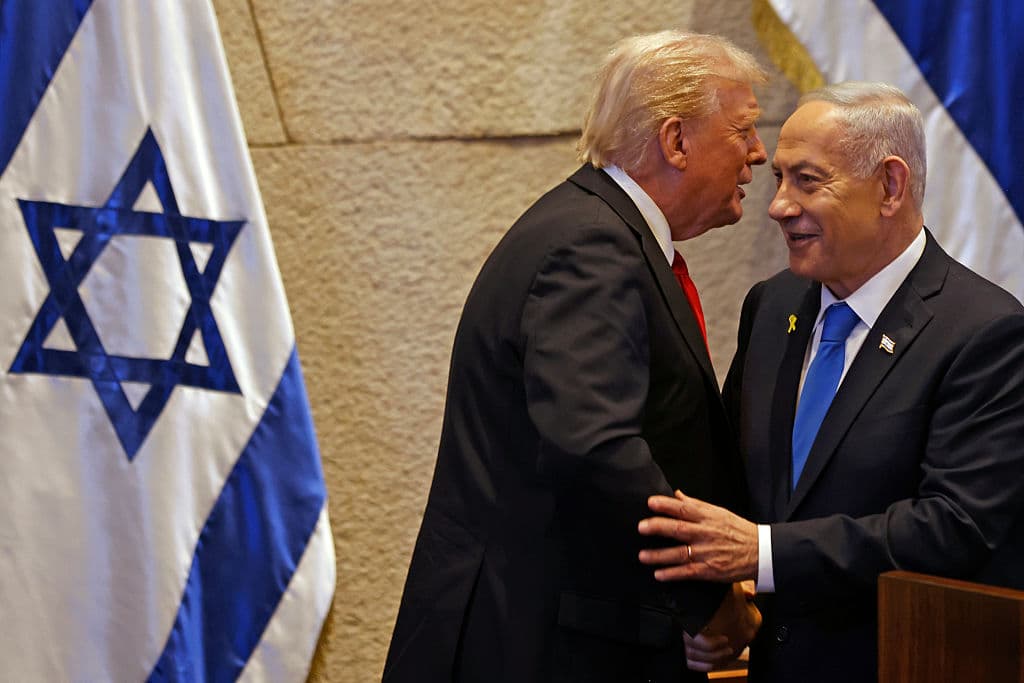
U.S. President Donald Trump speaks with Israel's Prime Minister Benjamin Netanyahu in the Knesset

US President Donald Trump speaks with Israel’s Prime Minister Benjamin Netanyahu (Jalaa Marey – Pool/Getty Images)

Published: 14 April 2026

Last updated: 14 April 2026

A new survey from Pew Research Center suggests a significant shift in American public opinion towards Israel, one that could have long-term implications for the relationship between Washington and Jerusalem.

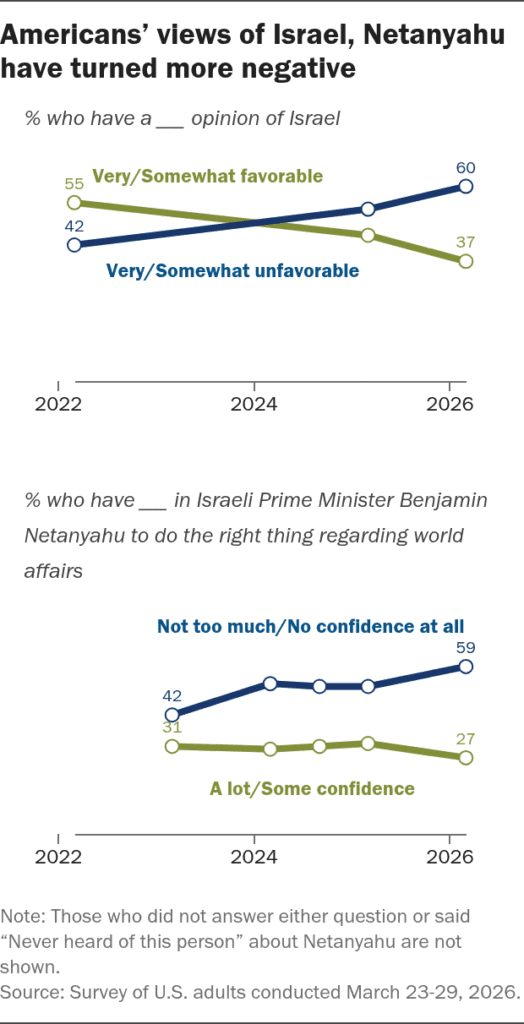
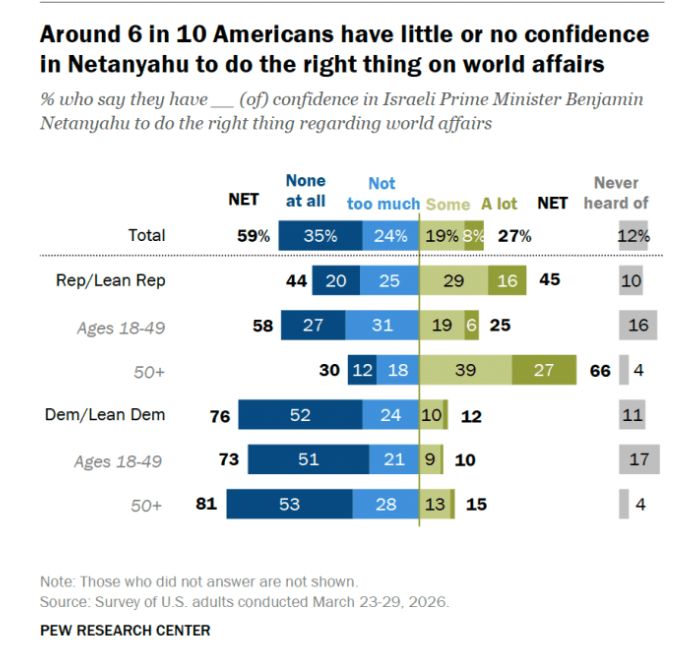
Around 60% of Americans now say they hold a somewhat or very unfavourable view of Israel, up sharply from 53% last year and just 40% in 2022. The proportion expressing a very unfavourable view has nearly tripled over that period to 28%. Confidence in Israeli Prime Minister Benjamin Netanyahu has also declined, with 59% of Americans saying they have little or no confidence in his handling of world affairs.

The survey, conducted in late March among more than 3,500 US adults, comes amid the ongoing US- and Israeli-led war in Iran. Taken together, the findings point to a broader trend: growing scepticism towards Israel across large parts of the American public.

The decline is increasingly bipartisan, led by younger Americans

While the US remains politically polarised on Israel, the latest data suggests the shift is increasingly bipartisan, driven in particular by younger voters.

Among Democrats, unfavourable views of Israel are now dominant. Around 80% of Democrats and Democratic-leaning independents express negative views, up from 69% last year and 53% in 2022. Nearly half of Democrats under 50 say they hold a very unfavourable opinion.

Republicans remain more supportive overall, but even here the trend is moving. A majority of Republicans still view Israel positively (58%), yet unfavourable views have increased, especially among younger Republicans. Among those aged 18 to 49, 57% now hold a negative view, up from 50% last year.
The generational divide is now one of the most striking features of US opinion. Older Americans, particularly older Republicans, continue to express strong support for Israel. Younger Americans, across both parties, are significantly more critical.

Religious and demographic divides are shaping support for Israel

Public opinion also varies sharply across religious groups. Jewish Americans and White evangelical Protestants remain among the most supportive of Israel, with around two-thirds expressing favourable views. However, even within these groups, support is no longer uniform, particularly when it comes to Israeli leadership.

The Jewish Independent

Among other groups, support is far lower. Fewer than four in ten White non-evangelical Protestants view Israel positively, alongside roughly a third of Catholics and Black Protestants. Among religiously unaffiliated Americans, positive views drop to just over one in five. Among Muslim Americans, support is minimal.

Notably, criticism of the Israeli government extends even into traditionally pro-Israel constituencies. A majority of US Jews now say they have little or no confidence in Netanyahu’s leadership, and separate polling suggests many identify as both “pro-Israel” and critical of current government policies.

Confidence in leadership is shaping attitudes on both sides

Confidence in political leadership appears to be a key factor shaping public attitudes. In the US, more than half of respondents say they lack confidence in Donald Trump to manage the US–Israel relationship effectively. While Republicans remain broadly supportive of Trump’s approach, Democrats overwhelmingly express scepticism. Younger Republicans are also notably less confident than older ones.

The Jewish Independent

At the same time, Netanyahu’s standing has declined across much of the US electorate. Among Democrats, three-quarters express little or no confidence in him, with around half saying they have no confidence at all. Among Republicans, views are now split, marking a shift from previous years when Republican support for Netanyahu was more consistent.

These trends suggest that attitudes towards Israel are increasingly intertwined with perceptions of political leadership, both in Washington and Jerusalem.

The Iran conflict is shaping how Americans prioritise Israel

The survey also highlights how Americans prioritise different international issues. While 53% say the Israel–Hamas conflict is personally important to them, a much larger share, 77%, say the same about US military action involving Iran. Nearly half of Americans describe the Iran-related conflict as very important, compared to just 22% for Israel–Hamas.

This distinction is significant. It suggests that, for many Americans, Israel is increasingly viewed through the lens of broader US foreign policy, particularly the risks associated with military escalation in the Middle East, rather than as a standalone issue.

There are also differences within political and religious groups. Jewish and Muslim Americans are similarly likely to view the Israel–Hamas conflict as personally important, while White evangelical Protestants place greater emphasis on US military action involving Iran.

What does it mean for US–Israel relations?

“If the American people don’t want a pro-Israel policy, the policy will change”  argues Jason Willick, writing in The Washington Post. Willick suggests that the long-term strength of US–Israel relations ultimately depends not only on shared strategic interests, but on public opinion.

Historically, US support for Israel has been underpinned by broad political consensus. But in a democratic system, that consensus is not fixed. Over time, shifts in public sentiment tend to shape policy direction, particularly on foreign affairs. If American voters become more sceptical of Israel, political leaders are likely to follow.

Willick also challenges the idea that US policy is primarily driven by lobbying. Instead, he argues that it largely reflects public attitudes. From this perspective, Israel’s closer alignment with a US-led confrontation involving Iran, especially one that may be unpopular domestically, carries political risks.

Willick frames the current moment as a departure from past patterns. For most of its history, Israel has avoided becoming a direct co-belligerent with the US in major wars. The recent conflict changes that dynamic, tying Israel more closely to the fluctuations of American domestic politics.

More broadly, Willick sees Israel’s post–October 7 strategy shifting from deterrence to an effort to decisively eliminate threats such as Iran as a “historic gamble” on continued US backing. If that gamble fails, the consequences may not be immediate, but could emerge in future crises.

The implication is not that the US–Israel alliance is about to collapse. But it may become more conditional, more contested, and more sensitive to political change in Washington.

You might also like
  • The Altalena should be a warning, not a political weapon
    Shahar Burla
  • Turkey emerges as military threat to Israel
    Dror Doron
  • Because of my Zionist values, I’m joining an Arab party
    Yoav Segalovitz
logomark.67a07ee3
We believe in the free flow of information

Republish our articles for free, online or in print, by using our Creative Commons licence

You might also like

    interfaith war
    FeatureWorld

    The illusion of Just War: Conflict ethics in Judaism, Christianity and Islam

    Dave Moskovitz
    settler outpost west bank
    NewsIsrael

    Israel is cementing its control over the West Bank and East Jerusalem while the world is distracted

    Martin Kear
    Protest
    AnalysisIsrael

    Western ‘Palestinianism’ colonises everything – and hurts Palestinians

    Andres Spokoiny 1

About the author

Shahar Burla

Shahar Burla

Dr Shahar Burla is a Sydney-based researcher, lecturer and Contributing Editor of TJI. Shahar holds a Master’s degree in political science from Hebrew University and a PhD in political science from Bar-Ilan University. He is the author of Political Imagination in the Diaspora: The Construction of a Pro-Israeli Narrative (2013) and co-editor of Australia and Israel: A Diasporic, Cultural and Political Relationship (2015).

More from the author

OpinionIsrael

The Altalena should be a warning, not a political weapon

AnalysisIsrael

Who is Ofer Winter and could he upset Netanyahu’s election?

AnalysisIsrael

Bennett’s balancing act: can he win over the right without losing the centre?

OpinionIsrael

Flying to vote is an act of love, not impudence

Comments

No comments on this article yet. Be the first to add your thoughts.