Published: 25 January 2019
Last updated: 4 March 2024
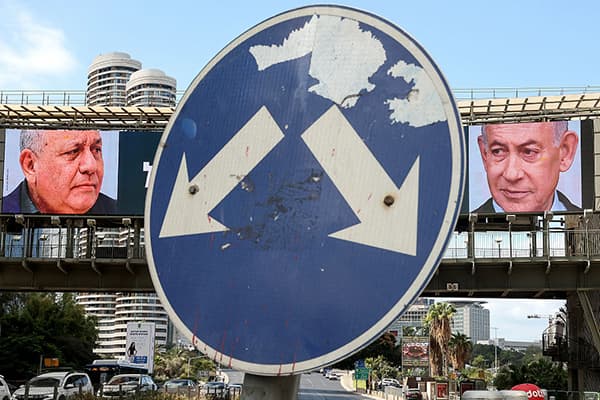
In an apparent response to being branded as a ‘leftist’ by Likudniks for his statement that Israel should amend the Jewish Nation-State law to include the word “equality”, Gantz released an ad depicting the destruction wrought on Gaza during Operation protective Edge in 2014, while he was the IDF Chief of Staff.
Under the title, Hamas suffers blow after blow, the following data was screened against the backdrop of images showing the destruction of Gaza and accompanied by dramatic music: “6,231 targets destroyed. 1364 terrorists killed. 3.5 years of quiet. Only the strong wins. Gantz. Israel before everything.”
SEE THE AD
To further emphasise the measures which Gantz used to stop violence from the besieged strip, the preview for the ad on Facebook proudly proclaims, “Parts of Gaza have been returned back to the stone age. #BG19.”
Gantz’s campaign slogan Only The Strong Win is a variation on an infamous tweet from Netanyahu, who last summer declared that “the weak crumble, are slaughtered and are erased from history while the strong, for good or for ill, survive”.
This advert is especially disappointing for those who were hoping he would be a candidate that would be critiquing the policies of Netanyahu from the left, not the right.
The advert, which contains some inflated figures about Palestinian deaths, makes no mention of the 73 Israelis who were killed, or the thousands of Palestinians who were injured in the 50-day war. The official casualty figures published by Israel’s Ministry of Foreign Affairs of 936 militants killed are disputed, and Gantz's total appears to include deaths of so-called “uncategorised males” aged between 16 and 50, bringing the number up to 1,364.
This classification means Israel could not confirm whether they were militants or civilians. According to the figures from B’tselem, only 37% of the 2202 Palestinians killed in aerial bombardments were enemy combatants.
The advert has been condemned from both left and right parties in Israel. Naftali Bennett, co-leader of the New Right Party, accused Gantz of “falling asleep” during his time as Chief of Staff, for failing to authorise ground troops for the first 18 days of war to act against the tunnels which Hamas had built to infiltrate Israeli territory.
From the left, Meretz MK Michal Rozin wrote, “Arrogant images of the flattening of Gaza - is that Gantz's vision? Israel needs a real political horizon - not just power, power and more power. Of that we have enough. And in the case of Gaza it also led us to a dead end.”
In claiming "3.5 years of quiet", the advert ignores the thousands of rockets that have been fired by Hamas into Israel since the war ended, which have devastated so many communities in southern Israel. It also ignores the incredible human suffering that still exists in Gaza due to the continuing siege by Israel and Egypt.
[gallery columns="1" size="large" ids="25476"]
Gantz is seen by many in Israel as the liberal Zionist hope for a new type of leader based on the kind of dignified leadership displayed by much-admired prime ministers of the past such as David Ben-Gurion and Menachem Begin.
In that regard, this advert is especially disappointing for those who were hoping he would be a candidate that would be critiquing the policies of Netanyahu from the left, not the right. One of Israel’s most outspoken liberals, Haaretz journalist Gideon Levy, recently declared in an interview "I'm not joking when I say that if I have to choose between Gantz, Lapid, or Netanyahu today, I choose Netanyahu without hesitation".
Levy argues that Netanyahu has acted with far more moderation towards the Palestinians than would any leader of the so called “centre-left.” In spite of opposition from many in the PM’s own party and much of his cabinet, after all it was Netanyahu who supported the disengagement from Gaza in 2004, the Gilad Shalit deal in 2011, an apology to Turkey in 2016 and a ceasefire agreement with Hamas the day after close to 500 rockets were fired into Israel in November 2018.
He also approved a series of payments that began last year from Qatar to Hamas civil servants in Gaza. that began last year as a way of extricating the Strip from a humanitarian crisis amid a spiral of violence. The cash injection is part of an unofficial truce between Hamas and Israel that aimed to end months of violent protests along the Gaza-Israel border in exchange for an easing of Israel’s blockade of the coastal enclave.
A total of US$90 million is to be distributed in six monthly instalments of US$15 million, according to authorities, primarily to cover salaries of officials working for Hamas. The first two have gone through and Netanyahu has just authorised a third instalment, after earlier wanting to delay it.
Given how unexpected these moves have been by Netanyahu, Levy wrote an op-ed last year that must have been seen as a gift from heaven for those on the Right. It’s headline was, “Netanyahu, Man of Peace.” In a piece filled with praise for the leader he very much despises, Levy suggested that “it’s doubtful a single other Israeli politician would have gotten through the past six months without sending the troops to Gaza for another round of useless bloodshed.”
One of Israel’s most outspoken liberals, Haaretz journalist Gideon Levy, recently declared: "I'm not joking when I say that if I have to choose between Gantz, Lapid, or Netanyahu today, I choose Netanyahu without hesitation".
So when Gantz and other centre-left leaders such as Yair Lapid, Ehud Barak and Avi Gabbay seek to replace Netanyahu as PM over his compromises with Hamas to avoid war, what does this say about how they view the Israeli electorate? Are they right in suggesting that what most people here want is a strongman who will be even tougher than his predecessor?
If a leader stepped forward tomorrow, who articulated a plan for a future that didn’t involve Israel “living by the sword”, would they stand a chance of winning? If they dared use the word “peace” in their slogan, or aspired to end the siege on Gaza in exchange for tangible security guarantees, would anyone take them seriously?
At present Meretz, Raam and the Joint List are the only parties speaking this language. Together, they would struggle to muster more than 20 seats in the Knesset.
The recent phase of campaigning suggests that the debate is no longer between right and left amongst Jewish Israelis, but rather “shades of right” that broadly agree on security policy and are for or against Netanyahu based on how they view the corruption investigations against him.
In short, to Bibi or not to Bibi.
READ MORE
Liberman’s 'Up yours' campaign slogan will target Arabs, leftist demons and Netanyahu (Haaretz)
Netanyahu’s attack on mainstream media in controversial poster demonstrates its power (Haaretz)
The dark horse who could topple Netanyahu from his throne (The Jewish Independent)