Aa
  • Read, Watch, Listen
  • TJI Series
  • Community Action
  • Events
  • Zedi
Follow us and continue the conversation
  • LinkedIn
  • Instagram
  • FaceBook
  • X
  • YouTube
Test yourself with the TJI Quiz!

Adjust size of text

Aa

Follow us and continue the conversation

  • LinkedIn
  • Instagram
  • FaceBook
  • X
  • YouTube

Your saved articles

You haven't saved any articles

What are you looking for?

Original reporting, insightful analysis and diverse views, delivered straight to your inbox

  • LinkedIn
  • Instagram
  • FaceBook
  • X
  • YouTube
Your support fuels our mission to inform, entertain and inspire.

The Jewish Independent is bound by the Standards of Practice of the Australian Press Council. If you believe the Standards may have been breached, you may approach The Jewish Independent or make a complaint to the Australian Press Council in writing at www.presscouncil.org.au. The Council may also be contacted on 1800 025 712.

  • Our Story
  • Contact us
  • Our Team
  • Support us
  • Guidelines
  • Pitch your idea
  • Republishing us
  • Community Action
  • Our Awards
  • LinkedIn
  • Instagram
  • FaceBook
  • X
  • YouTube
Aboriginal FlagTorres Strait Islanders Flag

The Jewish Independent acknowledges Aboriginal and Torres Strait Islander peoples as the Traditional Owners and Custodians of Country throughout Australia. We pay our respects to Elders past and present, and strive to honour their rich history of storytelling in our work and mission.

© The Jewish Independent 2026All Rights Reserved
Website design and development by Your Creative, MelbourneTerms & ConditionsPrivacy Policy
HomeRead, Watch, ListenIsrael
ReviewIsrael

Forgotten: a rediscovery of Israel’s buried Palestinian history

A recently-published book explores the erasure of historical Palestinian presence in Israel. Since it was written, the problem has got worse.
Ittay Flescher
Print this
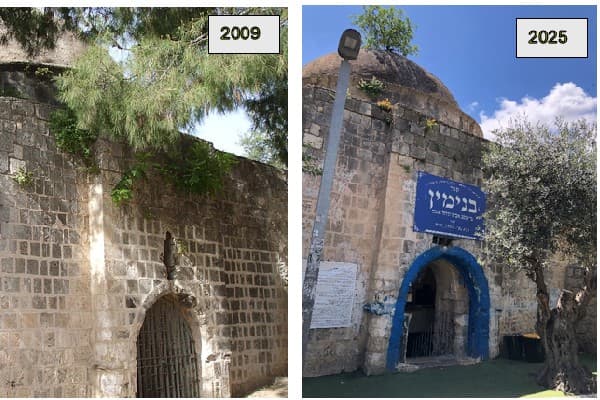
Tomb of Benjamin

Previously believed to be the Muslim scholar Nabi Ukkasha, this building is now labelled “Tomb of Benjamin” in Hebrew (Ittay Flescher)

Published: 14 May 2025

Last updated: 15 May 2025

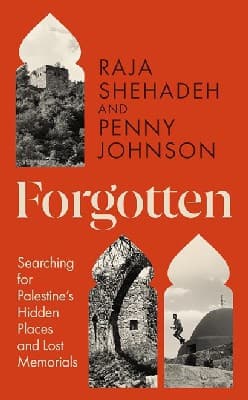
Reading Forgotten: Searching for Palestine’s Hidden Places and Lost Memorials by Raja Shehadeh and Penny Johnson is like walking through a cemetery without headstones: the absence of memory is as loud as what’s remembered. It is a book of quiet Palestinian rebellion, of resisting erasure not through confrontation, but through careful attention: to place, to story, and to what lies just beneath the surface.

The authors guide us across through pre-1948 Palestine — what is now Israel, East Jerusalem, the West Bank and Gaza — not to lecture, but to notice. They trace the contours of a land shaped by grief, love, and, above all, complexity. They visit abandoned shrines, razed villages, forgotten tombs. In each, they ask: What do we remember? And what do we choose to forget?

In Chapter 5, they search for the tomb of Nabi Ukkasha, a 7th-century companion of the prophet Mohammed whose grave is believed to lie in the heart of West Jerusalem, not far from Jaffa road on Rehov Haneviim, and just a stone’s throw from Aroma café and light rail tracks.

I, too, went looking for this site, after reading the book, and what I found startled me. Like the authors, I saw a minaret, a mosque and an ancient domed mausoleum with a similar design to that of Rachel’s tomb in Bethlehem. Yet since they wrote the book two years ago, something had changed. Not only was there no acknowledgement of Nabi Ukkasha, now there are Hebrew signs proclaiming the “Tomb of Benjamin,” surrounded by Hebrew prayer books, , menorahs, and tzedakah boxes. The Islamic identity of the tomb had been replaced with a single narrative asserting itself over another.

How did this happen?
Security concerns

It started quietly after October 7, 2023, when security concerns led the IDF to severely limit access to Rachel’s Tomb in Bethlehem. That site is sacred to many Jews, especially around the anniversary of Rachel's death. Rachel Imenu died giving birth to Benjamin—and because some believe Benjamin also died on the same date, his yahrzeit is commemorated together with hers.

So, when Rachel’s Tomb became inaccessible, groups of Hasids from Breslov began gathering at this Muslim tomb in central Jerusalem, claiming it was in fact Benjamin’s burial place. A reference in Sefer HaYashar, a medieval Jewish text, says Benjamin was buried "opposite the Jebusite" — which some interpret as Jerusalem. That was enough to begin reshaping the site’s story.

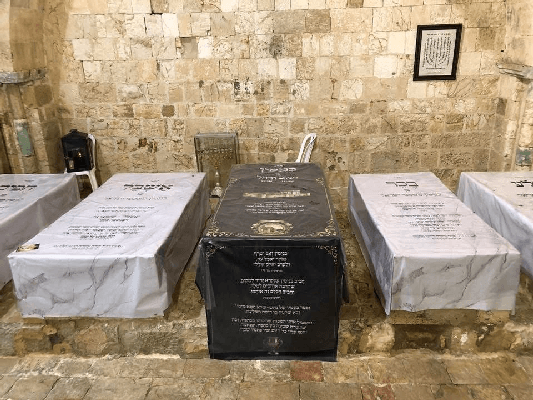
There are five graves in the tomb. The central one has a black cover, which now reads, “Benjamin, son of Issac and Rachel, while the other four are white and are labelled for Benjamin’s sons: Bela, Becher, Ashbel, and Huppim. Many haredi Jews now gather to kiss the tomb and to pray for everything from good health to desirable marriages. 

The central coffin is now draped in a cloth identifying it as containing Benjamin, son of Isaac and Rachel (Ittay Flescher)

But this transformation wasn’t done with historical research, archaeological support, or interfaith dialogue. It was done through physical takeover. Fake official signs now appear in the same typesetting and design used by the Jerusalem Municipality. And neither the city nor the Israel Antiquities Authority stopped it. Some say they even enabled it through inaction.

There’s a painful irony here. Because if we’re honest, the story of holy site appropriation in this land is not one-sided.

Appropriation of tombs

Jews know what it means to lose access to sacred space. The Temple Mount — Judaism’s holiest site — is now home to the Al-Aqsa Mosque and Dome of the Rock. Jews may visit but not pray there.

The Cave of the Patriarchs in Hebron, where our biblical ancestors are buried, was converted into the Ibrahimi Mosque in the 7th century, and today is physically divided, with Jewish and Muslim sections guarded by soldiers.

Rachel’s Tomb — where Muslims once prayed in a space they called the Bilal ibn Rabah Mosque — has now been fortified and claimed almost entirely by Jewish worshippers.

The Jewish Independent

Even the Tomb of Joseph in Nablus is contested: Jews believe it houses the remains of the biblical Joseph, while some Muslims claim it is the burial place of a local sheikh. Each of these sites contains layers — stories laid on top of one another like sediment, shaped by devotion, conquest, and myth.

But Forgotten is not about keeping score. It is about asking what happens when one story denies the legitimacy of another, when history is not shared, but seized.

In the final chapter, Shehadeh and Johnson stand before the new Simon Wiesenthal Centre Museum of Tolerance, built atop the historic Mamilla Cemetery in the western part of the city, where generations of Jerusalem’s Muslims were buried.

“As we looked up at the forbidding façade of a building supposedly dedicated to tolerance, it became clear to us that confronting the denial of the experiences of the other, as well as connections – lost, remembered, present and threatened – are what unites our explorations throughout this book.”

It’s a searing line. Because true tolerance demands more than slogans. It requires the courage to acknowledge someone else’s sacredness, even when it overlaps with our own.

And yet, this book is not hopeless. It is, in many ways, an ode to the resilience of memory. Trees still grow where villages once stood. Byzantine ruins peer out from the soil. A qasr (meaning castle in Arabic), thought to be lost, gleams in the afternoon sun. In a land constantly at risk of forgetting, Shehadeh and Johnson remind us that not everything disappears. Some truths linger, waiting to be seen again.

Reading Forgotten left me with a deep ache, but also a sense of duty. Not just to remember what was, but to honour it. To protect what remains. To build a future where our sacred stories can coexist, rather than compete. In a land that too often demands loyalty to a single truth, Forgotten dares to hold many.

We owe this place, and each other, no less.

Forgotten: Searching for Palestine’s Hidden Places and Lost Memorials by Raja Shehadeh and Penny Johnson was published by Allen and Unwin in March 2025.

Raja Shehadeh will be speaking about this book at the Sydney Writers Festival via video on Friday May 23.

You might also like
  • Fear of Netanyahu victory may drive big surge in Palestinian voter turnout
    Ben Lynfield
  • Israel is cementing its control over the West Bank and East Jerusalem while the world is distracted
    Martin Kear
  • Rediscovered in Melbourne: the 75-year odyssey of Nazi-looted Jewish books
    Jason Schulman
logomark.67a07ee3
We believe in the free flow of information

Republish our articles for free, online or in print, by using our Creative Commons licence

You might also like

    haredi street guitar
    Photo EssayArts & Culture

    Jerusalemites through the lens

    Sharon Gabay
    Segalovitz Abbas
    Israel Votes 2026AnalysisIsrael

    Segalovitz decision to join Arab party is a paradigm change for Israel

    Eetta Prince-Gibson
    altalena
    Israel Votes 2026OpinionIsrael

    The Altalena should be a warning, not a political weapon

    Shahar Burla 1

About the author

Ittay Flescher

Ittay Flescher

Ittay Flescher is the Jerusalem Correspondent for The Jewish Independent. For over twenty years, he has worked as an educator, journalist, and peacebuilder in Melbourne and Jerusalem. His book, The Holy and the Broken: A Cry for Israeli-Palestinian Peace from a Land that Must Be Shared, was longlisted for the 2025 Walkley Book Awards.

More from the author

AnalysisIsrael

What ‘Zionism’ means in Israel:  it’s not what you think

AnalysisIsrael

From haven to hotbed: how Israel’s perception of Australia has changed

FeatureIsrael

New wave of Russian-speaking migrants may be key to Israel’s future

AnalysisIsrael

How a new International Peace Fund could make a tangible difference

Comments5

  • Avatar of Mandy

    Mandy25 January at 10:31 pm

    Thank you for your sensitive review of this interesting little book, and your ability to empathize with “the other”. I’m really glad I stopped by your publication, it has given me some hope. Keep up the good work Jewish Independent!

  • Avatar of Simon Krite

    Simon Krite20 May at 04:03 am

    David – Not shooting the messenger, just pointing out that when the “messenger” consistently frames events through a revisionist, anti-Zionist lens, it’s worth questioning the message. Support for Israel doesn’t require delusion, but it also shouldn’t require swallowing narratives that erase context, downplay terrorism, or undermine Jewish self-determination. Truth deserves scrutiny too. Did you see Itai’s interview with Eylon?

  • Avatar of David Milston

    David Milston18 May at 11:52 pm

    Simon Krite seems to believe in shooting the messenger because he is unable to refute the truth that Itai Flescher has described. Support for Israel should not require deluding ourselves.

  • Avatar of Vivienne Aarons

    Vivienne Aarons15 May at 07:27 pm

    Walking in Jerusalem today 15th May with a certified Israeli guide, this particular grave was discussed. His story was that the graves belonged to a Jerusalem Islamic family, later altered to be that of a companion of Mohommad, and then later “taken over” as the grave of Benjamin. Plenty of co-opting by everyone, and none of it good. However it pales into insignificance compared with the Palestinian narrative that there were never 2 Jewish Temples on the Temple Mount. That is truly erasing a people’s history.

  • Avatar of Simon Krite

    Simon Krite15 May at 08:37 am

    Another “rediscovery” of buried Palestinian history — this time guided by Ittay Flescher, who’s made a comfortable career out of the multi-faith peace industry, only to watch that carefully curated dream go up in flames post–October 7.

    Let’s be clear: no one is disputing that the land carries layers of memory for all its peoples. But when Flescher throws his weight behind a book like Forgotten, by Raja Shehadeh and Penny Johnson — both known for their long-standing affiliations with anti-Zionist causes — what we’re really getting is not “history,” but a politically filtered narrative designed to undermine the legitimacy of Israel’s existence, piece by piece (or, shall we say, “site by site”).

    This isn’t Flescher’s first rodeo in historical rebranding. His articles in Haaretz, ABC Religion & Ethics, and Crikey follow the same pattern — morally equating Israeli statehood with Palestinian victimhood, presenting occupation as the only lens, and carefully omitting context like the endless waves of terrorism or repeated refusals of statehood.

    And let’s not forget The Holy and the Broken, his earlier work, which attempted to fuse Leonard Cohen lyrics with moral relativism. Beautiful prose, dangerous message: all trauma is equal, therefore all blame is shared. But after October 7, that balancing act falls flat. There’s no symmetry between rape, child slaughter, and hostage-taking — and a state trying to stop it.

    Yes, Ittay’s a polished storyteller. Yes, his interfaith work once had value. But this piece — like the book he’s promoting — feels less like honest reflection and more like another page from the revisionist playbook: undermine Zionism gently, one poetic phrase at a time.

    And one more thing — did anyone catch Flescher’s meltdown with Eylon Levy? If not, I strongly suggest you look it up and start asking the right questions. It’s telling.

    Because in the end, the real threat isn’t loud propaganda — it’s the softly spoken, academically framed revisionism that rewrites the story of a people’s survival as someone else’s erasure.