Aa
  • Read, Watch, Listen
  • TJI Series
  • Community Action
  • Events
  • Zedi
Follow us and continue the conversation
  • LinkedIn
  • Instagram
  • FaceBook
  • X
  • YouTube
Test yourself with the TJI Quiz!

Adjust size of text

Aa

Follow us and continue the conversation

  • LinkedIn
  • Instagram
  • FaceBook
  • X
  • YouTube

Your saved articles

You haven't saved any articles

What are you looking for?

Original reporting, insightful analysis and diverse views, delivered straight to your inbox

  • LinkedIn
  • Instagram
  • FaceBook
  • X
  • YouTube
Your support fuels our mission to inform, entertain and inspire.

The Jewish Independent is bound by the Standards of Practice of the Australian Press Council. If you believe the Standards may have been breached, you may approach The Jewish Independent or make a complaint to the Australian Press Council in writing at www.presscouncil.org.au. The Council may also be contacted on 1800 025 712.

  • Our Story
  • Contact us
  • Our Team
  • Support us
  • Guidelines
  • Pitch your idea
  • Republishing us
  • Community Action
  • Our Awards
  • LinkedIn
  • Instagram
  • FaceBook
  • X
  • YouTube
Aboriginal FlagTorres Strait Islanders Flag

The Jewish Independent acknowledges Aboriginal and Torres Strait Islander peoples as the Traditional Owners and Custodians of Country throughout Australia. We pay our respects to Elders past and present, and strive to honour their rich history of storytelling in our work and mission.

© The Jewish Independent 2026All Rights Reserved
Website design and development by Your Creative, MelbourneTerms & ConditionsPrivacy Policy
HomeRead, Watch, ListenIsrael
ExplainerIsrael

Coalition instability and draft crisis push Israel towards early election

Israel's next national election is scheduled for late 2026, but the political system is already in campaign mode.
Shahar Burla
Print this
ISRAEL-PALESTINIAN-CONFLICT-HOSTAGES-FUNERAL

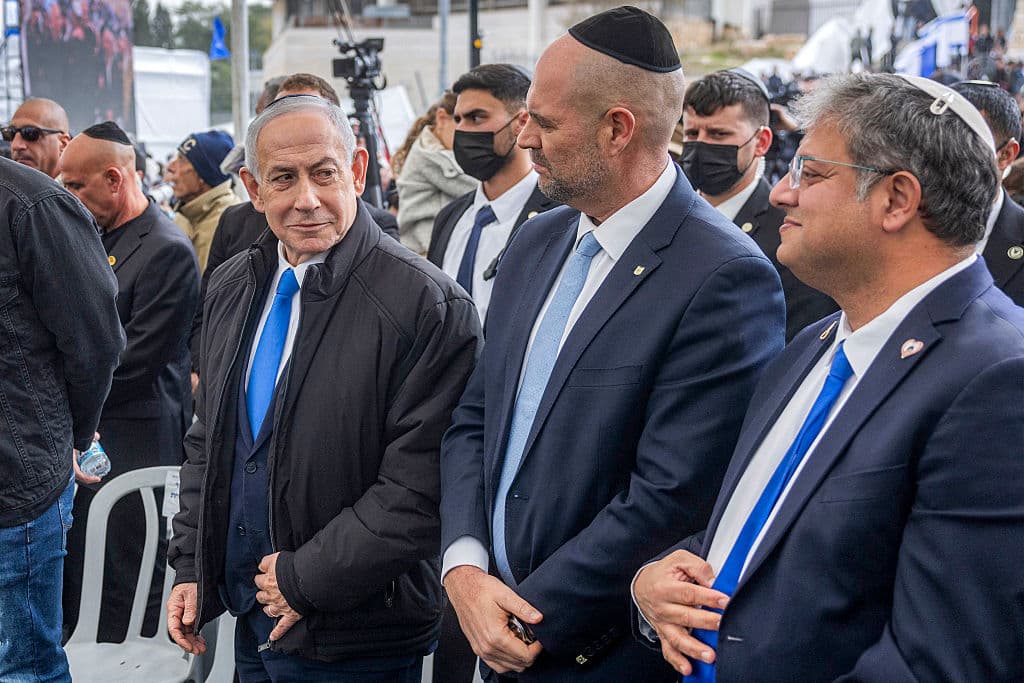
(L to R) Israel’s Prime Minister Benjamin Netanyahu, Speaker Amir Ohana, and far-right National Security Minister Itamar Ben Gvir attend the funeral of Israeli hostage Ran Gvili, whose remains were finally brought back to Israel on January 26, 2026 (Chaim Goldberg / POOL / AFP via Getty Images)

Published: 29 January 2026

Last updated: 29 January 2026

Israel’s next national election is officially scheduled for late 2026. In reality, Israel is already edging towards the polls much sooner. With the state budget passing its first Knesset reading on Wednesday, the political system entered a decisive phase that will determine when Israelis will next vote — possibly as early as May or possibly later in September.

Coalition instability, the unresolved ultra-Orthodox draft crisis, shifting opposition alliances and renewed Arab party unity have pushed the country into de facto campaign mode. The question is no longer whether Israel will face an early election, but under what political and procedural conditions it will arrive.

Here’s how the key pieces fit together.

When will the 2026 election be held?

The legal date for elections to the 26th Knesset is Tuesday, 27 October 2026. In practice, almost no one in the political system believes Israel will get anywhere near that deadline.

The strongest consensus is that elections will be held much earlier, most likely in early September 2026, with Tuesday, 8 September emerging as the leading option. Elections are traditionally avoided during the July–August summer period, when many Israelis are overseas, and the High Holidays significantly compress the political calendar. With Rosh Hashanah falling on 11 September, the first week of September is widely seen as the latest realistic window.

A September election, however, hinges on one critical condition: passage of the 2026 state budget. The budget must be approved in three readings by 31 March. Failure to do so would automatically dissolve the Knesset, topple the government and trigger elections within 90 days, pushing Israel into an election by early July.


The Knesset passed the first reading of the budget this week, after rabbis from the ultra-Orthodox Degel HaTorah party instructed their MKs to support the coalition bill. The vote passed 62–55. However, around two months of committee work still lie ahead before the budget can reach its final readings.

The delay, the budget was originally meant to pass by the end of December, stems from the Haredi parties’ refusal to support it unless legislation formalising large-scale yeshiva exemptions from military service is passed at the same time. Without such a law, the coalition lacks a stable majority. Benjamin Netanyahu is now attempting to secure backing for a compromise draft bill that would allow the budget to pass.

Alongside the September scenario, Likud sources say the Prime Minister’s inner circle is actively considering a much earlier election, potentially on 26 May. The formal justification would again be budget failure, framed in a way that avoids publicly “dissolving” the government or assigning direct blame to coalition partners. Some estimates suggest Netanyahu may not even wait until the March deadline, instead signalling as early as February that no agreement is possible.

The May option carries a distinct political logic. It would place the campaign immediately after Holocaust Remembrance Day, Memorial Day and Independence Day, Israel’s most emotionally charged period, and potentially shortly after a high-profile visit by Donald Trump, expected around Independence Day celebrations in late April. Likud strategists believe the proximity of national ceremonies and international optics could shape voter sentiment deep into election day itself.

In short, while October remains the legal outer limit, the real contest is between September and May — and the fate of the budget will decide which path Israel takes.

What do the polls say?

Current polling suggests the 2026 election will be fought between two broad blocs: the pro-Netanyahu camp, anchored by Likud and its right-wing and ultra-Orthodox allies, and a heterogeneous opposition often described as the “anyone but Bibi” bloc. That opposition spans centrist, centre-right and left-wing Jewish parties, alongside Arab parties and remains fluid and unsettled.

Unlike Netanyahu’s bloc, which is largely fixed, the opposition camp is still evolving. Party mergers and realignments remain possible until the registration deadline, roughly two months before election day, and polling volatility reflects that uncertainty.

One proposal drawing particular attention comes from former IDF chief of staff Gadi Eisenkot, now head of the new Yashar party. Eisenkot has floated the idea of a unified list with former prime minister Naftali Bennett and Opposition Leader Yair Lapid of Yesh Atid, alongside agreed guiding principles endorsed by figures such as Avigdor Lieberman and Yair Golan.

Polls conducted in January suggest such a merger would create the largest single party in the Knesset, overtaking Likud by a wide margin. Surveys published by Zman Yisrael and Channel 12 show the combined slate winning 36–38 seats, compared with around 25 for Likud. Symbolically, that would mark the first time in more than a decade, outside the 2019–21 cycle,  that Likud was not Israel’s dominant party.

But the numbers also reveal the limits of this strategy. While a merger boosts the size of the leading opposition faction, it does not meaningfully change the balance between the blocs. Whether the parties run together or separately, polls consistently point to a deadlock.

In the Zman Yisrael poll, anti-Netanyahu parties win 67 seats without a merger and 68 with one, but those totals include 11 seats held by Arab parties, as well as centrist and right-wing factions that have ruled out sitting together. Channel 12 reports a similar stalemate.

The picture is further complicated by uncertainty at the margins. Some polls suggest both Benny Gantz’s Blue and White and Bezalel Smotrich’s Religious Zionism could scrape past the electoral threshold, while others predict their disappearance from the Knesset entirely.

The bottom line is stark: polls suggest momentum and reshuffling — but not resolution. Unless one bloc fundamentally shifts its red lines after election day, Israel appears headed towards yet another political stalemate.

How is the ultra-Orthodox draft exemption shaping the election?

At the heart of the coming election lies one of Israel’s most combustible domestic issues: the long-standing exemption of ultra-Orthodox men from military service. More than any single failure since October 7, it has become the coalition’s most exposed political fault line.

As Israel fights its longest war, the IDF has warned of an urgent need for around 20,000 additional combat troops. Against that backdrop, the scale of non-enlistment in the ultra-Orthodox community has become impossible to ignore. This year alone, the army issued 53,000 draft notices, yet only 701 Haredim reported in response. Since enforcement was stepped up last July, 425 draft evaders have been arrested, more than double the figure from the first half of the year.

While secular Israelis and non-Haredi religious Jews continue to serve, and die,  in uniform, the overwhelming majority of ultra-Orthodox men remain exempt, engaged in full-time yeshiva study. Meanwhile, hundreds of thousands of reservists have spent months away from families, jobs and communities. What was once a chronic grievance has hardened into open resentment.

Politically, the implications are profound. Likud is now structurally dependent on ultra-Orthodox parties to sustain a governing coalition. In return, those parties are demanding permanent draft exemptions and continued large-scale funding for education systems that largely reject core secular subjects.

The 2026 election is therefore likely to be shaped less by ideology than by lived experience: reservists and their families,  many of whom traditionally voted Likud or hard right,  their wider social circles, and the roughly 85 per cent of Israelis who are not ultra-Orthodox, many of whom now see the draft exemption as a breaking point in Israel’s social contract.

Is the Arab Joint List returning?

Leaders of Israel’s four Arab-majority parties have announced plans to run together in the next election, reviving the Joint List in an effort to boost turnout and block another Netanyahu-led government.

The decision was announced by Mansour Abbas (Ra’am), Sami Abu Shehadeh (Balad), Ayman Odeh (Hadash) and Ahmad Tibi (Ta’al), following a large protest march in Sakhnin against spiralling violence and crime in Arab communities.

A unified list would strengthen Arab representation and potentially restore lost seats. In 2015, the Joint List won 15 seats, becoming the Knesset’s third-largest faction. Since then, ideological rifts and personal rivalries have fractured the alliance, costing the parties around five seats over successive elections.

The differences remain real: Ra’am is Islamist; the other three parties are secular. Hadash is rooted in communist and nationalist traditions, Balad is the most uncompromising toward Zionist cooperation, and Ta’al is centred largely on Tibi’s leadership.

Electorally, a united list is expected to raise turnout and complicate efforts by Jewish parties alone to reach 61 seats, increasing Arab parties’ leverage — even if they are excluded from government.

At the same time, Lieberman, Lapid and Gantz have all ruled out forming a coalition reliant on Arab parties, reflecting widespread Jewish opposition to such arrangements since October 7.

For now, the alliance is planned as a technical bloc, allowing parties to split into separate factions after the vote. Abbas has left the door open to future coalition participation, as he did in the 2021 “government of change”, and has recently taken steps to broaden Ra’am’s legitimacy with Jewish voters.

What is certain is that Netanyahu will seek to use the Joint List’s return as a mobilisation tool for the right, just as he did in 2015. Once again, Arab political unity may prove both a potential kingmaker and a powerful rallying cry for his opponents.

READ MORE 

Israel’s election may come soon and could change the country forever (The Hill) 

Israeli parliament passes first reading of state budget with support of two key Haredi parties (Haaretz)

Can newly unified Arab Israeli bloc bridge gaps to block Netanyahu next election? (Paywall, Al-Monitor) 

Polls: Bennett-Lapid-Eisenkot merger would be biggest party, but not change overall result (Times of Israel) 

Gadi Eisenkot pushing for unified list with Bennett, Lapid to rival Netanyahu's Likud (The Jerusalem Post) 

You might also like
  • Bennett’s balancing act: can he win over the right without losing the centre?
    Shahar Burla
  • Flying to vote is an act of love, not impudence
    Shahar Burla
  • Netanyahu rejects Trump’s Gaza plan, testing US influence in the region
    Shahar Burla
logomark.67a07ee3
We believe in the free flow of information

Republish our articles for free, online or in print, by using our Creative Commons licence

You might also like

    Palestinians Inspect Fire-Damaged Home Following Settler Attack Near Nablus
    OpinionIsrael

    The West Bank After Tel: a line in the sand has been crossed

    Mohammad Asideh
    Marwan Barghouti demonstration
    Israel Hamas WarAnalysisIsrael

    Palestinians disillusioned with Hamas and armed struggle: new survey

    Shahar Burla
    Neri Shotan CEO of the Kibbutz Movement Foundatio
    Israel Hamas WarInterviewIsrael

    When the state faltered, civil society and Diaspora Jewry stepped up

    Shahar Burla

Comments

No comments on this article yet. Be the first to add your thoughts.

About the author

Shahar Burla

Shahar Burla

Dr Shahar Burla is a Sydney-based researcher, lecturer and Contributing Editor of TJI. Shahar holds a Master’s degree in political science from Hebrew University and a PhD in political science from Bar-Ilan University. He is the author of Political Imagination in the Diaspora: The Construction of a Pro-Israeli Narrative (2013) and co-editor of Australia and Israel: A Diasporic, Cultural and Political Relationship (2015).

More from the author

AnalysisIsrael

Bennett’s balancing act: can he win over the right without losing the centre?

OpinionIsrael

Flying to vote is an act of love, not impudence

AnalysisIsrael

Palestinians disillusioned with Hamas and armed struggle: new survey

AnalysisIsrael

Netanyahu rejects Trump’s Gaza plan, testing US influence in the region