
Aa
  • Read, Watch, Listen
  • TJI Series
  • Community Action
  • Events
  • Zedi
Follow us and continue the conversation
  • LinkedIn
  • Instagram
  • FaceBook
  • X
  • YouTube
Test yourself with the TJI Quiz!

Adjust size of text

Aa

Follow us and continue the conversation

  • LinkedIn
  • Instagram
  • FaceBook
  • X
  • YouTube

Your saved articles

You haven't saved any articles

What are you looking for?

Original reporting, insightful analysis and diverse views, delivered straight to your inbox

  • LinkedIn
  • Instagram
  • FaceBook
  • X
  • YouTube
Your support fuels our mission to inform, entertain and inspire.

The Jewish Independent is bound by the Standards of Practice of the Australian Press Council. If you believe the Standards may have been breached, you may approach The Jewish Independent or make a complaint to the Australian Press Council in writing at www.presscouncil.org.au. The Council may also be contacted on 1800 025 712.

  • Our Story
  • Contact us
  • Our Team
  • Support us
  • Guidelines
  • Pitch your idea
  • Republishing us
  • Community Action
  • Our Awards
  • LinkedIn
  • Instagram
  • FaceBook
  • X
  • YouTube
Aboriginal FlagTorres Strait Islanders Flag

The Jewish Independent acknowledges Aboriginal and Torres Strait Islander peoples as the Traditional Owners and Custodians of Country throughout Australia. We pay our respects to Elders past and present, and strive to honour their rich history of storytelling in our work and mission.

© The Jewish Independent 2026All Rights Reserved
Website design and development by Your Creative, MelbourneTerms & ConditionsPrivacy Policy
HomeRead, Watch, ListenIsrael
AnalysisIsrael

Growing emigration wave threatens Israeli society: Knesset report

The number of Israelis moving abroad has more than doubled since 2023, while the number moving to Israel has declined.
Shahar Burla
Print this
Different coloured suitcases

More Israelis are packing their bags and not returning (TJI)

Published: 23 October 2025

Last updated: 23 October 2025

Israel is facing accelerating emigration, powered by anti-democratic reforms, the October 7 attack and the Gaza War, and resulting economic pressures

A new Knesset report shows the number of Israelis moving abroad has more than doubled since 2023. The emigration wave is not balanced by immigration, which has declined over the past decade.

Between early 2022 and mid-2024, more than 125,000 citizens left Israel — the largest loss of human capital in such a short period. The trend is believed to have continued through 2025 as the Gaza conflict dragged on.

Knesset Immigration Committee chair MK Gilad Kariv warned that “this is no longer a trend — it’s a tsunami. Many Israelis are choosing to build their future outside the State of Israel, and fewer and fewer are returning.”

He called the phenomenon “a real strategic threat” to the resilience of Israeli society, accusing the government of prioritising policies that “trample on Zionist values and the future of Israeli society.”

October 7... eroded many Israelis’ faith in the state’s basic covenant with its citizens: to ensure their safety and promote the national interest.

Dr Ran Porat

Dramatic numbers

Drawing on Central Bureau of Statistics (CBS) data, the report was presented to the Knesset Committee for Immigration, Absorption and Diaspora Affairs, which convened a special session to address the growing emigration wave. The CBS defines an emigrant as anyone who has spent at least nine months abroad.
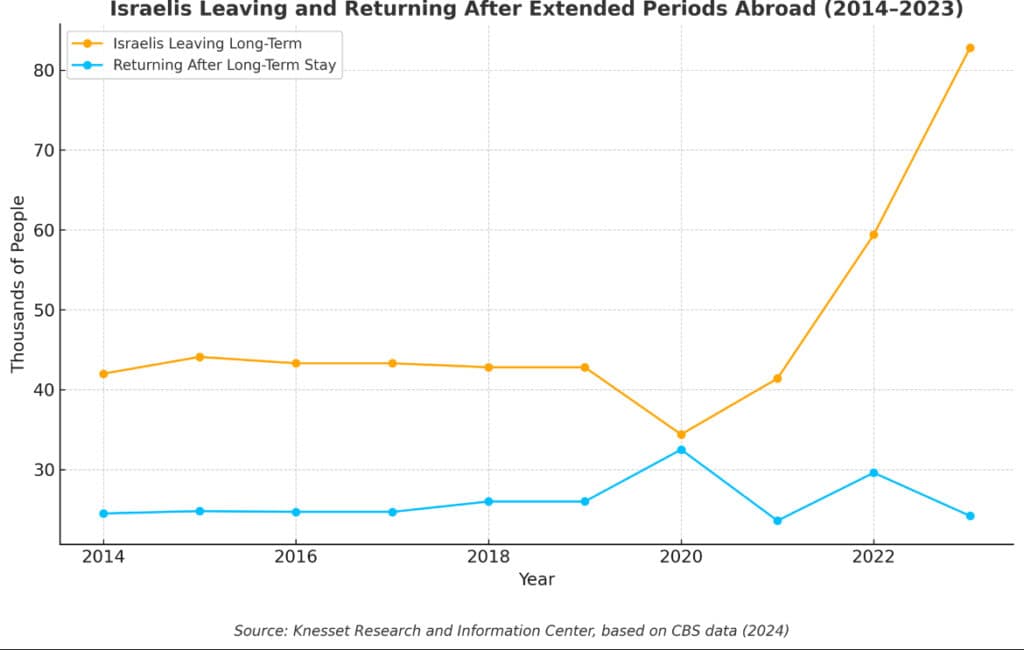

Between 2020 and 2024, Israel recorded a net loss of 145,900 citizens. In 2020, 34,000 people left for extended periods, followed by 43,400 in 2021, while the number of returnees fell to 32,500 and 23,600 respectively. In 2022 and 2023, long-term departures rose sharply — 59,400 in 2022 (a 44 % increase on the previous year) and 82,800 in 2023 (up a further 39 %), with a notable spike after the October 2023 outbreak of war.

The Jewish Independent

Emigration remained high in 2024, with about 50,000 departures between January and August — a rate consistent with the previous year. Meanwhile, fewer Israelis returned home: 24,200 in 2023 (down from 29,600 in 2022) and just 12,100 in the first eight months of 2024 (compared with 15,600 over the same period a year earlier).

Overall, departures have consistently outpaced returns. In 2023, the gap nearly doubled to 58,600 people, before narrowing slightly to 36,900 by August 2024.

Danny Zaken, a senior official with the National Insurance Institute, reported a sharp rise in the number of Israelis living abroad who have requested to cancel their residency — a sign, he said, that they have no intention of returning. In previous years, an average of 2,500 such requests were filed annually; in 2023, that number rose to 6,300, and by 2024 it had climbed to 8,400.

Security and economic drivers

Dr Ran Porat, from the Australian Centre for Jewish Civilisation at Monash University, who completed his doctorate on the Israeli diaspora in Australia (known as “Ausraelis”), told The Jewish Independent that the current rise in emigration is not surprising.

It mirrors earlier surges during national crises — such as after the 2006 Lebanon War — when Israelis’ sense of personal and national security declined. “Economic factors and internal political strife are also strong predictors of emigration in many countries, and Israel is no exception,” he said.

“There is no doubt that the intense internal rift since 2023 surrounding the government’s controversial judicial overhaul acted as a major push factor, prompting many Israelis to leave. However, the unprecedented catastrophe of October 7 — which exposed Israel’s vulnerabilities in protecting its citizens — together with the ensuing war in Gaza, attacks on multiple fronts, economic hardship and deep political divisions, has further eroded many Israelis’ faith in the state’s basic covenant with its citizens: to ensure their safety and promote the national interest. Many now feel that promise has been broken.”

Emigration of the most capable

The report also highlights striking geographic and demographic patterns. Tel Aviv recorded the highest share of departures in 2024, accounting for about 14 per cent of all Israelis who left the country, followed by Haifa (7.7 per cent), Netanya (6.9 per cent) and Jerusalem (6.3 per cent).

Men continued to outnumber women among those leaving — 42,605 compared with 40,169 — and the largest cohort was aged 30 to 49, totalling nearly 29,000. Younger Israelis also featured prominently, with more than 22,000 under 19 and about 16,000 in their twenties, while roughly 15,500 were aged 50 and over. Together, the data suggest that emigration is affecting Israelis across generations, though particularly those in their prime working years.

MK Vladimir Beliak, from the centrist Yesh Atid party, said those leaving are often the most capable and economically productive citizens. “This emigration is causing billions of shekels in losses each year,” he said, adding that “instead of trying to understand what is happening, the government’s response can be summed up as ‘good riddance.’” He argued that the coalition views the outflow as politically advantageous, believing most emigrants are not right-wing voters. “But if they don’t put an end to this tsunami, they will soon discover that the best people in the country have left.”

Immigration from the West lower than a decade ago

The report’s calculation of a net migration loss of 125,200 did not include new immigrants (Olim). Israel received more than 74,000 new citizens in 2022, 46,000 in 2023 and about 24,000 in the first eight months of 2024, according to CBS data.

In 2025, immigration from Western countries rose slightly, driven by growing antisemitism abroad and renewed enthusiasm for Zionism following the Hamas attacks of October 7, 2023, according to aliyah advocates. However, overall immigration from the US, France, the UK, Canada and other countries remains lower than a decade ago.

Eric Michaelson, director of aliyah at the Immigration and Absorption Ministry, admitted that his office has no formal plan to stem the emigration wave. “We are not a ministry for preventing emigration, and we do not have a mandate to stop it,” he told the committee. “Our responsibility is to assist new immigrants and returning residents — and to help keep them in the country for the long term.”

Leaving Israel — but not for Australia

While the number of Israelis leaving the country has increased sharply, only a small proportion have chosen Australia as their permanent destination. Official Australian migration data from mid-2023 to mid-2025 indicate that around 200 Israeli passport holders relocated to Australia with the intention of settling long-term.

Dr Porat told The Jewish Independent that the number of short-term Israeli migrants — such as those on corporate relocations or seasonal work visas — “has remained stable, nearly equal to the number of short-term visa holders who departed Australia over the past two years, around 700 or so.”

By 2025, the Israeli community in Australia is estimated at roughly 15,000 people — about 10 per cent of the broader Jewish population. “Approximately three-quarters of Israeli migrants to Australia are Jewish,” Porat noted.

Several factors explain this pattern. Historically, Australia has absorbed only a small share of broader Israeli emigration, with most migrants opting for destinations such as North America or Europe, particularly the UK and Germany. Although new Israeli communities have recently emerged in places like Cyprus, Australia remains relatively marginal due to its distance, complex visa processes and high relocation costs, Porat explained.

He added that a major deterrent in recent years has been “the sharp rise in antisemitism, which has manifested in aggressive mass protests against Israel in major Australian cities.” This, he said, “has drastically reduced Australia’s appeal as an immigration destination for Israeli Jews.”

You might also like
  • Because of my Zionist values, I’m joining an Arab party
    Yoav Segalovitz
  • Mansour Abbas’s bold bid to reshape Israeli politics
    Shahar Burla
  • How Netanyahu can stay in power without winning
    Shahar Burla
logomark.67a07ee3
We believe in the free flow of information

Republish our articles for free, online or in print, by using our Creative Commons licence

You might also like

    ISRAEL-TRANSPORT-AVIATION-STRIKE
    Israel Votes 2026AnalysisIsrael

    Bennett’s balancing act: can he win over the right without losing the centre?

    Shahar Burla 1
    Democracy protest
    Israel Votes 2026AnalysisIsrael

    What ‘Zionism’ means in Israel:  it’s not what you think

    Ittay Flescher 1
    beautiful six hostages
    Israel Votes 2026OpinionIsrael

    The memory of the hostages should guide Israel’s choices for the future

    Nirit Eylon

Comments1

  • Avatar of Yosi

    Yosi16 November at 04:51 am

    Australia has had protests against the genocide Israel has committed against the Palestinian people. There are many ex Israelis here who are anti zionist and anti genocide

About the author

Shahar Burla

Shahar Burla

Dr Shahar Burla is a Sydney-based researcher, lecturer and Contributing Editor of TJI. Shahar holds a Master’s degree in political science from Hebrew University and a PhD in political science from Bar-Ilan University. He is the author of Political Imagination in the Diaspora: The Construction of a Pro-Israeli Narrative (2013) and co-editor of Australia and Israel: A Diasporic, Cultural and Political Relationship (2015).

More from the author

AnalysisIsrael

Who is Ofer Winter and could he upset Netanyahu’s election?

AnalysisIsrael

Bennett’s balancing act: can he win over the right without losing the centre?

OpinionIsrael

Flying to vote is an act of love, not impudence

AnalysisIsrael

Palestinians disillusioned with Hamas and armed struggle: new survey