Aa
  • Read, Watch, Listen
  • TJI Series
  • Community Action
  • Events
  • Zedi
Follow us and continue the conversation
  • LinkedIn
  • Instagram
  • FaceBook
  • X
  • YouTube
Test yourself with the TJI Quiz!

Adjust size of text

Aa

Follow us and continue the conversation

  • LinkedIn
  • Instagram
  • FaceBook
  • X
  • YouTube

Your saved articles

You haven't saved any articles

What are you looking for?

Original reporting, insightful analysis and diverse views, delivered straight to your inbox

  • LinkedIn
  • Instagram
  • FaceBook
  • X
  • YouTube
Your support fuels our mission to inform, entertain and inspire.

The Jewish Independent is bound by the Standards of Practice of the Australian Press Council. If you believe the Standards may have been breached, you may approach The Jewish Independent or make a complaint to the Australian Press Council in writing at www.presscouncil.org.au. The Council may also be contacted on 1800 025 712.

  • Our Story
  • Contact us
  • Our Team
  • Support us
  • Guidelines
  • Pitch your idea
  • Republishing us
  • Community Action
  • Our Awards
  • LinkedIn
  • Instagram
  • FaceBook
  • X
  • YouTube
Aboriginal FlagTorres Strait Islanders Flag

The Jewish Independent acknowledges Aboriginal and Torres Strait Islander peoples as the Traditional Owners and Custodians of Country throughout Australia. We pay our respects to Elders past and present, and strive to honour their rich history of storytelling in our work and mission.

© The Jewish Independent 2026All Rights Reserved
Website design and development by Your Creative, MelbourneTerms & ConditionsPrivacy Policy
HomeRead, Watch, ListenIsrael
FeatureIsrael

Making a difference in the Palestinian territories, one flock at a time

Ric Benjamin
Print this

Published: 29 September 2023

Last updated: 5 March 2024

RIC BENJAMIN spends a day walking with a shepherd in the Jordan Valley to protect him from settler attack. 

Some people ask why we bother protesting. “Walking and chanting can’t change anything,” they say. 

Well, walking with a purpose can have power. I saw it when I joined Rabbis for Human Rights (RFHR) on a shepherd escort in Occupied Palestinian Territories (OPT). 

The Bedouin walk their flocks in the morning before the heat of the day, so, I was picked up at 5am by Dani Brodsky, OPT organiser for RFHR, with two other volunteers.

This amazing organisation is out in the OPT on an almost daily basis walking with Bedouin shepherds and Palestinian farmers (mostly olive and almond growers) to protect them and their flocks or trees from settler violence, aimed at clearing them from their land. When trees are vandalised or burnt, RFHR organises groups to come and do planting days to replace them. 

Our job today was to be present, to simply walk silently among the sheep and provide a visible disincentive to the settlers to come and disrupt the shepherds. 

Shepherds from a Bedouin community near a settlement in the northern Jordan Valley have been harassed for months. A shepherd I’ll call Ibrahim showed us these photos of injuries he and his sheep have suffered.

The Jewish Independent

Other times, the settlers have simply opened the taps of the water carriers so that there was no water available for the sheep. The settlers don’t come often, but the last time was only four days before I visited, so the shepherds were on high alert. 

Ibrahim asked us to follow his son to the flock that needed escorting. We walked across this dry and rocky landscape for a kilometre before being introduced to the shepherd we would be walking with this morning, whom I'll call Amir.  

We walked without speaking in this silent desert landscape, the only sound from the bells on the sheep. Amir clearly appreciated our presence, but he asked us to stay wide of the flock so as not to spook the sheep.

I learned to appreciate that shepherding is a slow affair when it’s done on foot. As the aim of moving the flock is for food in that very barren land, we tended to walk about 500m and then stop for 30 minutes for the sheep to feed, then on again. The shepherds use whistles and calls to instruct the sheep to stop or turn, communicating directly with the flock rather than using dogs, as Australian farmers do.

About 9am we came down the side of a valley towards grazing land near the illegal settlement. This is Bedouin land, so they have every right to graze there, but proximity equals danger. 

We were watching the sheep under the shade of a bush, when we heard a discussion in Hebrew float across the valley. Looking up we could see the herders from the settlement. There were six or seven of them - way too many for simply managing a flock. Amir tells us these are the people who had attacked him four days earlier. So, as they spread out along the ridge, Dani asked us to stand up and move out to become more visible. 

Ric Benjamin, far left, with other volunteers supporting Palestinian shepherds (Ric Benjamin)

We did not move down into the valley where the herd was because we do not want to be accused of provoking or creating an incident. We hoped that our mere presence would be enough to avoid confrontation.  

For the next 90 minutes we followed Amir and his flock. Spending more time in the sun, to be as visible as possible, we tracked the movements of the settlers across the valley. Eventually the settlers turned their flock, moved away over the ridge and disappeared. 

Did we actively prevent a violent incident? Or was this nothing more than what happens most of the time in the OPT - parallel lives of two linked but separate peoples?  

Dani and Amir both felt we had helped avoid a confrontation.  Amir said he wished we could be here every day.

Dani goes out on herd or harvest escorts four or five days a week in the Jordan Valley or supports others working around the South Hebron Hills. 

The commitment of these activists to put themselves in harm’s way to protect or document these infringements on civil and human rights is critically important.

We drove away, back to our air conditioned, café-loving lifestyle, but I feared for the communities we were leaving behind. 

All they want is to continue a way of life and livelihood that is generations old.  

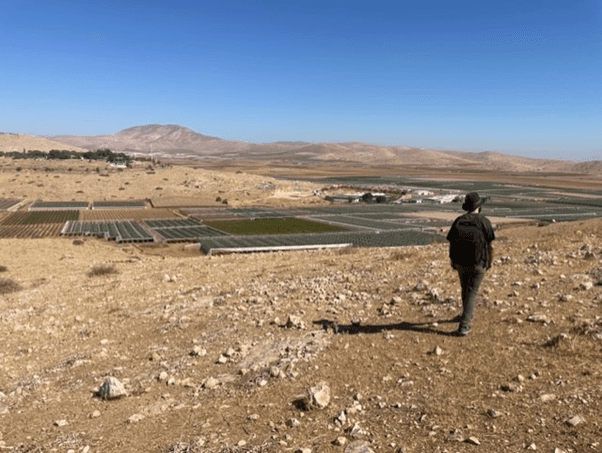
Palestinian grazing land with a Jewish settlement in the background (Ric Benjamin)

Less than an hour from Tel Aviv, they wake up on their land, but without any control or protection. Israel’s occupation of the West Bank has corrupted its soul - making it possible for land to be stolen for settlements, for settlers to attack, maim and kill while the army stands back - and too often soldiers stand next to the settler attackers because they are tasked with only intervening when Jewish lives are at risk. 

As long as there is an occupation, these things will continue to get worse.  

It is a cancer that eats away at Israeli society, where 18-year-old soldiers become brutalised as they are commanded to humiliate and intimidate Palestinians who are just trying to live their lives: children going to school, people wanting to work, grandparents needing medical care.  

But at least for today, in a small corner of the Jordan Valley, a Bedouin community was able to graze their sheep uninterrupted with the help of a small group of nervous volunteers. 

Rabbis for Human Rights is a grantee of the New Israel Fund.

The names of the shepherds in this story and the exact location in the Occupied Palestinian Territories have been changed to protect them from retribution.

RELATED STORIES
Israelis are losing faith in a peaceful two-state solution – poll (Jerusalem Post)
The survey also recorded a decrease in the number of Arab Muslims living in Israel experiencing discrimination.

The Palestinian dream is dying — and it's a nightmare for Israel (Newsweek)
Just 30 years after the Oslo Accords set the stage for the formation of the first autonomous Palestinian leadership body to be recognised by Israel, the Palestinian National Authority (PA) stands on the brink of collapse, with dwindling territorial control, deteriorating popular support and no clear successor for its aging longtime leader.

On addressing Jews (Peter Beinart & George Bishara, Jewish Currents)
The death of the two-state paradigm provides an opportunity for the Palestinian national movement to once again speak explicitly to Jews.

Heading toward a second Nakba (David Shulman, New York Review)

Top photo: A Palestinian shepherd in the Jordan Valley (Ric Benjamin)

You might also like
  • ‘Israel is systemically eliminating Palestinian collective life’:  B’Tselem
    Deborah Stone
  • LGBT asylum seekers caught between Palestinian violence and Israeli bureaucracy
    Jarod Rhine-Davis
  • Western ‘Palestinianism’ colonises everything – and hurts Palestinians
    Andres Spokoiny
logomark.67a07ee3
We believe in the free flow of information

Republish our articles for free, online or in print, by using our Creative Commons licence

You might also like

    Woman with land and houses behind her
    NewsAustralia

    Australia to increase sanctions against West Bank settlements

    Deborah Stone 2
    altalena
    Israel Votes 2026OpinionIsrael

    The Altalena should be a warning, not a political weapon

    Shahar Burla 1
    Ofer_Winter_2026
    Israel Votes 2026AnalysisIsrael

    Who is Ofer Winter and could he upset Netanyahu’s election?

    Shahar Burla

About the author

Ric Benjamin

Ric Benjamin

Ric Benjamin has been a social justice activist for 30 years and is currently the chair of the New Israel Fund Australia.

More from the author

AnalysisIsrael

What Israel’s activists can learn from Australian firefighters

OpinionAustralia

Recognising Palestine is both a strategic and moral act

AnalysisIsrael

Three moves that could put a two-state solution within reach