Aa
  • Read, Watch, Listen
  • TJI Series
  • Community Action
  • Events
  • Zedi
Follow us and continue the conversation
  • LinkedIn
  • Instagram
  • FaceBook
  • X
  • YouTube
Test yourself with the TJI Quiz!

Adjust size of text

Aa

Follow us and continue the conversation

  • LinkedIn
  • Instagram
  • FaceBook
  • X
  • YouTube

Your saved articles

You haven't saved any articles

What are you looking for?

Original reporting, insightful analysis and diverse views, delivered straight to your inbox

  • LinkedIn
  • Instagram
  • FaceBook
  • X
  • YouTube
Your support fuels our mission to inform, entertain and inspire.

The Jewish Independent is bound by the Standards of Practice of the Australian Press Council. If you believe the Standards may have been breached, you may approach The Jewish Independent or make a complaint to the Australian Press Council in writing at www.presscouncil.org.au. The Council may also be contacted on 1800 025 712.

  • Our Story
  • Contact us
  • Our Team
  • Support us
  • Guidelines
  • Pitch your idea
  • Republishing us
  • Community Action
  • Our Awards
  • LinkedIn
  • Instagram
  • FaceBook
  • X
  • YouTube
Aboriginal FlagTorres Strait Islanders Flag

The Jewish Independent acknowledges Aboriginal and Torres Strait Islander peoples as the Traditional Owners and Custodians of Country throughout Australia. We pay our respects to Elders past and present, and strive to honour their rich history of storytelling in our work and mission.

© The Jewish Independent 2026All Rights Reserved
Website design and development by Your Creative, MelbourneTerms & ConditionsPrivacy Policy
HomeRead, Watch, ListenIsrael
AnalysisIsrael

What Israel’s activists can learn from Australian firefighters

Israeli and Palestinian civil society groups are fighting on multiple fronts to ensure the structures of a democratic Israel and the vision of two states do not go up in flames.
Ric Benjamin
Print this
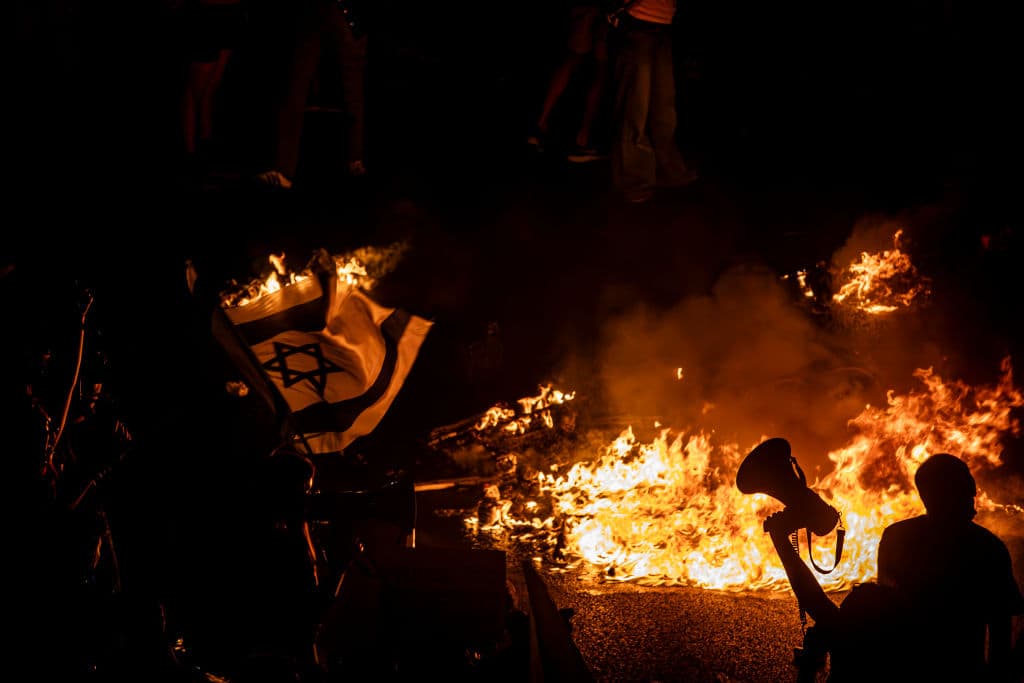
Israeli protest flag fire

Israeli protestors wave flags next to a bonfire during a protest against Prime Minister Benjamin Netanyahu firing of Defense Minster Yoav Gallant during conflict over judicial independence (Eyal Warshavsky/SOPA Images/LightRocket via Getty Images)

Published: 27 February 2026

Last updated: 27 February 2026

A few years ago, I spoke with a Country Fire Authority volunteer about how bushfires are actually fought. It’s not all brute force and hoses, he explained, but reading the terrain, choosing where to stand, and acting before heat and wind make the decisions for you.   

After returning from a New Israel Fund conference in Israel and the West Bank, that lesson feels uncomfortably relevant. Civil society there is battling multiple fire fronts of another kind — both political and physical: settler violence in the West Bank, a headlong rush toward annexation, a government assault on judicial independence, the on-going disaster in Gaza, the rise of organised crime in Palestinian towns inside Israel and a refusal to confront the systemic failures that led to the Hamas attacks of 7 October 2023.   

Yet amid this burning season, ordinary people are working with precision and courage. They are applying the firefighter’s art — assessment, containment, and, when needed, controlled burns — to keep a fragile hope alive. 

Read the fire

Firefighters begin by asking not where the flames are highest, but where conditions are most dangerous. Israeli civil society groups are doing the same.   
They see settler violence not as isolated flare-ups but as a pattern fed by fuel (impunity), weather (political support) and terrain (military control). The judicial overhaul is recognised not as a technical reform but as the stripping away of firebreaks — the checks and balances that protect democracy from authoritarian heat.   

The refusal to establish a state commission of inquiry into 7 October isn’t hesitation; it’s denial. Without understanding what burned before, the next blaze will be worse. The continuing deaths of civilians in Gaza isn’t a ceasefire, it’s the continuation of a war long after there was any justification for it.  The rise of violent organised crime in Palestinian towns within Israel isn’t a society without rules, it’s an abandonment of law enforcement.  Fires that are misread kill people. So do political decisions that are dismissed as disconnected or unintentional.   

Anchor and flank

No trained firefighter runs headlong into a wind-driven blaze. You anchor on firm ground and work the flanks — exactly what Israeli and Palestinian activists are doing together.   

In the South Hebron Hills and the Jordan Valley, Jewish and international volunteers provide ‘protective presence”: accompanying Palestinian farmers and shepherds from settler violence, filming attacks, filing police complaints, and building legal cases one village at a time. It’s thankless, dangerous work that rarely makes headlines.   

Together they document truth, protect life, and challenge impunity. Every village held, every rebuilt tent and re-planted olive tree is a small act of resistance, a deliberate decision to stay human in inhuman conditions. This isn’t heroism for show — it’s containment, achieved through solidarity. 

Fire against fire

Sometimes a blaze can only be stopped by burning out the fuel ahead of it. Activists confronting de facto annexation are doing just that.   

They challenge illegal outposts as soon as they appear and expose the quiet bureaucratic moves — land seizures through classification, new roads, sealed-off grazing areas, destruction of buildings — that convert occupation into permanence. Jewish, Palestinian and international partners are lighting political “backburns” by insisting on legality, transparency and shared humanity.   

It’s perilous work, inviting smears, arrests, even violence. But waiting until annexation is officially declared would mean facing a crown fire too entrenched to fight. Prevention, not provocation, is the point. 

Structure protection

When a bushfire nears a town, firefighters defend what makes recovery possible. In Israel’s political blaze, the High Court and the independence of the attorney general are two critical structures.   

Civil society’s protests, petitions and international outreach are the equivalents of clearing brush and sealing roofs. The goal isn’t to uphold privilege but to keep alive the principle that power must be bound by law. Once those institutions burn, rebuilding will take generations, not elections. 

Learn from disasters

Veteran firefighters know most fatalities occur when the fire “turns” unexpectedly. The Israeli government’s refusal to establish a full, independent inquiry into 7 October ignores that lesson.   

Without honest accounting, the same failures — intelligence blindness, political arrogance, contempt for warnings — will align again. The two plus years of street protests and civil society’s call for transparency isn’t just about accountability. It’s about learning critical lessons before the wind changes. 

Think beyond containment

Even as civil society holds the line, there is a deeper recognition that containment alone isn’t enough. Without a political solution — two states for two peoples, each living with safety and dignity — the fires will keep reigniting.   

That vision has been buried under years of cynicism, violence and bad faith. Yet in co-existence organisations, shared protests and co‑operative ventures, Jewish and Palestinian activists are quietly reviving it. They know peace isn’t an abstract slogan; it’s the only durable firewall. 

Call in the neighbours  

Bushfire seasons remind Australians that fighting fire depends on solidarity: neighbours helping neighbours, volunteers crossing borders. The same principle applies here.    

International partners, including Australia, can provide critical oxygen: funding grassroots democracy work, supporting human rights monitoring, and refusing to treat occupation, blockade and impunity as normal. Ignoring these local firefighters means letting the blaze spread unchecked. Supporting them means recognising that Israeli democracy and Palestinian freedom are not separate battles — they’re the same fire line.   

Hold the line

None of this looks like triumph. Fire lines rarely do. But containment is what keeps the living space of the future intact.   

Civil society — Jews and Palestinians, local and international — are holding the hose together. They’re not trying to extinguish every flame. They’re fighting to keep people alive and law, equality and hope from burning down entirely.   

In this burning season, fighting until the winds change isn’t idealism. It’s survival.

You might also like
  • ‘Israel is systemically eliminating Palestinian collective life’:  B’Tselem
    Deborah Stone
  • Tame apologises – but with little grace
    Deborah Stone
  • Confronting Richard Flanagan and the myth of the Israel lobby
    Mary Garden
logomark.67a07ee3
We believe in the free flow of information

Republish our articles for free, online or in print, by using our Creative Commons licence

You might also like

    haredi street guitar
    Photo EssayArts & Culture

    Jerusalemites through the lens

    Sharon Gabay
    ISRAEL-LGBTQ-PRIDE-PARADE-PALESTINIAN-CONFLICT-HOSTAGES
    NewsIsrael

    LGBT asylum seekers caught between Palestinian violence and Israeli bureaucracy

    Jarod Rhine-Davis
    Erdogan Turkey
    AnalysisIsrael

    Turkey emerges as military threat to Israel

    Dror Doron

About the author

Ric Benjamin

Ric Benjamin

Ric Benjamin has been a social justice activist for 30 years and is currently the chair of the New Israel Fund Australia.

More from the author

OpinionAustralia

Recognising Palestine is both a strategic and moral act

AnalysisIsrael

Three moves that could put a two-state solution within reach

FeatureIsrael

Making a difference in the Palestinian territories, one flock at a time

Comments

No comments on this article yet. Be the first to add your thoughts.