Aa
  • Read, Watch, Listen
  • TJI Series
  • Community Action
  • Events
  • Zedi
Follow us and continue the conversation
  • LinkedIn
  • Instagram
  • FaceBook
  • X
  • YouTube
Test yourself with the TJI Quiz!

Adjust size of text

Aa

Follow us and continue the conversation

  • LinkedIn
  • Instagram
  • FaceBook
  • X
  • YouTube

Your saved articles

You haven't saved any articles

What are you looking for?

Original reporting, insightful analysis and diverse views, delivered straight to your inbox

  • LinkedIn
  • Instagram
  • FaceBook
  • X
  • YouTube
Your support fuels our mission to inform, entertain and inspire.

The Jewish Independent is bound by the Standards of Practice of the Australian Press Council. If you believe the Standards may have been breached, you may approach The Jewish Independent or make a complaint to the Australian Press Council in writing at www.presscouncil.org.au. The Council may also be contacted on 1800 025 712.

  • Our Story
  • Contact us
  • Our Team
  • Support us
  • Guidelines
  • Pitch your idea
  • Republishing us
  • Community Action
  • Our Awards
  • LinkedIn
  • Instagram
  • FaceBook
  • X
  • YouTube
Aboriginal FlagTorres Strait Islanders Flag

The Jewish Independent acknowledges Aboriginal and Torres Strait Islander peoples as the Traditional Owners and Custodians of Country throughout Australia. We pay our respects to Elders past and present, and strive to honour their rich history of storytelling in our work and mission.

© The Jewish Independent 2026All Rights Reserved
Website design and development by Your Creative, MelbourneTerms & ConditionsPrivacy Policy
HomeRead, Watch, ListenIsrael
Israel Hamas WarAnalysisIsrael

Palestinians disillusioned with Hamas and armed struggle: new survey

A recent opinion poll reveals a significant shift in the Palestinian political landscape, showing a decline in support for Hamas and armed struggle while imprisoned Fatah leader Marwan Barghouti has emerged as the leading candidate to succeed President Mahmoud Abbas
Shahar Burla
Print this
Marwan Barghouti demonstration

Palestinian in Nablus, West Bank, demand the release of Marwan Barghouti during a demonstration in July 2026 (Nasser Ishtayeh/SOPA Images/LightRocket via Getty Images)

Published: 18 August 2026

Last updated: 18 August 2026

A new Palestinian opinion poll points to a significant shift in the political landscape after the Gaza war.

Hamas has lost substantial public support, fewer Palestinians believe armed struggle is the most effective path forward, and imprisoned Fatah leader Marwan Barghouti has emerged as the strongest candidate to succeed Palestinian Authority President Mahmoud Abbas.

The findings reveal a Palestinian public that is disillusioned with Hamas, deeply dissatisfied with the Palestinian Authority and increasingly sceptical that violence has produced meaningful gains, but remains unwilling to support disarmament without guarantees of an Israeli withdrawal.

The poll was conducted by the Ramallah-based Palestinian Center for Policy and Survey Research, led by prominent pollster Dr Khalil Shikaki, between August 5 and 8. Researchers interviewed 1,270 Palestinians face-to-face, including 830 in the West Bank and 440 in Gaza. The margin of error was 3.5 percentage points.

The survey comes as Palestinians prepare for legislative elections scheduled for November 28 and presidential elections expected in early 2027. It was also conducted after Hamas accepted the Mladenov plan for beginning the second phase of US President Donald Trump’s Gaza plan, including provisions for the group to relinquish its weapons.

Barghouti leads as Abbas’s authority collapses

Marwan Barghouti, the imprisoned Fatah leader who played a prominent role during the Second Intifada, is the clear frontrunner to succeed Abbas.
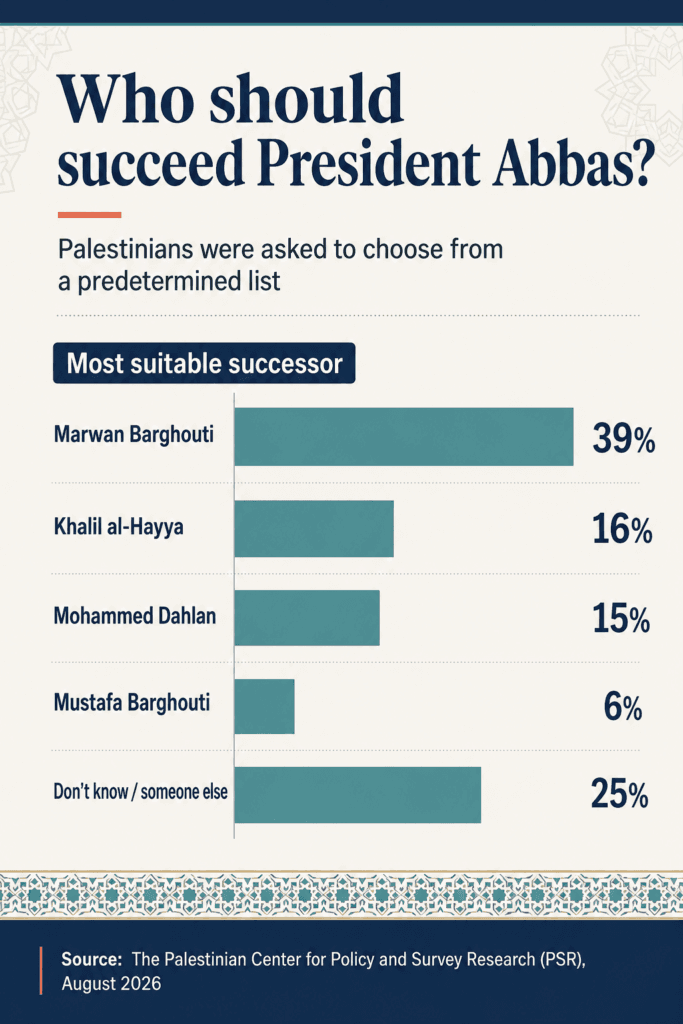
When respondents were asked to select the person most suitable to replace the Palestinian president from a list of potential candidates, 39 per cent chose Barghouti. Hamas leader Khalil al-Hayya received 16 per cent, former Fatah strongman Mohammed Dahlan 15 per cent and Palestinian National Initiative leader Mustafa Barghouti six per cent. One-quarter selected another candidate or did not know.

In a hypothetical presidential contest, Marwan Barghouti would receive 54 per cent of the votes among those intending to participate. Al-Hayya would receive 26 per cent, while Abbas would attract only 14 per cent.

Barghouti’s popularity reflects both his personal standing and the depth of Palestinian dissatisfaction with the current leadership. Only 20 per cent approve of Abbas’s performance, compared with 76 per cent who are dissatisfied. Approval is slightly higher in Gaza, at 26 per cent, but falls to just 16 per cent in the West Bank, where the Palestinian Authority governs.

The Jewish Independent

A large majority, 82 per cent in the West Bank and 74 per cent in Gaza, want Abbas to resign. Meanwhile, 83 per cent believe there is corruption within Palestinian Authority institutions and 65 per cent describe the authority as a burden on the Palestinian people.

The appetite for change is therefore clear, but it does not necessarily translate into support for either major political faction. Barghouti’s advantage derives partly from his ability to embody Palestinian resistance, while remaining separate from the unpopular leadership of both Abbas and Hamas.

Hamas loses electoral ground

The survey suggests electoral participation could be substantial if Palestinians believe the contest is competitive and inclusive. Although 40 per cent said they would not participate in a presidential election, projected turnout for legislative elections rises to 66 per cent if all the factions that contested the last parliamentary election in 2006 are allowed to participate.

Among likely voters, Fatah would receive 32 per cent and Hamas 29 per cent, with smaller parties collectively attracting 18 per cent. The remaining 21 per cent are undecided.

There are important regional differences. Hamas would lead in Gaza with 34 per cent, compared with 30 per cent for Fatah. In the West Bank, Fatah would receive 34 per cent and Hamas 25 per cent. Yet the most important finding is not the narrow gap between the two parties, but the scale of Hamas’s decline. Ten months ago, 44 per cent of likely voters said they would support Hamas, including 49 per cent in Gaza.

When respondents were asked more broadly which party or political orientation they supported, Fatah and Hamas each received 24 per cent. Thirty-eight per cent supported no party or were undecided.

Hamas’s underlying support has fallen from 35 per cent across the Palestinian territories in October 2025 to 24 per cent today. In Gaza, it has declined from 41 to 33 per cent, while support in the West Bank now stands at only 18 per cent.

The change appears closely connected to Palestinians’ assessment of the war. Only 20 per cent believe Hamas emerged victorious, down from 39 per cent 10 months ago. Sixty per cent believe neither side won, while 15 per cent say Israel was victorious.

The decline is particularly dramatic in the West Bank, where belief in a Hamas victory has fallen from 48 to 21 per cent. After Gaza’s immense destruction and loss of life, Hamas’s claim that armed resistance can deliver strategic achievements appears to have lost much of its appeal.

Hamas’s decline does not extend to disarmament

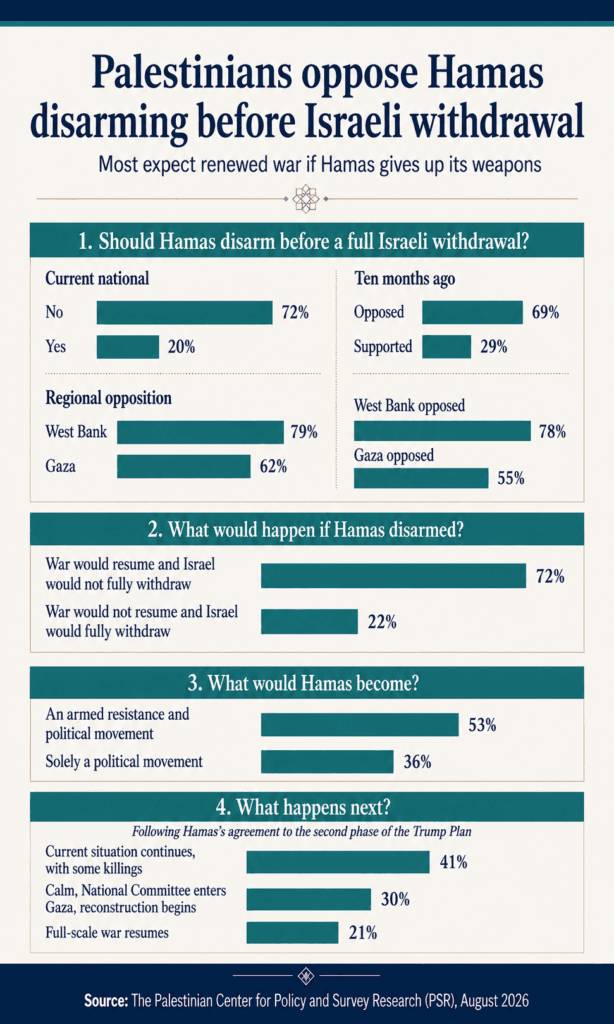
Hamas’s loss of popularity should not, however, be confused with public acceptance of its immediate disarmament. Seventy-two per cent oppose Hamas surrendering its weapons before Israel completely withdraws from Gaza, while only 20 per cent support disarmament taking place first. Opposition is highest in the West Bank at 79 per cent, compared with 62 per cent in Gaza.

These figures have barely changed since October 2025, when 69 per cent opposed disarmament before an Israeli withdrawal.

The position appears to be driven less by confidence in Hamas than by distrust of Israel. Seventy-two per cent believe that if Hamas disarmed, the war would resume and Israel would not fully withdraw. Only 22 per cent believe disarmament would lead to an end to the war and a complete withdrawal.

This distinction is central to understanding the poll. Many Palestinians appear willing to withdraw their political support from Hamas without accepting that the group should give up its weapons unconditionally. For these respondents, disarmament is tied to the sequencing and credibility of an Israeli withdrawal rather than approval of Hamas’s conduct.

Expectations for the Trump plan are similarly cautious. Forty-one per cent expect the present situation, including intermittent Israeli strikes, to continue. Thirty per cent believe calm could be restored, a new administrative committee installed and reconstruction begun, while 21 per cent expect full-scale war to resume.

Armed struggle loses ground, but peace remains distant

The poll also records a modest but potentially significant decline in support for armed struggle. Thirty-six per cent support a return to confrontation and an armed intifada, down from 41 per cent ten months ago. By comparison, 54 per cent support nonviolent popular resistance and 67 per cent favour joining additional international organisations.

This suggests more Palestinians are questioning the effectiveness of armed struggle after the Gaza war. However, it does not amount to renewed confidence in the existing peace process.

The Jewish Independent

Support for a two-state solution remains almost unchanged, at 44 per cent, while 50 per cent oppose it. But when respondents were offered several clearly defined political models, 56 per cent preferred two states based on the 1967 borders, up from 47 per cent in October 2025. Fourteen per cent preferred a confederation, while 10 per cent supported a single state with equal rights.

The apparent contradiction reflects the importance of how the proposal is framed. Palestinians are more receptive to a two-state solution when its borders and terms are specified, but many doubt it can still be achieved.

The Jewish Independent

Fifty-eight per cent believe settlement expansion has made two states impractical, while 64 per cent say the prospects of establishing an independent Palestinian state alongside Israel within five years are low or nonexistent.

The survey therefore captures a public moving away from Hamas and losing faith in armed struggle, but not yet moving decisively towards peace. Palestinians appear to want different leadership and more effective political strategies. Yet without confidence that Israel will withdraw from Gaza, restrain settlement expansion or accept a viable Palestinian state, declining support for Hamas is unlikely by itself to produce support for disarmament or compromise.

You might also like
  • Australia to increase sanctions against West Bank settlements
    Deborah Stone
  • New evidence Netanyahu was warned about October 7
    Shahar Burla
  • LGBT asylum seekers caught between Palestinian violence and Israeli bureaucracy
    Jarod Rhine-Davis
logomark.67a07ee3
We believe in the free flow of information

Republish our articles for free, online or in print, by using our Creative Commons licence

You might also like

    Rozana Beit Oula
    PeacebuildingOpinionIsrael

    Peacebuilding through the eyes of a sceptic

    Ron Finkel
    Ofer_Winter_2026
    Israel Votes 2026AnalysisIsrael

    Who is Ofer Winter and could he upset Netanyahu’s election?

    Shahar Burla
    Erdogan Turkey
    AnalysisIsrael

    Turkey emerges as military threat to Israel

    Dror Doron

Comments

No comments on this article yet. Be the first to add your thoughts.

About the author

Shahar Burla

Shahar Burla

Dr Shahar Burla is a Sydney-based researcher, lecturer and Contributing Editor of TJI. Shahar holds a Master’s degree in political science from Hebrew University and a PhD in political science from Bar-Ilan University. He is the author of Political Imagination in the Diaspora: The Construction of a Pro-Israeli Narrative (2013) and co-editor of Australia and Israel: A Diasporic, Cultural and Political Relationship (2015).

More from the author

FeatureIsrael

New evidence Netanyahu was warned about October 7

OpinionIsrael

The Altalena should be a warning, not a political weapon

AnalysisIsrael

Who is Ofer Winter and could he upset Netanyahu’s election?

AnalysisIsrael

Bennett’s balancing act: can he win over the right without losing the centre?