Aa
  • Read, Watch, Listen
  • TJI Series
  • Community Action
  • Events
  • Zedi
Follow us and continue the conversation
  • LinkedIn
  • Instagram
  • FaceBook
  • X
  • YouTube
Test yourself with the TJI Quiz!

Adjust size of text

Aa

Follow us and continue the conversation

  • LinkedIn
  • Instagram
  • FaceBook
  • X
  • YouTube

Your saved articles

You haven't saved any articles

What are you looking for?

Original reporting, insightful analysis and diverse views, delivered straight to your inbox

  • LinkedIn
  • Instagram
  • FaceBook
  • X
  • YouTube
Your support fuels our mission to inform, entertain and inspire.

The Jewish Independent is bound by the Standards of Practice of the Australian Press Council. If you believe the Standards may have been breached, you may approach The Jewish Independent or make a complaint to the Australian Press Council in writing at www.presscouncil.org.au. The Council may also be contacted on 1800 025 712.

  • Our Story
  • Contact us
  • Our Team
  • Support us
  • Guidelines
  • Pitch your idea
  • Republishing us
  • Community Action
  • Our Awards
  • LinkedIn
  • Instagram
  • FaceBook
  • X
  • YouTube
Aboriginal FlagTorres Strait Islanders Flag

The Jewish Independent acknowledges Aboriginal and Torres Strait Islander peoples as the Traditional Owners and Custodians of Country throughout Australia. We pay our respects to Elders past and present, and strive to honour their rich history of storytelling in our work and mission.

© The Jewish Independent 2026All Rights Reserved
Website design and development by Your Creative, MelbourneTerms & ConditionsPrivacy Policy
HomeRead, Watch, ListenIsrael
AnalysisIsrael

On the ground: the reality of building a Palestinian state

Palestine already has some of the institutions needed for a state, but life in the West Bank is dominated by Israeli control.
Ben Lynfield
Print this
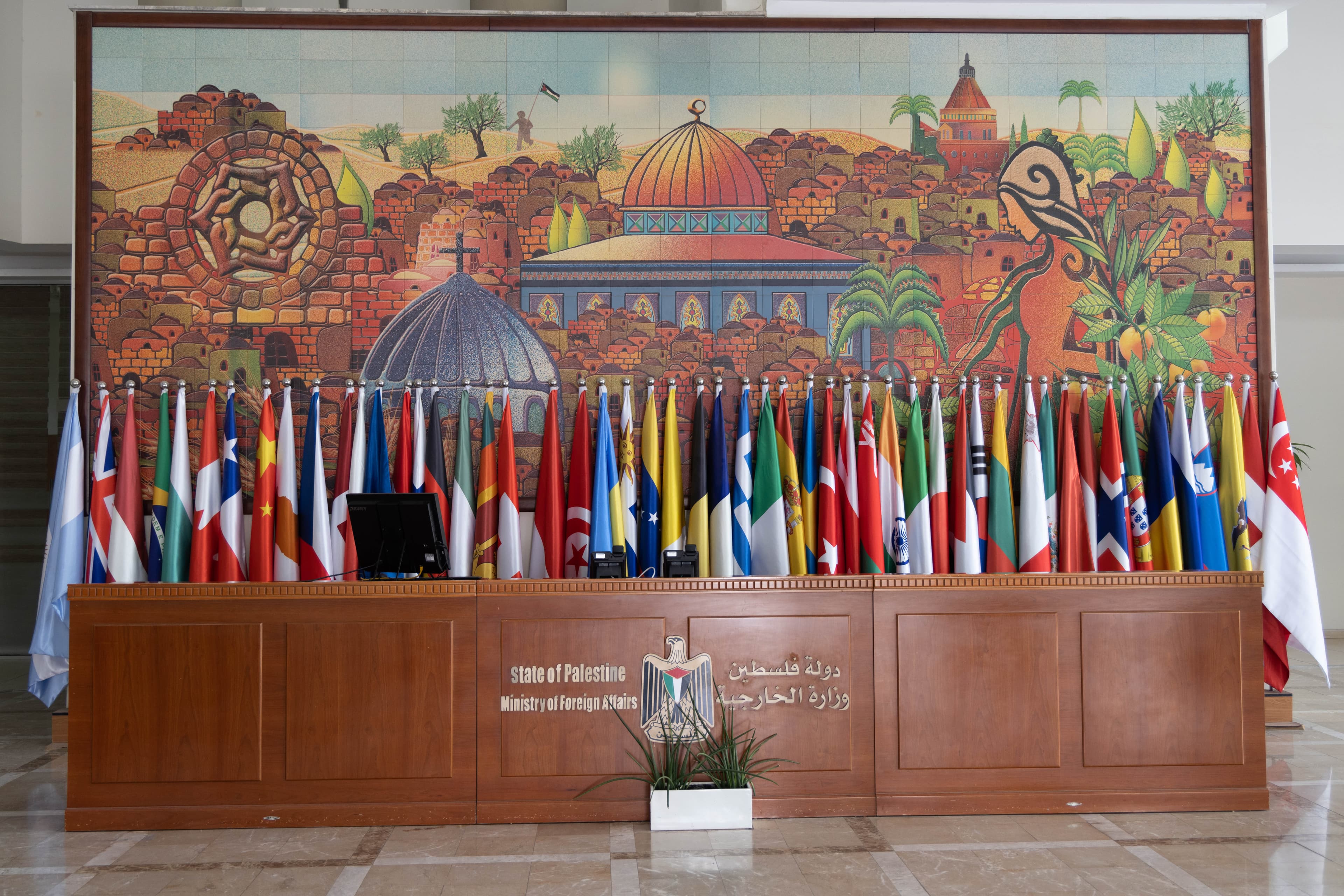
Desk with the words Ministry of Foreign Affairs, a row of international flags and a mural of Jerusalem.

The Palestinian Ministry of Foreign Affairs building in Ramallah is part of the framework for building a Palestinian state (Deborah …

Published: 18 August 2025

Last updated: 20 August 2025

The bones of a Palestinian state were set up by the Oslo Accords in 1993, which established areas of self-rule for Palestinians in the West Bank. But the institutions needed to run a state have been undermined by the reality of Israeli domination over virtually all aspects of Palestinian daily life, as well as by internal weakness and corruption.

The Palestinian Authority governs through a civil service with two dozen departments covering everything from foreign affairs to labour.

“You can talk about the efficacy of these institutions but they are there and the country is running,” says Ziad Abu Amr, a senior presidential adviser and former deputy prime minister of the Palestinian Authority.

Abu Amr says progress in institution-building was set back through Benjamin Netanyahu’s tenure in power. The Israeli right wants exclusive Jewish rule over the biblically-resonant area, and has accelerated Jewish settlement of the area, which they call Judea and Samaria.

The Israeli position is that the Palestinians themselves are to blame for their plight, with the PA allegedly failing to build the infrastructure of a state, being wracked by corruption, and maintaining hostility towards Israel.

Will recognition help?

The Palestinian Authority is well aware that international recognition, most recently announced by Australia, and in the past month also by France, the UK and Canada, won't make a state.

But it takes a pragmatic approach that sees recognition as a step to force Israel to the table.

“When these countries recognise the state of Palestine it doesn’t mean the problem is solved. It’s a symbolic step with political significance but no alternative to serious, important and hard negotiations with Israel,” Abu Amr told The Jewish Independent.

"Without Israeli acquiescence and agreement and succumbing to American and international pressure, there won’t be a Palestinian state on the ground. But this [recognition] is supposed to be one additional step of reassuring the Palestinians, giving them hope that peace is rewarding and the way to solve the conflict, and to add pressure on Israel to sit and negotiate the two state solution.”

The pressure on Palestine

Key Israeli mechanisms of control include withholding tax transfers and strictures on movement both within the West Bank and to Israel, where most Palestinians worked. Since the brutal Hamas attacks of October 7, 2023 Palestinian day laborers have been prevented from entering Israel proper.

These mechanisms, which Israel claims as strictly security measures, have contributed to a severe economic and governance crisis in the West Bank.

Meanwhile, settler and army violence are spiralling, a crisis largely ignored by a world focused on the devastating war in Gaza, which is on the brink of a major Israeli army escalation amid deadly starvation, lack of water and pervasive devastation among Palestinians. The PA has no influence over Gaza.

The Palestinian Authority is also facing a loss of internal legitimacy with only 16% of Palestinians supporting the current government of Fatah under President Mahmoud Abbas. The PA is dominated by old men (Abbas is aged 89) and succession is unclear. The last elections were held in 2006.

Structural control

Under the limited self rule currently in place, Palestinians are unable to get a valid birth certificate, change their legal address, get a valid Palestinian passport, travel outside of the West Bank and in many instances within the West Bank. In practical terms, PA employees who make up the largest share of the work force, cannot even get their full monthly salaries without Israeli approval.

A resident submits his application for vital documents to the PA’s ministry of interior, but this is something of a charade because Israeli army approval is required for validation. The arrangement, like so many others that give Israel dominance compared to the PA, date back to the 1993 Oslo self-rule agreements that were supposed to be temporary but have persisted amid violence, recriminations and, Palestinians charge, Israeli bad faith.

“All details of our lives are dependent on Israeli approval,” says Jehad Harb, a veteran analyst based in Ramallah.

“Today unfortunately there is no infrastructure in any realm for which the Palestinians can take responsibility, not in the security, economic or legal realms,” says Yaacov Amidror, former head of Israel’s National Security Council.

Amidror said the string of recognitions of Palestinian statehood “is very uncomfortable for Israel but it won’t change the situation on the ground because the Palestinians have no serious leaders and no serious state building and no one can guarantee that the state won’t turn into a state under Hamas control. So there is no chance any Israeli government will allow this.”

Salim Brake, a political scientist at Israel’s Open University, differs. He says Israel's right-wing governments "do injustice to the PA" by depicting it inaccurately, exaggerating corruption in order to discredit it. He argues this stance has harmed the PA and prevented it from functioning effectively. The reason, he says, is that they want a greater Israel stretching from the Mediterranean Sea to the Jordan River, encompassing all of the West Bank, not a two-state solution.

Security as control

Another Israeli tool for dominance and influence over daily life is a sweeping surveillance regime that records all text messages and a huge amount of the public’s phone calls, according to a recent report in The Guardian.

Israel says it acts within international law and that security steps are necessary to thwart terrorism and protect Israeli citizens. But Israeli sources quoted in the article said the system is also used to blackmail Palestinians to serve the occupation and is abused in other ways.

Economic control

Then there is control over people’s economic wellbeing. Israel’s powers to damage the Palestinian Authority financially, including by withholding transfers of tax revenues it collects on behalf of the PA, have resulted in PA employees, including teachers, sanitation workers and physicians, getting only partial salary payments for long periods. They have also reduced the PA’s ability to provide services.

Israel has cited PA stipends to those convicted of attacks on Israelis and to their families as the reason for not forwarding the money. Critics of Israel see this as a form of theft aimed at weakening the PA.

Elements of effective Palestinian governance

Leaders of the Palestinian Authority say that despite Israeli dominance, some key components of statehood have been established through ministries and services. They can point, for example, to the PA’s school system, that is generally popular, according to Harb. 

Brake gives PA governance positive grades: “In all the places where the Palestinian Authority is found, the government is working. They provide health, education and transportation, but in some sensitive realms like security there are locations like Jenin where they are weak. But in terms of civilian administration they are quite good. They make a good infrastructure for a state.”

But Brake adds that the PA has a serious legitimacy problem, with its last elections held seventeen years ago, no functioning legislative branch and uncertainty over who will succeed the aging president, Mahmoud Abbas. “Everyone is just waiting to see who will gain power after him and this creates tension,” he said.

Harb, the Ramallah based analyst, says the PA will have to follow up the recognitions with reforms, including holding elections, applying the basic law – a kind of limited constitution that is in abeyance – and “arrange security so that there is one framework that emphasises defense of the Palestinian citizen.”

He believes that despite Israeli moves aimed at rendering Palestinian statehood meaningless on the ground, such as plans announced last week for settlement construction that will effectively bisect the West Bank, the recognitions still have significance.

“Their importance is the protection of the two state solution,” he said.

You might also like
  • Israel election explainer: the main parties
    Shahar Burla
  • Sanctioning settlements is a defence of Israel, not an attack
    Elisheva Madar
  • Sanctions must influence, not just perform disapproval
    Adam Slonim
logomark.67a07ee3
We believe in the free flow of information

Republish our articles for free, online or in print, by using our Creative Commons licence

You might also like

    Segalovitz Abbas
    Israel Votes 2026AnalysisIsrael

    Segalovitz decision to join Arab party is a paradigm change for Israel

    Eetta Prince-Gibson
    Erdogan Turkey
    AnalysisIsrael

    Turkey emerges as military threat to Israel

    Dror Doron
    altalena
    Israel Votes 2026OpinionIsrael

    The Altalena should be a warning, not a political weapon

    Shahar Burla 1

About the author

Ben Lynfield

Ben Lynfield

Ben Lynfield covered Israeli and Palestinian politics for The Independent and served as Middle Eastern affairs correspondent at The Jerusalem Post. He writes for publications in the region and has contributed to the Christian Science Monitor, Foreign Policy and the New Statesman.

More from the author

FeatureIsrael

Fear of Netanyahu victory may drive big surge in Palestinian voter turnout

NewsIsrael

Abuse by IDF soldiers humiliates Muslim Palestinians

OpinionIsrael

Qusra siege exposes shared agenda of IDF and settler extremists

AnalysisIsrael

IDF ordered to evict West Bank camp in election show of strength

Comments

No comments on this article yet. Be the first to add your thoughts.