Aa
  • Read, Watch, Listen
  • TJI Series
  • Community Action
  • Events
  • Zedi
Follow us and continue the conversation
  • LinkedIn
  • Instagram
  • FaceBook
  • X
  • YouTube
Test yourself with the TJI Quiz!

Adjust size of text

Aa

Follow us and continue the conversation

  • LinkedIn
  • Instagram
  • FaceBook
  • X
  • YouTube

Your saved articles

You haven't saved any articles

What are you looking for?

Original reporting, insightful analysis and diverse views, delivered straight to your inbox

  • LinkedIn
  • Instagram
  • FaceBook
  • X
  • YouTube
Your support fuels our mission to inform, entertain and inspire.

The Jewish Independent is bound by the Standards of Practice of the Australian Press Council. If you believe the Standards may have been breached, you may approach The Jewish Independent or make a complaint to the Australian Press Council in writing at www.presscouncil.org.au. The Council may also be contacted on 1800 025 712.

  • Our Story
  • Contact us
  • Our Team
  • Support us
  • Guidelines
  • Pitch your idea
  • Republishing us
  • Community Action
  • Our Awards
  • LinkedIn
  • Instagram
  • FaceBook
  • X
  • YouTube
Aboriginal FlagTorres Strait Islanders Flag

The Jewish Independent acknowledges Aboriginal and Torres Strait Islander peoples as the Traditional Owners and Custodians of Country throughout Australia. We pay our respects to Elders past and present, and strive to honour their rich history of storytelling in our work and mission.

© The Jewish Independent 2026All Rights Reserved
Website design and development by Your Creative, MelbourneTerms & ConditionsPrivacy Policy
HomeRead, Watch, ListenIsrael
PeacebuildingIsrael

Peacebuilders cross language barriers to build rights for Arabs in Jerusalem

Mistranslations can be humorous but Arab residents of Jerusalem are disadvantaged when important information is not available in clear Arabic.
Deborah Stone
Print this
Translation 0202

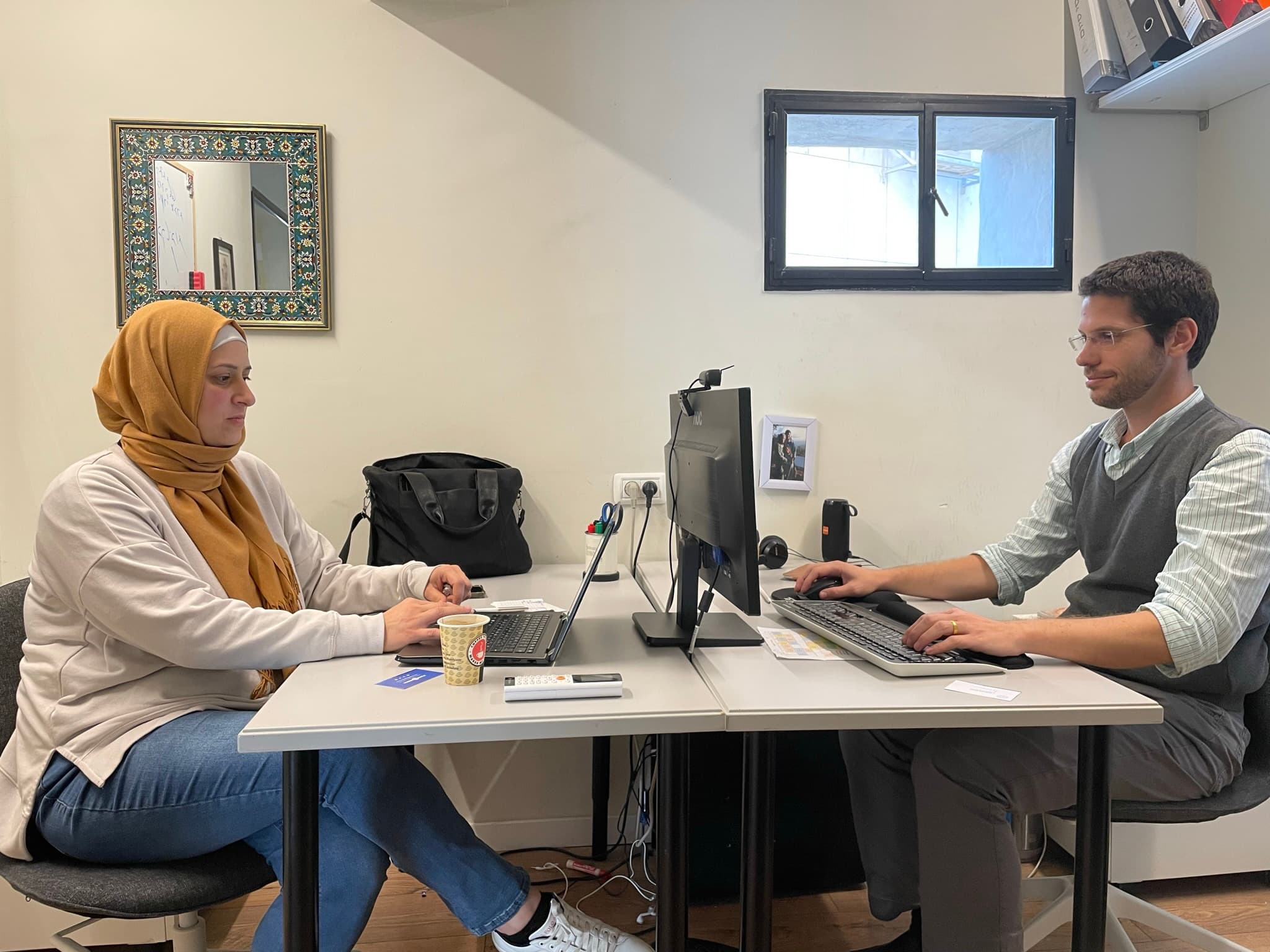
Zahieh Abu Ghannam and Noy Mordekovitch work together to counter the language barriers to peace (Deborah Stone)

Published: 16 May 2023

Last updated: 9 May 2025

Noy Mordekovitch had spent hours trying to persuade an Arab man from East Jerusalem to apply for his entitlements on the Jerusalem municipality website.

Like many Arab citizens of Israel, the man was suspicious of the municipality and daunted by the forms, which are often only in Hebrew. But this form was in Arabic, so he agreed to try. He returned to Mordekovitch discouraged.

“I couldn’t find the right place to fill in the form,” he reported. “Just a recipe.”

Arabic has two words for “filling”: one used for filling in a form, the other for stuffing vegetables. 

The amateur translation used the wrong word in the link to the form, building another barrier for a resident trying to exercise his rights.

Mordekovitch has a stock of such stories. He is Executive Director of 0202 Updates, a not-for-profit civil society organisation dedicated to providing information in Arabic to support the city’s 360,000 Arab residents. (The name comes from the landline code for Jerusalem.)

A sign meant to read ‘Beware of the danger from digging’ was translated to read ‘Beware of ignorance’.

Research 18 months ago found only 10% of government information is translated into Arabic and it is often not the 10% that the Arabic-speaking population needs. For example, the Ministry of Security translates its announcements, but many of the civil services don’t.
Translation isn’t seen as a priority so a service will be provided in Hebrew but then the Arabic information doesn’t go up for days. Or it’s not done by professionals, which leads to the kind of mistakes that occurred with the “stuffed” form.

“Someone will say to some guy on the desk, ‘Hey, you speak Arabic, can you translate this?’ and it leads to mistakes that are confusing, embarrassing and sometimes insulting,” Mordekovitch says.

A municipal road works notice warning "Please beware of the hole", was translated into Arabic as "You should develop."

A sign meant to read "Beware of the danger from digging" was translated to read "Beware of ignorance".

Mordekovitch is frustrated by the failure of Jerusalem authorities to provide appropriate information in Arabic, which has formal status in Israel as the country’s “official second language”.

“They invest 30,000 shekels in signage around a road project but they don’t invest a few shekels in a translation and you can imagine how this feels to people who are already marginalised and disadvantaged to be told effectively. ‘You are ignorant and you need to develop’."

As an organisation with the language skills in Hebrew and Arabic and an understanding of the system, 0202 Updates is often able to contact relevant government departments, get mistakes corrected and supply missing translations.

0202 Updates also creates its own content, explaining Israeli society and governance in Arabic and developing skills for Arab residents in advocacy, managing legal issues and finding their way around the system.

Most Arabic-speakers live in East Jerusalem, where they are in a grey zone as residents but not citizens of Israel. They can vote in municipal elections, but most choose not to do so because they don’t want to legitimise Israeli control over the area. The result is a Catch-22, where they frequently miss out on services.

Arabs in East Jerusalem face pressure from both sides.  Palestinian organisations lean on them to resist any cooperation with Israeli authorities and Israel is quick to categorise them as terrorists and revoke their residency if they make trouble.

“We want to create a safe environment for Palestinians in Jerusalem where they can exercise their rights as residents of the municipality,” Mordekovitch says. “With everything in East Jerusalem you need to work very gently. A lot of Arab residents are afraid to exercise their rights because they are afraid they will lose their jobs or get arrested.”

0202 Updates translates and mediates public information into Arabic for 30 government and civil society organisations, produces video information on civil services and provides direct help to Arab-speakers trying to deal with government services.

One of its greatest successes came when it translated forms for applying for concessions to municipal taxes into Arabic and even the mayor of Jerusalem shared the post.

“It was amazing. We had people tagging each other and dozens of people writing to thank us,” Mordekovitch said.

“The municipality is a huge burden for Palestinians. Eighty per cent of the populations is under the poverty line and they can apply for up to 70 per cent of the concessions for municipal taxes but the forms are all in Hebrew so it’s hard for people to get the concessions they are entitled to.”

Similarly, during Covid restrictions, 0202 Updates translated the form which enabled Arabic-speakers to exercise their right of appeal if they were fined for not wearing a mask.

“It’s hard for Arabs from East Jerusalem to appeal in the first place. They don’t have trust in the system but when the form was only available in Hebrew, most of them couldn’t manage it.”

In addition to the practical information they provide, 0202 Updates also bridges barriers by helping Arabic speakers understand Jewish culture. One surprising area of success has been in translating information about the Haredi community.

“There’s a lot of curiosity in the Palestinian community about the non-Haredi community,” says Associate Director Zahieh Abu Ghannam. “In Israeli society there is this schism between the secular and the religious but in Arabic society that schism is not as strong. There’s a sense we have something in common with the religious Jews.”

You might also like
  • Israel election explainer: the main parties
    Shahar Burla
  • Sanctioning settlements is a defence of Israel, not an attack
    Elisheva Madar
  • Sanctions must influence, not just perform disapproval
    Adam Slonim
logomark.67a07ee3
We believe in the free flow of information

Republish our articles for free, online or in print, by using our Creative Commons licence

You might also like

    Btselem
    NewsIsrael

    ‘Israel is systemically eliminating Palestinian collective life’:  Israeli human rights report

    Deborah Stone 1
    Woman with land and houses behind her
    NewsAustralia

    Australia to increase sanctions against West Bank settlements

    Deborah Stone 2
    Erdogan Turkey
    AnalysisIsrael

    Turkey emerges as military threat to Israel

    Dror Doron

About the author

Deborah Stone

Deborah Stone

Deborah Stone is Editor-in-Chief of TJI. She has more than 30 years experience as a journalist and editor, including as a reporter and feature writer on The Age and The Sunday Age, as Editor of the Australian Jewish News and as Editor of ArtsHub.

More from the author

ReflectionArts & Culture

On despair: A reflection after watching ‘Cancelled’

NewsAustralia

Proposed digital care law to offer protection against online antisemitism

NewsIsrael

‘Israel is systemically eliminating Palestinian collective life’:  Israeli human rights report

Australia

Tame apologises – but with little grace