Aa
  • Read, Watch, Listen
  • TJI Series
  • Community Action
  • Events
  • Zedi
Follow us and continue the conversation
  • LinkedIn
  • Instagram
  • FaceBook
  • X
  • YouTube
Test yourself with the TJI Quiz!

Adjust size of text

Aa

Follow us and continue the conversation

  • LinkedIn
  • Instagram
  • FaceBook
  • X
  • YouTube

Your saved articles

You haven't saved any articles

What are you looking for?

Original reporting, insightful analysis and diverse views, delivered straight to your inbox

  • LinkedIn
  • Instagram
  • FaceBook
  • X
  • YouTube
Your support fuels our mission to inform, entertain and inspire.

The Jewish Independent is bound by the Standards of Practice of the Australian Press Council. If you believe the Standards may have been breached, you may approach The Jewish Independent or make a complaint to the Australian Press Council in writing at www.presscouncil.org.au. The Council may also be contacted on 1800 025 712.

  • Our Story
  • Contact us
  • Our Team
  • Support us
  • Guidelines
  • Pitch your idea
  • Republishing us
  • Community Action
  • Our Awards
  • LinkedIn
  • Instagram
  • FaceBook
  • X
  • YouTube
Aboriginal FlagTorres Strait Islanders Flag

The Jewish Independent acknowledges Aboriginal and Torres Strait Islander peoples as the Traditional Owners and Custodians of Country throughout Australia. We pay our respects to Elders past and present, and strive to honour their rich history of storytelling in our work and mission.

© The Jewish Independent 2026All Rights Reserved
Website design and development by Your Creative, MelbourneTerms & ConditionsPrivacy Policy
HomeRead, Watch, ListenIsrael
OpinionIsrael

The stories Israel tells about itself

Ittay Flescher
Print this

Published: 28 April 2023

Last updated: 5 March 2024

ITTAY FLESCHER looks at the storytelling of this year’s ‘Extraordinary Zionist Congress’ with a critical eye.

In the 125 years since 1897 where Herzl began to dream in Basel, there have been many gatherings of Jewish leaders across the globe for the “World Zionist Congress,” but only this year’s has been called the “Extraordinary Zionist Congress.”

The name was intended to mark the occasion of Israel’s 75th birthday, as well as the significance of a live conference after the online years of covid lockdowns.

But the conference turned out to be extraordinary for none of the reasons the organisers imagined. These included a walkout by hundreds of delegates from the Left to protest the judicial overhaul, chaotic scenes when the voting began on key resolutions and then was dramatically cancelled by factions on the Right, and unprecedented fury at the presence of Religious Zionist MK Simcha Rotman.

For me, as a teacher of Israel Studies for more than 15 years, the most interesting part of the congress was the ideology that underlay the impressive show that opened the first night. Among the speeches from various dignitaries emphasising the theme of "Jewish unity" was a five-minute musical montage meant to encapsulate the story of Israel in the fictional tale of one girl.

We first meet her in Germany of 1928, where she tells us about her experience of Nazism, how in a moment she went from being a popular girl to being called a “dirty Jew.” That monologue ends with her telling her parents, “I want to be in a place that accepts me for who I am, a Jewish Girl.”
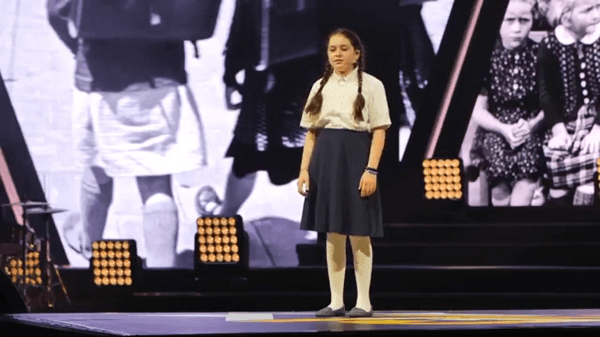
Screen capture rom the World Zionist Congress video

We next meet her in 1935 as a teenager, where she paints a conventionally sunny picture of Zionist settlement. “I woke up today in a new land I didn’t know. A land that’s much hotter, filled with sun that is always shining, with people who never stop smiling. In this land, I have amazing friends, and everyone here are halutzim (pioneers) who are building a state for us, the Jewish people.”

In 1948, she appears as a young woman, announcing, “I will do all in my power to be another link in the chain to ensure my nation has a homeland, a land of ours.”

In 1967, we see her in an IDF uniform holding a sweet baby and saying, “This place is worth fighting for,” before leaving the baby to go to the war and saying, “I’m doing this for you, because you deserve a better future.”

In 2023, we see her as a grandmother standing in front of the Azrieli Towers of Tel Aviv. She tells us that she has just received a call from her grandson Eli sharing two wonderful pieces of news. His startup company developing a cure for Alzheimer's has just received a $20 million investment, and she is about to become a great grandmother to twins. She finishes her monologue with an oft-quoted line from modern Zionism’s founder, Theodore Herzl, “If you will it, it is no dream.”

The story could be summed up as the journey from Holocaust to Rebirth to Start Up Nation.

The film shown at the World Zionist Congress (Hebrew only)

It is striking for what it omits. In this five-minute Israeli myth, and indeed in all the images, videos and artistic displays of Israeli society throughout the three-day World Zionist Congress, not once did we see any representation of the Mizrachi story, the Haredi story, and certainly not the Palestinian story.

I often imagine what this country would look like today if the dominant story we told about the birth of this country began at the Shalom Menachem Girls’ school in Aden, Yemen  or the rolling hills of Lifta overlooking Wadi al-Shami.

What if, instead of ending with a story of high-tech success, the Zionist story of 2023 ended with the plight of Shahar and Coral Sery, who despite being in the top 10% of income earners, will never own a home in this place that was meant to be their homeland because of the skyrocketing cost of living.

What if it included the faces of Layla Alsheikh and Robi Damelin, two bereaved mothers, one Israeli and one Palestinian, who travel the country and the world sharing their stories of grief and dialogue in the hope that no more parents ever have to suffer the pain of losing a child in this twice promised land?

I’m not naïve enough to expect I will see any of these stories featured at the next Zionist Congress but I do very much believe that changing the way we tell our history is essential to creating a different future. If all our heroes of the past are those who fought and died in war, from Yosef Trumpeldor to Shlomo Ben-Yosef, rather than those who struggled for justice and peace, from Daphni Leef to Michael Melchior, what message do we give to our children?

Nigerian writer Chimamanda Adichie observes that stories matter, but that all too often in our lives we operate from the perspective of hearing and knowing a single story — about a person, a situation, or perhaps a conflict.  We operate subconsciously from the perspective of that one story. 

 “The risk of the single story, the one perspective, is that it can lead us to default assumptions, conclusions and decisions that may be incomplete, and may lead to misunderstanding. Operating from the context of a single story can prevent us from a more complex, nuanced view of a situation,” she writes.

Given the many crises Israel is facing today as a result of the occupation, the judicial overhaul, the cost-of-living and lack of integrity in politics, one can only hope we will find new stories to share about our collective past, so that our future won’t appear as does our present.

Image: Screen capture from the Zionist Congress film

You might also like
  • Israel election explainer: the main parties
    Shahar Burla
  • Sanctioning settlements is a defence of Israel, not an attack
    Elisheva Madar
  • Sanctions must influence, not just perform disapproval
    Adam Slonim
logomark.67a07ee3
We believe in the free flow of information

Republish our articles for free, online or in print, by using our Creative Commons licence

You might also like

    altalena
    Israel Votes 2026OpinionIsrael

    The Altalena should be a warning, not a political weapon

    Shahar Burla 1
    Arab Israeli Palestinian election vote
    Israel Votes 2026FeatureIsrael

    Fear of Netanyahu victory may drive big surge in Palestinian voter turnout

    Ben Lynfield
    Btselem
    NewsIsrael

    ‘Israel is systemically eliminating Palestinian collective life’:  Israeli human rights report

    Deborah Stone 1

About the author

Ittay Flescher

Ittay Flescher

Ittay Flescher is the Jerusalem Correspondent for The Jewish Independent. For over twenty years, he has worked as an educator, journalist, and peacebuilder in Melbourne and Jerusalem. His book, The Holy and the Broken: A Cry for Israeli-Palestinian Peace from a Land that Must Be Shared, was longlisted for the 2025 Walkley Book Awards.

More from the author

AnalysisIsrael

What ‘Zionism’ means in Israel:  it’s not what you think

AnalysisIsrael

From haven to hotbed: how Israel’s perception of Australia has changed

FeatureIsrael

New wave of Russian-speaking migrants may be key to Israel’s future

AnalysisIsrael

How a new International Peace Fund could make a tangible difference