Aa
  • Read, Watch, Listen
  • TJI Series
  • Community Action
  • Events
  • Zedi
Follow us and continue the conversation
  • LinkedIn
  • Instagram
  • FaceBook
  • X
  • YouTube
Test yourself with the TJI Quiz!

Adjust size of text

Aa

Follow us and continue the conversation

  • LinkedIn
  • Instagram
  • FaceBook
  • X
  • YouTube

Your saved articles

You haven't saved any articles

What are you looking for?

Original reporting, insightful analysis and diverse views, delivered straight to your inbox

  • LinkedIn
  • Instagram
  • FaceBook
  • X
  • YouTube
Your support fuels our mission to inform, entertain and inspire.

The Jewish Independent is bound by the Standards of Practice of the Australian Press Council. If you believe the Standards may have been breached, you may approach The Jewish Independent or make a complaint to the Australian Press Council in writing at www.presscouncil.org.au. The Council may also be contacted on 1800 025 712.

  • Our Story
  • Contact us
  • Our Team
  • Support us
  • Guidelines
  • Pitch your idea
  • Republishing us
  • Community Action
  • Our Awards
  • LinkedIn
  • Instagram
  • FaceBook
  • X
  • YouTube
Aboriginal FlagTorres Strait Islanders Flag

The Jewish Independent acknowledges Aboriginal and Torres Strait Islander peoples as the Traditional Owners and Custodians of Country throughout Australia. We pay our respects to Elders past and present, and strive to honour their rich history of storytelling in our work and mission.

© The Jewish Independent 2026All Rights Reserved
Website design and development by Your Creative, MelbourneTerms & ConditionsPrivacy Policy
HomeRead, Watch, ListenIsrael
Israel Hamas WarFeatureIsrael

30 years after his death, Rabin is more popular with Palestinians than Israelis

As Israeli society has shifted firmly to the right, it is Palestinians who now look back on him as the only leader who was serious about bringing them peace.
Ben Lynfield
Print this
APTOPIX Mideast Israel Rabin

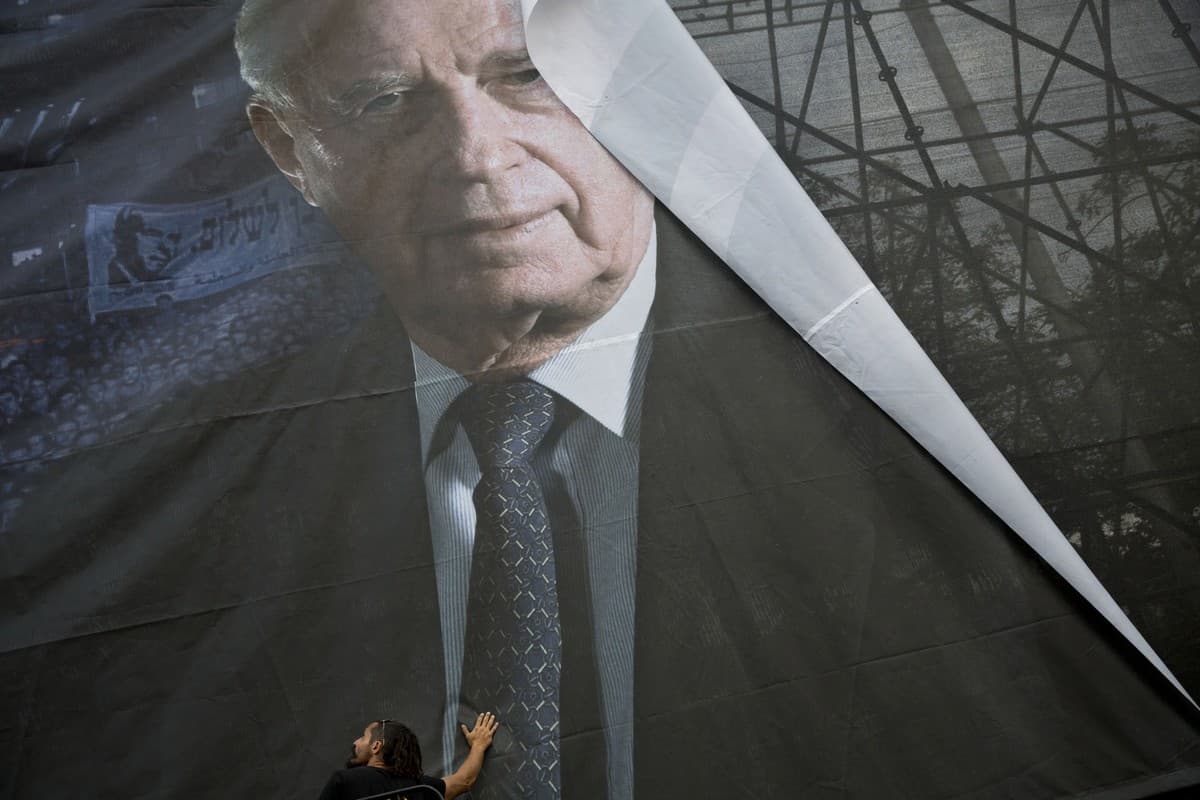
Israeli workers hang up a billboard with Rabin’s portrait on 20th anniversary of his assassination, in 2015 (AP/Oded Balilty)

Published: 30 October 2025

Last updated: 30 October 2025

Yitzhak Rabin’s peacemaking legacy was symbolically silenced by the IDF in the run up to the 30th anniversary of his assassination, which falls on November 4.

The IDF, which Rabin helped establish and famously led as Israel’s chief of staff during the 1967 war, banned its military ensembles from playing the “Song of Peace” at events marking his memorial.

The step, reversed by the IDF after Israel’s Kan public broadcaster reported on it, was another sign of how unpopular it has become in Israel to recall Rabin’s peace efforts with the Palestinians.

Rabin and tens of thousands of Israelis sang the upbeat song about bringing peace to the country on a Saturday evening at the close of a rally to support his bid to resolve the conflict with the Palestinians.

He was fatally shot by a Jewish fundamentalist settler supporting assassin moments later. The bloodied copy of the song found in Rabin’s pocket became a symbol of the tragic loss of a man who tried to make dramatic changes in how Israelis thought about the very purpose of their country.

As he told journalists soon after the Oslo agreement, Zionism for him was not about expanding the territory under Israeli sovereignty, but rather about having most of world Jewry live in Israel and building a society based on the best values of Judaism and Western civilisation.

Part and parcel of this was reducing the influence of ideological settlers bent on extending Israel and instead giving peace with the Palestinians a chance by agreeing to withdraw from West Bank and Gaza Strip cities and launch self-rule.

At the time of his death it was unclear whether he was willing to go all the way and agree to a sovereign Palestinian state alongside Israel, but the policy shift he engineered was enough to touch off strong opposition from the Right, stoked by incitement and fuelled by Hamas suicide bombings after extremist settler Baruch Goldstein massacred 29 Palestinians at mosque prayers in Hebron in 1994.
The failure of the Camp David summit, five years after the assassination, was cited by Prime Minister Ehud Barak, misleadingly in the view of some, as proof that there is no Palestinian peace partner.

That message stuck and was greatly reinforced by the devastating suicide bombings of the second intifada, which also took a heavy toll on Palestinian civilians. Later, Benjamin Netanyahu would be reelected with his tenures marked by relentlessly expanding settlements, undermining prospects for a Palestinian state and delegitimizing the left.

Then, the October 7 atrocities by Hamas turned even many leftists against the idea that there could be an accommodation with the Palestinians. “The country has moved to the right, or the religious right over the last 30 years,” says veteran strategic and political analyst Yossi Alpher, adding that there are increasing calls to free the assassin, Yigal Amir.

Israeli Left shifted after Oct 7

“After this war even people on the left who had agreed with Rabin would say he was on the wrong track; they would say we have no illusions today. If presented today, the general reaction [to the Oslo Agreement signed by Rabin and Yasser Arafat] including on the left and centre would be to say it’s naïve.”

In a twist of history, Rabin’s memory now seems to be far more popular among Palestinians than Israelis. The reasons are twofold. Firstly, their experience with Netanyahu, culminating in the massive casualties and overwhelming destruction from Israel’s Gaza war, makes Rabin look more favourable than he might have been in real time. And secondly, Rabin actually was more sincere and motivated to make peace with the Palestinians than any Israeli leader before or since.

Palestinian nostalgia

Palestinian political activist Samer Sinijlawi was jailed during the first intifada while Rabin was defence minister and famously called for Israel to “break the bones” of the youths waging the uprising. But he looks back on Rabin with some nostalgia.

“You can’t find someone close to him. You get a leader like that once in 50 years in Israel. Sometimes people in the Israeli centre-left start predicting that a person will be a new Rabin. But there is no one with his vision or leadership,” Sinijlawi said.

“I always remember his words that were full of courage and confidence when Hamas was exploding buses in the morning in Tel Aviv and in the afternoon in Jerusalem. Rabin always responded that ‘I will continue to fight terror and I’m moving ahead with the peace process.’ Where can you find such courage nowadays?” he asked.

Sinijlawi met Rabin when he was a youth leader for Arafat’s Fatah movement. “It was a very special opportunity for me. For a young Palestinian it was almost unbelievable to meet the prime minister of Israel.”

Sinijlawi does not mention that many Palestinians were dissatisfied with Rabin’s continuation of settlement construction in the Jerusalem area and that the Israeli leader never clarified whether there would actually be a Palestinian state at the end of the process.

Ramallah-based political analyst Jehad Harb also has positive associations about Rabin’s tenure. He remembers the optimistic days right after the signing of the Oslo agreement when Palestinians handed out olive branches to Israeli troops at checkpoints, hoping the occupation was coming to an end.

Dreaming of another Rabin

“There was a belief at that moment that Rabin was forthright and that the region would change to peace after the occupation. But after his assassination, things changed.”

Dalal Iriqat, a professor at the West Bank’s Arab American University, said she agreed with statements made from time to time by Palestinian Authority leaders that the emergence of “another Rabin” would spur peacemaking.

“Serious, sustainable peace needs responsible leaders who are serious about making peace,” Iriqat said. “After all these years, we need a reality check. All we see are consecutive governments and Netanyahu over the last 12 years aiming for short-term personal benefits,” said Iriqat, who writes a column in the al-Quds newspaper.

Currently, it is urgent for both Israelis and Palestinians to have capable leadership, she said. “Given that Trump has come on board with his Middle East plan means we need wise leadership on both sides. In Israel we don’t have this leadership,” she said.

“If you consider [Shimon] Peres with Rabin, yes, they were serious leaders. We need such serious leaders, people who were vocal, upfront and serious about peace. You don’t see that on the Israeli political platforms now. They say no to peace, no to a Palestinian state, yes to annexation, yes to military occupation, yes to apartheid, and they say there is no Palestinian partner.

Better but not enough

“Palestinian people do see that Rabin was different, which is not to say he was the ideal who would really think to realise Palestinian interests. That also takes a capable Palestinian leadership, which is missing,” she explained.

Palestinian citizens of Israel remember Rabin for beefing up budgets, improving somewhat their conditions and standing and for breaking with racist attitudes by relying on Arab parties in the Knesset to provide a blocking majority that prevented the Right from toppling his coalition.

“He was better than those before. He tried to make some changes but they were not enough,” says Jamal Zahalka, former head of the Balad party, a hardline Palestinian nationalist grouping.

Contrary to the view of many Palestinians looking back on his tenure, Zahalka says Rabin was not willing to make enough concessions to really make peace with the Palestinians. “He didn’t recognise the right for a Palestinian state, he wasn’t ready to withdraw from all territories or dismantle settlements. He wanted peace on his terms and his terms would not bring a just peace.”

You might also like
  • Iran unleashes renewed international terror campaign
    Dror Doron
  • Everything you need to know about President Herzog’s visit to Australia
    Shahar Burla
  • Decades delayed, Rabin’s Oslo vision is coming back to life
    Ittay Flescher
logomark.67a07ee3
We believe in the free flow of information

Republish our articles for free, online or in print, by using our Creative Commons licence

You might also like

    Protest against settler violence in Jerusalem
    DebateAustralia

    Sanctioning settlements is a defence of Israel, not an attack

    Elisheva Madar 2
    Knesset divided
    Israel Votes 2026ExplainerIsrael

    Israel election explainer: the main parties

    Shahar Burla 1
    Arab Israeli Palestinian election vote
    Israel Votes 2026FeatureIsrael

    Fear of Netanyahu victory may drive big surge in Palestinian voter turnout

    Ben Lynfield

About the author

Ben Lynfield

Ben Lynfield

Ben Lynfield covered Israeli and Palestinian politics for The Independent and served as Middle Eastern affairs correspondent at The Jerusalem Post. He writes for publications in the region and has contributed to the Christian Science Monitor, Foreign Policy and the New Statesman.

More from the author

FeatureIsrael

Fear of Netanyahu victory may drive big surge in Palestinian voter turnout

NewsIsrael

Abuse by IDF soldiers humiliates Muslim Palestinians

OpinionIsrael

Qusra siege exposes shared agenda of IDF and settler extremists

AnalysisIsrael

IDF ordered to evict West Bank camp in election show of strength

Comments1

  • Avatar of Rachel Sussman

    Rachel Sussman2 November at 03:27 am

    With all best intentions, I think the writer gives the Palestinians far too much credit… Yes, the death of Rabin was a backwards step, but since then they had opportunities (Barak for once as the writer mentioned)… to be honest, I have become somewhat pessimistic, I am afraid that from my life long experience, there will never be enough ‘consessions’ to satisfy the ‘Palestinians’ except of a ‘from the river to the sea’ that sees Israel gone… I pray I am wrong, I pray my past experience can be washed by a younger generation on both sides…