Aa
  • Read, Watch, Listen
  • TJI Series
  • Community Action
  • Events
  • Zedi
Follow us and continue the conversation
  • LinkedIn
  • Instagram
  • FaceBook
  • X
  • YouTube
Test yourself with the TJI Quiz!

Adjust size of text

Aa

Follow us and continue the conversation

  • LinkedIn
  • Instagram
  • FaceBook
  • X
  • YouTube

Your saved articles

You haven't saved any articles

What are you looking for?

Original reporting, insightful analysis and diverse views, delivered straight to your inbox

  • LinkedIn
  • Instagram
  • FaceBook
  • X
  • YouTube
Your support fuels our mission to inform, entertain and inspire.

The Jewish Independent is bound by the Standards of Practice of the Australian Press Council. If you believe the Standards may have been breached, you may approach The Jewish Independent or make a complaint to the Australian Press Council in writing at www.presscouncil.org.au. The Council may also be contacted on 1800 025 712.

  • Our Story
  • Contact us
  • Our Team
  • Support us
  • Guidelines
  • Pitch your idea
  • Republishing us
  • Community Action
  • Our Awards
  • LinkedIn
  • Instagram
  • FaceBook
  • X
  • YouTube
Aboriginal FlagTorres Strait Islanders Flag

The Jewish Independent acknowledges Aboriginal and Torres Strait Islander peoples as the Traditional Owners and Custodians of Country throughout Australia. We pay our respects to Elders past and present, and strive to honour their rich history of storytelling in our work and mission.

© The Jewish Independent 2026All Rights Reserved
Website design and development by Your Creative, MelbourneTerms & ConditionsPrivacy Policy
HomeRead, Watch, ListenIsrael
ReflectionIsrael

My experience standing with Palestinians against settler abuse 

Jews providing a protective presence for Palestinians in the West Bank are working for the long-term safety of all. We need the same empathy in Australia.  
Matt Friedman
Print this
Volunteers provide a protective presence for Palestinians in the West Bank (NIF)

Volunteers provide a protective presence for Palestinians in the West Bank (NIF)

Published: 10 September 2025

Last updated: 10 September 2025

My Arabic is just short of non-existent, but football (the round ball game) is as close to a universal language as we’ve got. 

One of the kids I’m playing with – let’s call him Ramy – is maybe 10-years-old, but he’s a natural leader. Ramy is constantly talking as he rallies the team: pass here, move there, leave it, nice shot!  

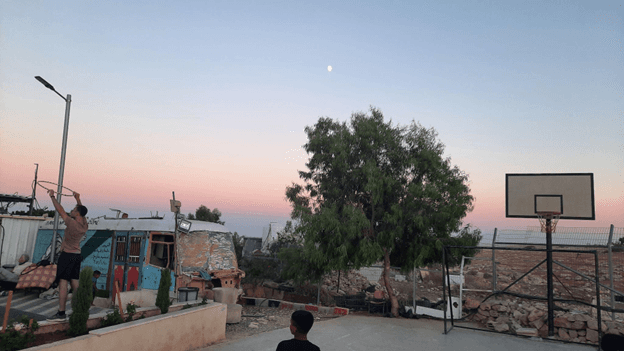
He also seems to have a natural sense of justice. He switches the teams around often to try to even out the great battle played on the concrete quarter-sized basketball court in the middle of Umm Al-Khair village, in the Hebron Hills of the West Bank. 

​​I hope ​he remembers playing football with a Jewish foreigner even if the fun cannot displace ​​the memory of the rest of the day.​​​

Dusk over Umm Al-Khair (Image: supplied).

I was not primarily there to play football​, but as part of a small group of protective presence volunteers. We were armed with two weapons: phones and non-Palestinian passports. 

The phones were to document the violence from settlers and soldiers that Palestinians in the West Bank expect every day. In my short time there, I took footage of soldiers preventing repairs to a house they had destroyed previously. This house is one of the 13,000 structures that have been demolished in the West Bank and East Jerusalem since 2009. The soldiers blocking the reconstruction ensured this family remained homeless. 
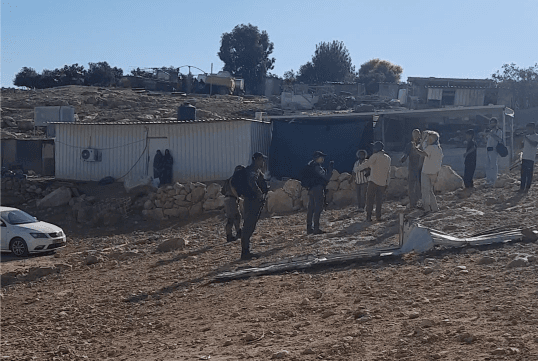
I also filmed a​n armed​ settler trespassing on village land, grazing his flock next to the water mains​ and ​causing hours of worry about what he might do to it. This time it was nothing, but two weeks earlier, he had cut the mains and let a devastating amount of water seep into the earth. ​​​

'A constant siege'

Acts of intimidation and violence by settlers and soldiers make life in the West Bank for Palestinians feel like a constant siege. They​ ​are well documented by Palestinians and protective presence volunteers. The Israeli organisation B’tselem hosts one repository of reports of violence, including many videos.  

Volunteers with non-Palestinian passports provide some protection. ​I​f I’m to be illegally detained, injured or murdered by soldiers, police officers or settlers, there’s a much greater chance of my case being taken seriously as an Australian than there is for a stateless Palestinian.

It takes courage to humanise people who seem to be standing against us, and even more to stand with them in criticism of our own community.  

According to Israeli NGO Yesh Din, just three per cent of investigations into accusations of settler violence lead to full or partial convictions – and most cases are never reported or investigated. The picture is similar for violence committed by soldiers, and in the rare case where soldiers have been convicted, they ​have ​receive​d​ lenient sentences.

The villagers of Umm Al-Khair know this, just as well as the settlers and soldiers know the pattern. This is why the village has asked for the constant presence of volunteers. 

​​As ​Anton Goodma​n, partnerships director at Rabbis for Human Rights, explained to me in stark terms, this privilege means we can do and say things that Palestinians can’t, because we’re much less likely to get shot.​ The ​​recent murder of Awdah Hathleen​​, the man who coordinated us volunteers in Umm Al-Khair, tragically highlights that this is not an exaggeration.​​     ​​​

Not that volunteers are well liked​​ in Israel​​.​ “Israeli society doesn’t know the difference between Palestinians who are terrorists and Palestinians who are being terrorised​,​”​ says Goodman​. For the IDF soldiers who are risking their lives on the premise that it will keep Jews safe, to have some of those same Jews literally standing in the way must feel deeply confusing​, if not infuriating​.

'A very different approach'

​​But there’s different ways to keep people safe​.​​ If any of the soldiers had asked me, I would have tried to explain that I’m not just here to protect Palestinians, but also because I believe this is the only way to secure real safety for Jews.​​​ 

The guns, checkpoints, surveillance, and violence may ​comfort some Israelis in the short-term, but the look of determined fury I saw on Ramy’s face as he watched the soldiers leave ​his village​ told a different story about the overall impact of​​ their day's work​.

In the long-run, if there's ever to be real security, ​we need a​ very different approach​​. An approach that builds ​​trust.  

Protective presence does this powerfully. For Israeli volunteers, it humanise​s​ Palestinians and makes them aware of the human rights abuses many​ face​ daily​. For Palestinians, who mostly interact with actively hostile Jewish Israelis, it’s powerful to see some who stand with them.

Residents of Umm Al-Khair and protective presence volunteers recording IDF soldiers (Image: supplied).

Rabbis for Human Rights is one of many organisations working to improve life for both Palestinians and Israelis. I was able to meet some of them ​during the 10​ ​day in-country component of the Naomi Chazan Fellowship, run by the New Israel Fund. 

​​​In far-off Australia, we rarely hear anything about these organisations​ run by Israeli and Palestinian activists building foundations for a more secure kind of shared future​. Instead, our media feeds are full of bombs and hostages, death tolls and disasters.​ 

​​For many it would seem ​inconceivable​. ​Increasingly explicit antisemitism has made any sense of compromise or nuance feel unsafe, so we have spiralled into polarised positions in which we justify our own monstrously non-empathetic ‘pro-Israel’ positions based on the monstrously non-empathetic ‘pro-Palestine’ positions of those opposite.

​​​Goodman understands​ the difficulty for diaspora Jews. However, he doesn’t think that putting unconditional support for Israel over the sanctity of human life helps the situation anywhere.​     ​​

“There’s a knee jerk reaction to lower the value of the other because we’re being attacked. Antisemitism doesn’t mean you have to hate other groups. The solution is to increase the love there is for others, to stand against all forms of discrimination.” 

If there are Israelis who can stand with Palestinians as a protective presence, Australian Jews must stand up for empathy too.​ 

There will always be a need to call out antisemitism whenever and wherever it happens. But in the long run, it will be the coalitions we build standing up for human life that repair our own foundations of trust in Australia and actually keep us all safe. We need to show up for others in the way we would want them to show up for us, even if that’s an act of faith. 

It​ is​ hard to be generous with empathy when it feels like ​an admission that we might be anything other than victims. It takes courage to humanise people who seem to be standing against us, and even more to stand with them in criticism of our own community.  

But I don’t think it can possibly be harder to do that here in Australia than it would be to do it in Israel itself. If there are Israelis who can stand with Palestinians as a protective presence, Australian Jews must stand up for empathy too.​ For all of our sakes.​ 

The Naomi Chazan Fellowship is a leadership program run by the New Israel Fund Australia for young Jewish adults passionate about social justice, human rights, and a better future for Israelis and Palestinians.​

You might also like
  • ‘Israel is systemically eliminating Palestinian collective life’:  B’Tselem
    Deborah Stone
  • Tame apologises – but with little grace
    Deborah Stone
  • Confronting Richard Flanagan and the myth of the Israel lobby
    Mary Garden
logomark.67a07ee3
We believe in the free flow of information

Republish our articles for free, online or in print, by using our Creative Commons licence

You might also like

    Arab Israeli Palestinian election vote
    Israel Votes 2026FeatureIsrael

    Fear of Netanyahu victory may drive big surge in Palestinian voter turnout

    Ben Lynfield
    Woman with land and houses behind her
    NewsAustralia

    Australia to increase sanctions against West Bank settlements

    Deborah Stone 2
    ISRAEL-LGBTQ-PRIDE-PARADE-PALESTINIAN-CONFLICT-HOSTAGES
    NewsIsrael

    LGBT asylum seekers caught between Palestinian violence and Israeli bureaucracy

    Jarod Rhine-Davis

About the author

Matt Friedman

Matt Friedman

Matt Friedman is a public policy researcher and poet living on Wurundjeri Country in Naarm/Melbourne. He comes from a background in education and has never quite kicked the habit.

Comments1

  • Avatar of Ric Benjamin

    Ric Benjamin12 September at 09:16 pm

    Kol HaKavod Matt! This is important work, thank you for your commitment.